

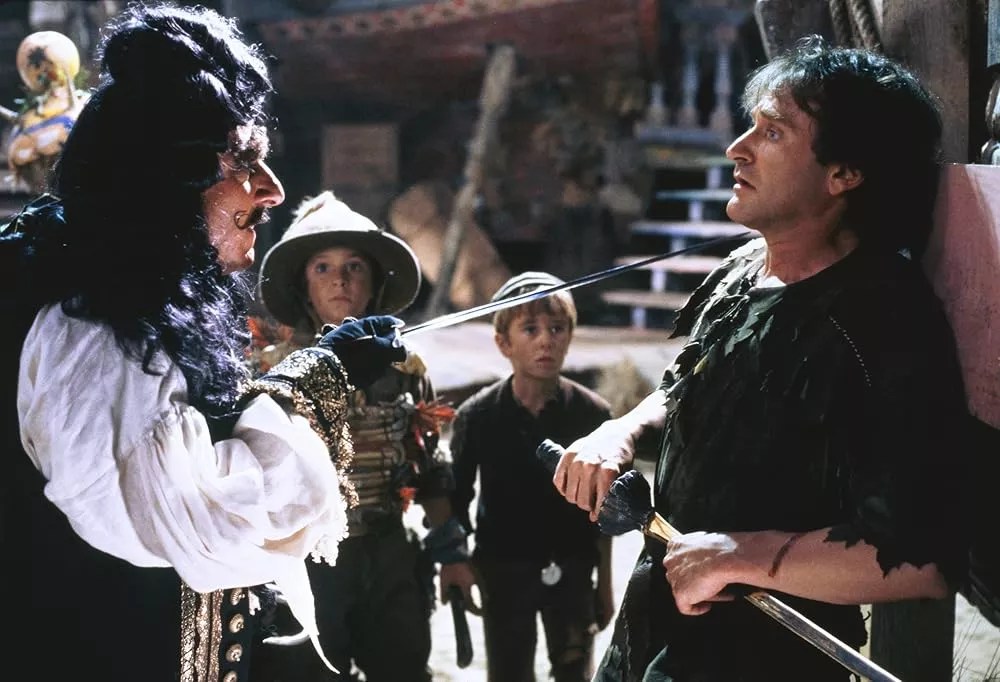
James V. Hart wants to set the record straight: He wasn’t the one who came up with the idea for 1991 children’s classic Hook, and it wasn’t Steven Spielberg, either. It was Hart’s son, Jake. “It was a 6-year-old kid who asked, ‘What if Peter Pan grew up?’” the screenwriter and producer recalled.
That simple question over dinner inspired Hart to write the script for what has become a beloved cinematic mainstay, starring Robin Williams as the Boy Who Never Grew Up – now all grown up – and Dustin Hoffman as his eternal nemesis, Captain Hook.
This weekend, Austin Film Festival presents screenings of both Hook and Hart’s follow-up, 1992’s Bram Stoker’s Dracula, as part of the Paramount Summer Classic Film Series, both with Hart in attendance.

It’s been 34 years since Hook was released, and Hart gets to share it with his now-grown-up kids in a different way, as shown when he got an unexpected call from Julia and her husband, La La Land producer Jordan Horowitz. “They were very emotional, and you could tell they were in a state. They had put the kids to bed and watched Hook as husband and wife, and parents for the first time. … She said, ‘It’s a totally different film when you have children. It’s a completely different experience.’ And it was interesting to finally hear the perspective that they had that my wife and I had from the very beginning.”
Yet Hook also remains a movie that fills small children with awe. Hart recalled a colleague in Scotland sending him a video of an outdoor screening of Hook, where a small child was standing, transfixed, mere inches from the screen. “She said, ‘He stayed there the whole film and was mesmerized,’” Hart said. “I guess you finally learn that if you’re in this business long enough, that if you do something like this, there’s a legacy to it. That’s pretty humbling.”
Yet while Hook and Dracula are now regarded as classics, they almost ended Hart’s career before it really started. “Nobody wanted to do either one of them,” Hart said. “In fact, I was let go by my agency when I was writing Hook and Dracula.”
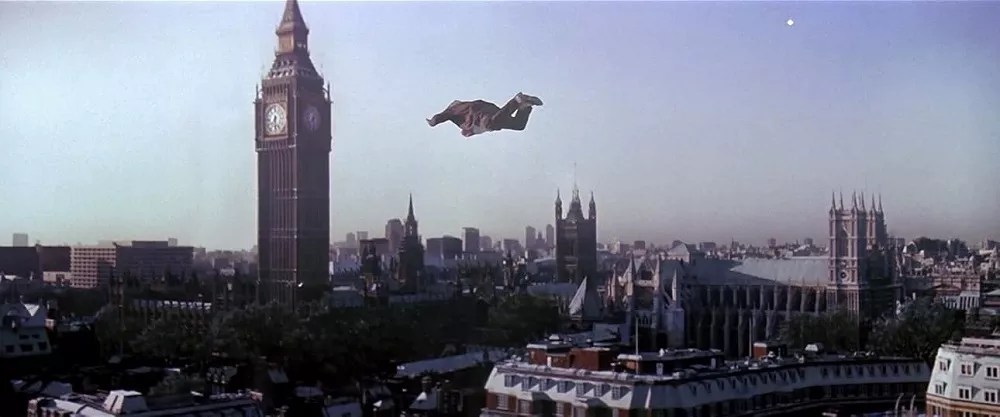
Each project came with very different problems. For Dracula, it was that everyone had made a Dracula film, so no studio thought there was anything left to say. For Hook, it was that everyone wanted to make a Peter Pan film but no one since Walt Disney had really cracked the equation. Hart said, “Spielberg wanted to do Peter Pan, Coppola wanted to Peter Pan, John Hughes had written a Peter Pan script, Michael Jackson wanted to do Peter Pan. There were so many Peter Pan projects circling out there but they were always the same story: Another group of kids goes back to Neverland and has the same kind of adventure with Peter Pan and Captain Hook.”
That’s when Hart turned up with his script and what he called “its blasphemous idea” of a grown-up Peter Pan – and Hollywood responded with a resounding no. “Every single studio, every producer we pitched it to, all turned it down. One studio executive said, ‘This is a really compelling story but I don’t believe that grown-ups can fly.’ Well, that’s a good point!”
Both Hook and Dracula were seen as wildly revisionist on release, but Hart counters that there’s nothing in either that doesn’t have roots in the original works. Peter Pan author J.M. Barrie himself wrote a screenplay version of his story that culminated in Peter growing up and marrying Wendy. And as for Dracula, many of the elements that people saw as transgressive only seemed so because they weren’t remembering the book at all. They were thinking of the 1924 stage version, penned by Hamilton Deane and revised by John L. Balderston, which made Bela Lugosi a star in America and became the basis of the classic 1931 Universal horror, Dracula. What they all missed was “how Stoker wrote Dracula,” Hart said, and especially how much the book was inspired by the real Vlad Tepes. “A prince and a royal knight, protecting the cross of Christ. A charismatic leader of nations. I went, ‘We’ve never seen this’ [and] that’s what [director Francis Ford Coppola] liked about the script, that it went back to the historical figure. … Francis was the one who told the studio, ‘Jim’s right. We’ve never seen this story.’”
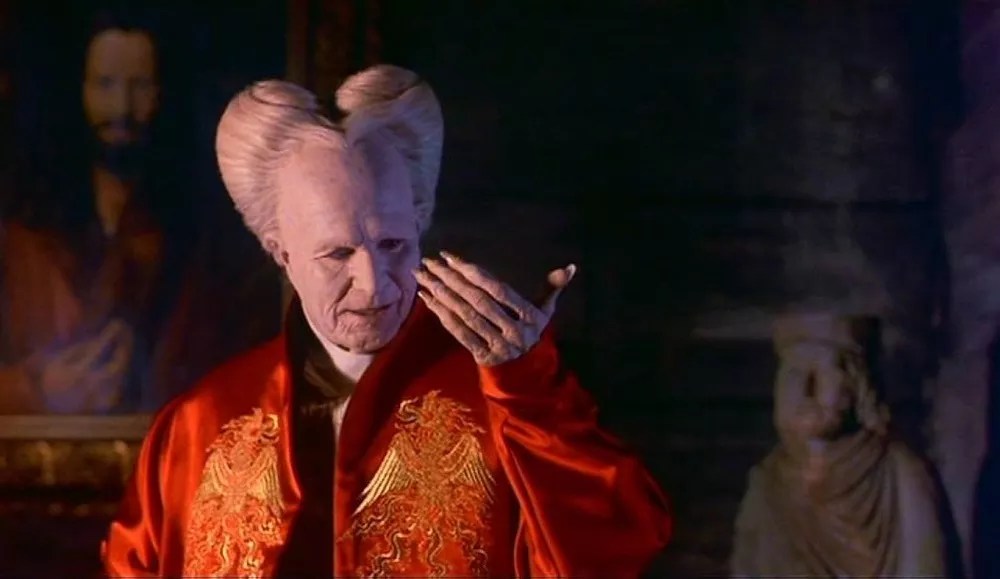
That’s why Hart’s version of Dracula includes many elements from the book that never really made it into earlier adaptations, like how vampires can walk in daylight, or that Dracula is finally dispatched with a Bowie knife (a replica of which sits on Hart’s desk). Even the film’s biggest addition, the romance between Dracula (Gary Oldman) and Mina Harker (Winona Ryder), wasn’t cut from whole cloth. In the original book, he noted, “there is evidence that Mina was changed by Dracula and became empathetic towards him and protective towards him. Even the reincarnation is seeded in Stoker.”
However, just because he could literally point to the page in Stoker’s original book that inspired him didn’t mean he was immune to allegations about blasphemy against the source material, just like he faced with Hook. He recalled one particularly scathing review from when Dracula opened in Fort Worth. “‘How dare Jim Hart put a Texan with a Bowie knife in a Dracula movie?’ His response: “Read the book!”
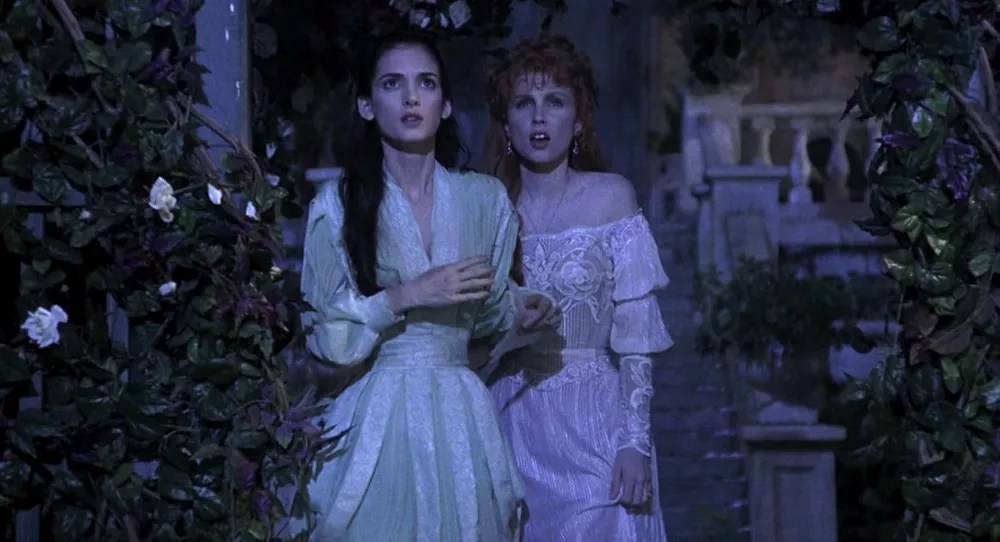
Not that it’s simply the book translated directly to the screen. Much to Hart’s continuing disappointment, he had to cut a planned sequence when Mina and Lucy Westenra (Sadie Frost) visit the towering cliffs and ancient ruins of Whitby. “It stopped the flow.”
Moreover, he admits that there’s a memorable moment from Bram Stoker’s Dracula that comes from one of those post-Lugosi versions. He was lucky enough to see the opening night of 1977 Broadway revival of the Deane and Balderston play at the Martin Beck Theatre (renamed as the Al Hirschfield Theatre since 2003). The production has become legendary for its sets by goth king Edward Gorey and a highly sexualized incarnation of Dracula as performed by Frank Langella. Hart confesses to taking one moment from this version. It’s at the end of the second act when Langella, “in bed with his Errol Flynn, Shakespeare shirt on,” slices open his own chest to suckle Lucy Westenra on his blood as the lights go out and the curtain drops. “There’s a collective gasp from in the theatre,” he said, then silence – except for one audience member. “This woman in a very loud voice said, ‘I’d rather spend one night with Dracula dead than the rest of my life with my husband alive.’”
This was the moment at which Hart realized something very important about this vampire tale. It may be that it was Nosferatu, F.W. Murnau’s legendary unlicensed adaptation of Dracula, that gave the story its female protagonist in the form of Ellen, the Mina Harker analog played by Greta Schröder, but its audience was always women. He recalled dinner party conversations on the subject: “All of our friends were lawyers and investment bankers and shit, and I was the unemployed scriptwriter, and I would ask people, ‘Have you read Dracula?’ and women would raise their hand.”
It was those responses, and the eruption from the seats of the Martin Beck, that Hart called “a decoder” for the script. After decades of post-Balderston/Dean versions of Dracula centering on two-fisted heroes, this was how he could really take the story back to the author’s intentions. “Stoker wrote a book about unbridled female sexuality. To a Victorian man, that would be terrifying.”
Paramount Summer Classic Film Series and Austin Film Festival presents Hook and Bram Stoker’s Dracula, Sunday, June 20, Paramount Theatre. Tickets at austintheatre.org.
This article appears in July 18 • 2025 and July 11 • 2025.
