

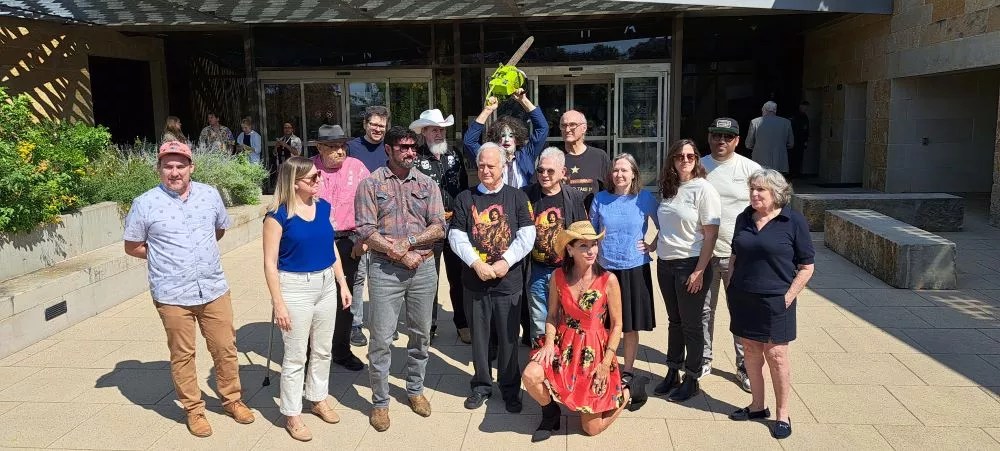
October 11, 1974: The Texas Chain Saw Massacre rips into cinemas, changing horror and putting Austin on the filmmaking map. Fifty years later, Mayor Kirk Watson and Council Member Paige Ellis hosted a ceremony announcing The Texas Chain Saw Massacre day.
The event celebrated a film that redefined horror and has become acknowledged as a masterpiece, even becoming part of MoMA’s permanent collection in New York: not bad for a zero-budget regional feature filmed around Austin with a cast and crew of UT grads and local talents.
On the steps of City Hall at noon on Friday, Watson recalled talking with late cowriter/director Tobe Hooper, who he had got to know when he was becoming mayor for the first time back in 1997. One time, he was hanging out at the filmmaker’s house when he recounted to Hooper about his first time watching Chain Saw. He was studying law at Baylor and went to a screening at the Ivy Twin cinema in Waco. He told Hooper how it was the first time he’d ever been so shocked by a scene in a movie that he stood up to leave. “He said, ‘what was it?’ and he was very excited, and I said it was the scene where the young woman is placed on the meat hook, and Tobe very casually reaches over to a shelf and says, ‘This meat hook?’”
The proclamation event was filled with such personal reminiscences because it’s impossible to separate Austin from the film, and the film from Austin. Austin Film Commission Executive Director Brian Gannon echoed that sentiment, noting, “What other city on earth can you celebrate a movie as important as Texas Chain Saw Massacre on its fiftieth anniversary?” Moreover, he noted that this was the film that showed people you could make a movie in Austin and it became the wellspring for billions in production spending over the intervening decades. Indeed, the sequel, 1985’s The Texas Chainsaw Massacre Part 2 was directly responsible for the creation of the Austin Film Commission. “We had dueling chainsaws going down Montopolis Drive, and Dennis Hopper running around downtown with a chainsaw, and city officials said, ‘We should probably have a liaison to deal with some of the craziness that comes with film production.’”
It’s also had an immeasurable impact on filmmakers both from Austin and beyond, with Gannon noting Steven Spielberg and Robert Rodriguez among its devotees. That list also includes Austin Film Society cofounder Richard Linklater – or, as AFS Cinema head programmer Lars Nilsen called him, “my boss.” Like Gannon, Nilsen called The Texas Chain Saw Massacre “the nascent cry of Austin film environment today,” and noted that the film has gone from being “the least socially acceptable film title you could mention outside of an outright porno movie” to being “accepted in some sense as an art film, and deservedly so.”

The celebration also marked an extremely rare appearance by Perry Lorenz, who played the pickup driver in the final scene. He paid tribute to actress Marilyn Burns, famous as original final girl Sally Hardesty. Not only was she his passenger during his brief onscreen appearance, she was also a close friend of Lorenz’s wife, Sharon. Ine of many cast and crew who has since passed, he called her “wonderful” and a pivotal part of the film.
Equally, Ed Guinn (who played the cattle truck driver who famously wings a wrench at Leatherface’s head) commemorated production designer Bob Burns, who brought him on to the shoot. “He knew I had a truck,” he half-joked. “I always say the truck was the actor, and I was the extra hired to operate it.”
However, for all the self-deprecation, Guinn will forever be part of the cultural impact of Chain Saw, a connection that Danziger joked about. He noted that, “as a kid from a small Texas town in the Bronx,” he moved to Austin in 1964 for graduate school, earned two masters degrees, had a career in mental health, started his own production company, “and my legacy is that I got whacked by Leatherface.”
The Texas Chain Saw Massacre screens this weekend at AFS Cinema (6259 Middle Fiskville, austinfilm.org), and the Blue Starlite Mini Urban Drive-In will show the movie at their Downtown location (300 San Antonio, book parking slots here). Next weekend, the Bullock Texas State History Museum will be holding their own anniversary screening at the Texas Spirit Theater (1800 Congress, thestoryoftexas.com) in association with the Texas Film Commission. Then the celebration comes to a three-day blowout at Hooper’s (1010 King Ct., Kingsland, hooperskingsland.com) with Danziger, Guinn, McMinn, and Neal being joined by John Dugan (Grandpa), Bill Vail (Kirk), and cinematographer Daniel Pearl for screenings of The Texas Chain Saw Massacre and The Texas Chainsaw Massacre Part 2.
This article appears in October 11 • 2024.
