


Stage and screen are two very different media, and Dominic Cooke is now fluent in both. He laughs at the old joke that one big difference between them is that you can’t pull focus in the theatre. “You do, actually, but you do it by moving people around the bloody stage.”
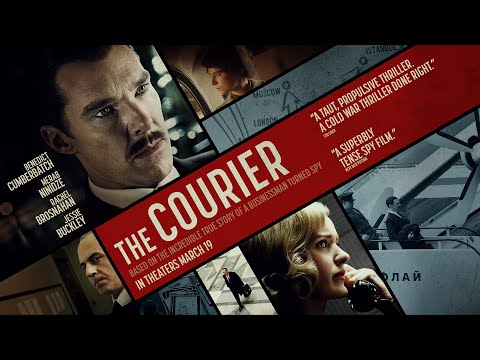
A veteran of the RSC and London’s National Theatre, he’s now helmed two British period pieces: His 2018 adaptation of Ian McEwan’s On Chesil Beach, and now spy drama The Courier (read our review here). It’s based on the true spy story of British businessman Greville Wynne (played by Benedict Cumberbatch) and Russian intelligence agent Oleg Penkovsky (Merab Ninidze), two overlooked but key players in bringing the world back from the brink of Armageddon during the Cuban Missile Crisis, and paid terrible costs for their heroism.
When it comes to making the switch between theatre directing and films, Cooke admits to having a bit of a head start. “My father was a film editor,” he said, “and I worked the summer holidays in the cutting room, rolling up trims in the old days of 35mm when it was all done by hand.” He never planned to make movies, instead lured by the stage, but he credited his father with giving him the skills to make the jump. “I realized what I had absorbed from him in terms of the process of filmmaking.
Austin Chronicle: So what is your obsession with 1962, because between this and On Chesil Beach …
Dominic Cooke: I have no idea! It’s pure coincidence. I never set out to make even one film set in that period, and then I made two. … This film really appealed to me, the script was beautiful, and it was useful to know what that period was like because I had done so much research for the other movie.
I was born four years later, but the world had changed dramatically in those four years – especially the U.K. between ’62 and ’66. So I can’t really say that there is an obsession, but I am waiting for the third one because I do think things come in threes. I did find a play recently that’s set in 1962 that I might do, and that’ll be the end of it.
AC: There have been previous films and shows about Greville Wynne, but what attracted you to his story, and where did you see the space for you to bring something new?
DC: You know, I haven’t seen the other versions, so I have no idea what they’re like. I did a huge amount of reading about him, and watched all that interview footage, and there’s a lot of interesting material on both of them, him and Penkovsky as well.
I’m not drawn to spy movies as a genre. There are many that I really enjoy, but I’m not “I must go to see that because it’s a spy movie.” I think it’s because the films tend to be quite cold, they’re about calculation, they’re about strategy, and that appeals to me much less than the inner life of a character. What I loved about the script – and it’s partly because Wynne was a rookie – is that it gets into the personal costs, and inner lives and relationships. I thought that was unusual, that I’d never seen that combination in a spy story, especially a real spy story.
AC: What were the challenges of balancing Wynne and Penkovsky in the script, especially since Wynne wrote several books but the GRU wasn’t big on open records?
DC: Penkovsky’s name was dirt in the Soviet Union. He became a symbol of everything that was wrong with traitors. They defamed him, they lied about him, they said he wasn’t actually a war hero. There was all kinds of crap talked about him, and that’s never been revised in Russia. So even when we went over to cast, we were given quite a hard time by a lot of actors. “How can you possibly tell the story of this evil man?”
“Penkovsky’s name was dirt in the Soviet Union. He became a symbol of everything that was wrong with traitors. They defamed him, they lied about him, they said he wasn’t actually a war hero.” – Dominic Cooke on Oleg Penkovsky, the Russian double agent who helped avert apocalypse, and subject of The Courier
Wynne’s background was the most useful thing. He was working class from Wales, he had an incredibly pushy mother – pushy in terms of aspirational for him – and she had airs and graces, as you would say at the time. He was held back because he was extremely dyslexic, and at the time that wasn’t understood so he was treated like he was not very bright, even though he was. So there was a lot in him that was deeply frustrated, and when he met Penkovsky it was a platonic love affair. It was the bromance thing, because he thought Penkovsky was incredible. He was this genuine hero, didn’t give a damn. He didn’t play by the rules, and I think there was a deep admiration. That’s one of the few elements of Greville Wynne’s memoirs that really rings true. It’s like a younger brother, and it’s actually quite touching. I think that’s why he made the sacrifices he did.
AC: Obviously, every director wants to work with Benedict Cumberbatch, but he seems very fitted for this part. He catches something about that era, and the inner life of this culture of restraint. What was the process of working with Benedict on this character who would be easy to regard as antiquated.
DC: What you describe is the essence of the way I was thinking about it. My dad was born in ’29, my mum was born in ’32, my grandparents were born in the bloody 1890s, so I knew that world, and even in the ’70s in Britain it was so uptight. I think some people can’t do that. If they did that, they’d just be stuffy and weird, like it’s a concrete wall. But I know that Benedict, because I’d worked with him in the past and I’ve watched him over the years, that I knew he’d be able to get that formality, but find something really full of feeling underneath that.
Actually, they were all like that. I think that Jessie Buckley is incredible in this movie, because she is as far away from [Wynne’s wife, Sheila] as you can possibly imagine. Jessie’s very free and open as a person, and from a different class. Sheila was quite posh, she was upper-middle class, and well brought-up, and she found again that sort of restraint and containment, yet again something underneath.
It’s something some actors can do, but some can’t act out of their own period. They can be brilliant actors, but they can’t find that balance of the manners and behavior of a different time period with a human center.
The Courier is in theatres now. Read our review and find listings on our Showtimes pages.
This article appears in March 26 • 2021.
