




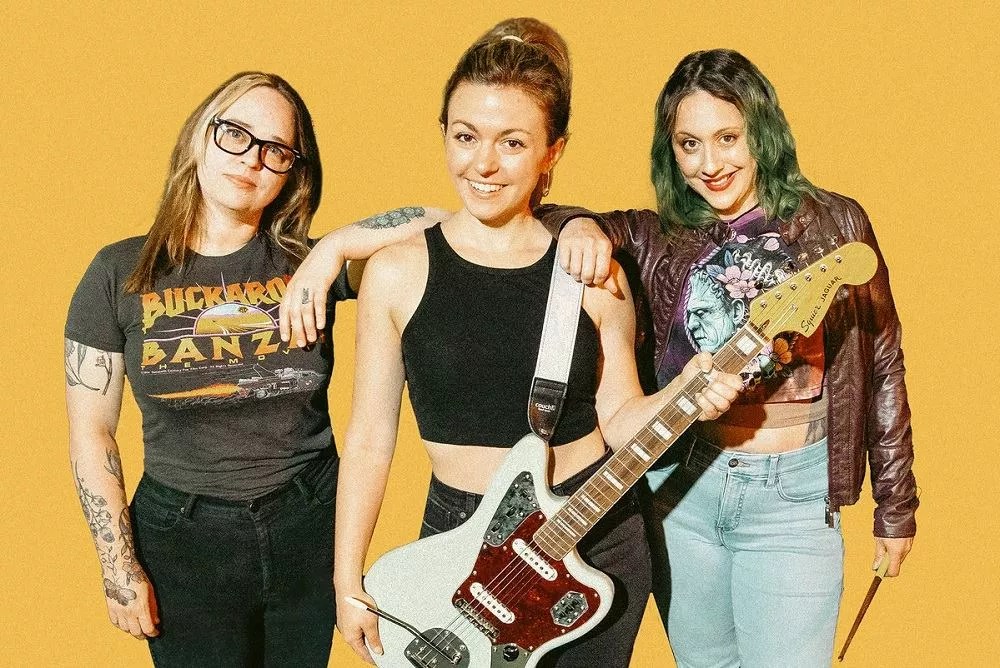
It’s not often that I get sent records, real vinyl recordings. So I was a little surprised when I was sent a promotional copy of both the album and CD for The Good Stuff, the debut full-length from pop-punk outfit Hoverborg.
The all-female retro trio from Pittsburgh must have picked my name out of a hat, I guessed, or hired a PR agency that had gone overboard on sending out promotional copies. Maybe it’s that the album is stuffed with cheeky references to ’80s and ’90s movies, like the Clerks-quoting “I’m Not Even Supposed to Be Here Today,” or the Back to the Future nod of “Say Hi to Your Mom For Me,” and they were hoping for favorable coverage from Gen-X film critics.
The album is a follow-up to their 2020 digital-only debut EP, Weezer homage Simpleton. The vinyl is professionally made, but there are a few oddities. No one in the band is credited, although the bassist looks a little like Austin-based actress and filmmaker Kelli Horan. Maybe that’s why I was sent a copy. After all, I’ve covered her films before, such as her directorial debut, “A Grievance With Gravity”.
The only real clue is the label: Greenless Records. Same name as a local production film company, Greenless Studio.
A few weeks later, I’m drinking coffee with Horan’s husband, Phil Lybrand: director of Austin-made films like maternity comedy Maybe Shower and Texas Gothic horror Meet Me There, founder of Greenless Studio, and now the man behind Greenless Records. He’s bouncing between Austin and his new home in Portland, Ore., and he wanted to chat about his new venture into the world of indie music and the accompanying documentary, Destroy All Humans.
Only, here’s the thing. Yes, there is an album, which is also available on Bandcamp and Spotify. And, yes, there is a documentary, which is streaming on YouTube now after a successful festival run.
But there is no Hoverborg. “It’s the first physically released AI-generated album,” Lybrand said. “At least, the first that will admit it. I’m sure there are others.”
The trio staring from the album cover, and appearing in the videos? Actresses. It’s Horan starring with Melissa Sapienza as the drummer, and Erika Krenn as the guitarist and lead singer. Hey, it’s not like Lybrand invented the idea of a fake band publicly representing music generated in the studio (stand up, Milli Vanilli and Boney M). “I have very mixed feelings about the whole process,” Lybrand said, “and that’s the point of the film.”
Several years ago, he’d been given an Android developer account, and because of that he’d ended up on the right PR firm list and was given access to AI music generator Udio when it was still in Beta. “I was like, ‘AI music? Sure, I’ll add it to the list of things to play around with.’”
“The first two things humans ever want to do [with technology] is to make it cuss, and make it show boobs.”
“The first two things humans ever want to do is to make it cuss, and make it show boobs, [and] that rang true with Udio too. When I first got into the platform and I start looking at the featured section and scrolling through, the most popular songs were all about pooping your pants and farting.”
And Lybrand’s a human, and so he was not above that either. “I’m not ashamed to admit that I made some goofy, Richard Cheese-style, ‘What if I did Big Band-style, but it was about something stupid?’ Of course, you have to.”
This was around the time that “Drowned in the Sun” was making headlines, an AI-generated fake Nirvana song with real human vocals. “It didn’t sound very good,” Lybrand said, but he was tempted to generate his own version. “It didn’t work. The male vocals sounded like complete trash. … It sounds more like Stone Temple Pilots.”
The more he played with Udio, the more he realized that it was definitely capable of producing what sounded like real human music. Real enough to fool actual real humans? Real enough to make audiences believe that multiple songs were all from the same band? Quickly, Lybrand realized that the answer to both those questions was a resounding yes. He said, “The scary part was how coherent I was able to make it sound.”
Even more disturbing was how different the music sounded with one change to the instructions, showing how much the system had absorbed and coded external bias. Apparently, AI doesn’t believe women can record grunge. “I did A/B testing with the exact same prompts and the exact same lyrics, and if I did male vocals they were whiny and emo, and I could see the eyebrows pointing at each other – that kind of emo. You change to female vocalists and it sounds like Josie and the Pussycats.”
Case in point: That bad Nirvana knockoff that he originally generated? Change that gender prompt and it became Hoverborg’s first single, “Sticks & Stones,” which sounds less like it crawled from Seattle and more like the band would be opening for the Muffs or Letters to Cleo in 2003.

The more he experimented, the more he became fascinated with what was happening inside the machine, asking questions about training data and built-in bias. On the song “Rory Gilmore,” he realized that the vocalist sounded like Gilmore Girls star Alexis Bledel. “I think it’s Rory Gilmore singing about Rory Gilmore. Now, they have safeguards in place. You can’t go in there and go ‘using Rory Gilmore’s voice.’ It’ll give you an error [but] there’s ways around the prompting. … Somebody found out they built all their tags using rateyourmusic.com, and so if you were to copy the exact description from that website for Weezer and plug it in, it would give you Weezer, one for one.”
Lybrand soon found he had enough songs to make an album, but it was Horan who convinced him he had to make a documentary about the process and the ethical and artistic questions it raises.
What was most deeply disturbing was that he started realizing how much AI generated music is already out there, with concerns that streaming platforms are using near-perfect AI-generated covers to avoid paying licensing fees. That near-perfect (for the moment) part is where Lybrand started to hear clues about what is and isn’t ‘real.’ “The vocals, a lot of times, sound double-tracked,” he said. “Have you ever seen the movie, The Mothman Prophecies? Remember when they’re talking about the digital voice, that the tonals are different? ‘These did not come from human vocal chords.’ There’s something intrinsic, and I don’t know that if I didn’t spend so much time building it myself.”
And, as the man that released an AI album, Lybrand isn’t letting himself off the hook on this. When he originally released the album online without telling people it was AI generated, “I was catfishing,” he said. “I tried to minimize it as much as possible. I’d tell people, ‘You spent money on this, you’ve got to know this. Also, can I interview you? But first of all, do you want your money back?’”
If anything, Destroy All Humans is about the problems raised by humans not asking questions about AI media creation and consumption already, and freely offbraining the creative and curating experiences to imitation machines. “It doesn’t matter if you think it’s good or bad,” Lybrand said. “It’s not going away.”

Hoverborg’s entire back catalog, including the Simpleton EP, The Good Stuff, and their newest release, O, Petunia, is available through Bandcamp and Spotify.
This article appears in June 20 • 2025.
