


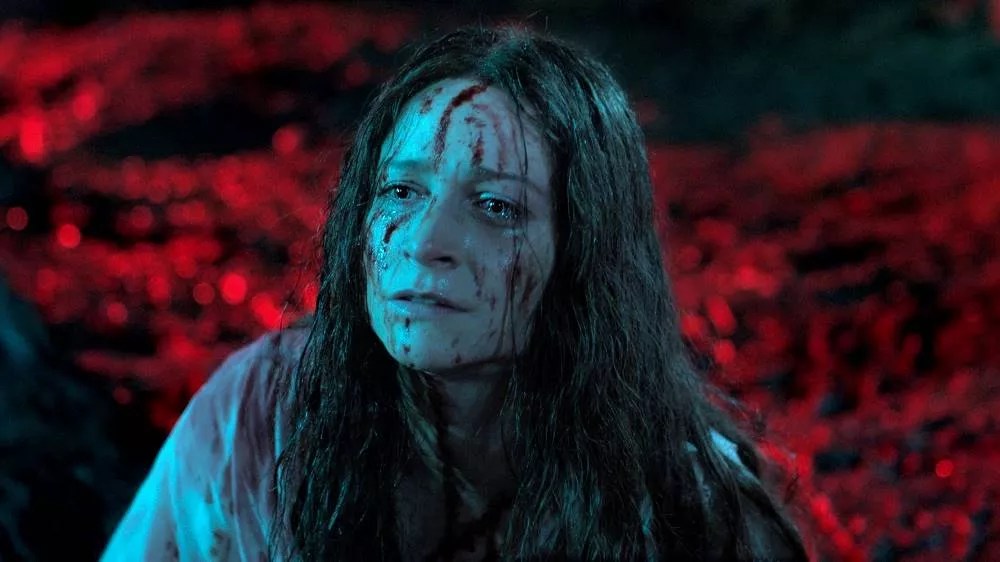
Video nasty. The term conjures up both images of blood-splattered extreme horror, and of the censorious culture that kept those films out of the hands of innocent kids. Or, at least, that’s what the unstable protagonist of Censor tells herself.
It’s a very specific moment in British history. In 1985, the long-running miners strike was rumbling, Thatcher was busy wrecking the nation, but headline writers and tabloid muckrakers had got all in a tizzy about what became known as video nasties. In horror circles these films would often be regarded as classics, or at least sleazy cult favorites.
The British Board of Film Classification had just changed its name from the British Board of Film Censors, but was on a complete tear. The prior year, the Video Recordings Act had given them remit over home releases, and honestly they should have put the word censor back. Every film that wanted a home release that even flirted with extremity was either withheld a certificate, or cut to ribbons.To be fair, the early video store scene in the U.K. was a free-for-all. With tapes slipping through the classification net, stores would just have stock alphabetized, so you’d often find a Polish Disney knock-off next to a Mexican supernatural slasher and the first 90 minutes of The Winds of War, bootlegged off the TV. Regulation was inevitable, and the BBFC (like America’s MPAA, an industry, rather than governmental, entity) had to do something before the government stepped in.
The cuts were more extreme with videos than with celluloid, because the films weren’t in cinemas and so the normal, strict rules of theatrical admission went out the window. Films that had already been passed for cinemas could be denied a video release. It also gave the BBFC much greater powers over films: even if they refused a film a certificate for theatrical distribution cinema, local councils could issue a license that would allow screenings in their jurisdiction. But when it came to video, the power was all with the BBFC, and distributors and stores could even be prosecuted for distributing obscene material. In all, about 160 movies were effectively banned from British shelves and VHS players, all horrors, many of them now seen as classics of the genre.
The shadows of the video nasty era are cast long over Censor, even if the letters BBFC are never uttered. However, that’s clearly where the tightly-wrapped Enid Baines (Niamh Algar) works, looking through submitted tapes and giving them a certificate, or demanding cuts before a film gets a release, or at least at the certificate upon which the filmmakers have planned. Three incidents smash into Enid’s life, resurrecting old nightmares. First, two decades after her sister Nina disappeared her parents have finally asked for their missing daughter to be legally declared dead. Then the press links a particularly brutal murder to a film that Enid approved for uncut release, causing her to become a hated figure in the press (a nod to the real-world claims that the two boys that killed two-year-old James Bulger in 1993 were influenced by Child’s Play 3). But above all is a print that has been submitted for review, a lost slab of British gore called Don’t Go in the Church by an enigmatic director called Frederick North (Adrian Schiller), that has triggered old and buried memories relating to her sister’s abduction.
In a sense, Censor falls prey to the same cultural trap in which some of the video nasties were caught. A lot were just schlock, but that was no excuse for banning them, and whipping up paranoia. Others did indeed have a deeper meaning under the gore. Some aspired to be insightful, but never carried the subversive intellectual heft they needed. First-time feature director and co-writer Prano Bailey-Bond’s broadest and most successful point is that censors rarely do more than inflict their own fixations and damage onto the films they judge (a pivotal office scene shows how arbitrary these calls really are). But tying Enid’s censorious instincts up with her childhood trauma, and how she collapses through the demi-monde of low-budget filmmakers and into the inevitable bloody denouement, almost feels superficial. There’s only passing reference to gender, race, and class in the censors’ office, which seems like a missed detail, stripping away something deep in the history of the era (that the push to censor came from an establishment that was profoundly white, mostly male, upper-middle class, and inherently Anglican). As a simple story of a moralizer being brought down by their own bloody instincts, it works; but asides about the catharsis of gore, and the inner evil of humanity not needing horror movies to be seeded, imply the script wanted something deeper.
Where Bailey-Bond excels is in the construction of Enid’s unraveling world. After years of retro-influenced films trying to emulate the giallo aesthetic with a few colored bulbs and a lot of tight black leather, her feel for the VHS era is a welcome relief. It’s never a gimmick: the flickers between aspect ratios, the precise use of static crackle, are the record of Enid’s corrupting image. It’s details of narrative and setting, even to the name of the new film dragging Enid down. Three of the films on the nasties list were Don’t Go in the something – four, if you add the alternate title for Night of the Seagulls – and tying it all in to the old “mysterious film of unknown provenance” trope binds it even closer to the bloody mass of ’80s gore.
Yet it’s not just in the movie nods. Mercifully, Bailey-Bond doesn’t try to recreate the hyper-sleazed, overblown look of 1980s London that has become popular in recent cinema. Instead, it’s that very beige Britain, a country of artificial fibers and a particular kind of dusty grime that you can practically run your fingers through on the screen. She also perfectly captures the look and feel of the old-school British corner video store, with their crusty shelves, and taboo titles hidden in brown paper bags under the counter. It’s more than emulating a cinematic look, like those faux-gialli. It’s creating an engrossing, disturbing, yet authentic world that cracks wide open like Enid’s fragile psyche.
Censor World Premiere
Midnighters
Sundance Film Festival 2021
This article appears in January 29 • 2021.
