

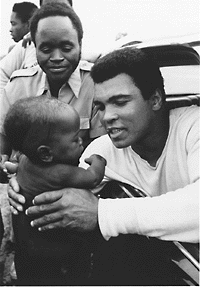
 Muhammad Ali in Zaire |
my lifetime, only one public figure
has claimed to be “the greatest” and not been a liar. That person is Muhammad
Ali.
Why has Muhammad Ali meant so much to me, a white Jewish girl from New
Jersey who has no feel for sports — no less the raw combat of professional
boxing? How could the sight of Ali in his glory days convince this young girl
of the artistry of the sport and so deeply demonstrate how a masterful
combination of speed, strength, confidence, and cunning could vanquish all
opponents? And how did it come to be that Ali first entered my radar not as a
boxer but as a political upstart — a proud black man who renounced his slave
name and proclaimed his faith in a dogmatically non-white religion, a draft
resister who put his career on the line for his principles, a charismatic and
personable public figure whose voice and deeds are so much a part of his times?
In my usual backward manner, I had to first discover the greatness of the man’s
deeds in the arena of social discourse before I could marvel at his brilliance
in any athletic arena. Though my route may have been circuitous, once
convinced, there has been no turning back.
Was this recognition what drew the audience in the Dorothy Chandler Pavilion
at this week’s Academy Awards ceremony to such a thunderously emotional
standing ovation when Ali took the stage with George Foreman and When We
Were Kings director Leon Gast and executive producer Barry Sonenberg? The
movie, a document of the Ali-Foreman title bout in Zaire in 1974, won the Oscar
for best documentary feature of the year. A couple of days earlier, When We
Were Kings was also recognized with the Truer Than Fiction award and a
standing ovation for Ali at the Independent Spirit Awards. The movie is quite
wonderful and deserving of honor, but I guarantee you that it is not what
thrust the audience to their feet. Still showing on only a few screens (and
opening in Austin this Friday, March 28, at the Dobie Theatre), it’s safe to
say that not too many audience members had first-hand knowledge of the film.
What inspired the outpouring was the presence of Muhammad Ali and the awareness
that they were in the company of greatness.
As a sports legend, the three-time heavyweight boxing champion has the crowns
to back up his claims to greatness. In his prime, Ali commanded the ring with
an unmatched combination of speed, power, grace, and intelligence. He was
boastful and loquacious and worked the media as no sports figure ever had
before. His baby-faced handsomeness and fast wit certainly helped make him one
of the first superstars of the electronic age.
Yet there was a large part of America who saw the brash young boxer’s poems
and pronouncements as clownish self-promotion and nothing more. Ali stunned the
world in 1964 when, the day after he defeated Sonny Liston to win his first
heavyweight title, he announced his religious conversion to the Nation of
Islam. Renouncing the name of Cassius Marcellus Clay, Jr., the champion
declared, to the chagrin of many, that he would thereafter be called Muhammad
Ali.
By 1966, the draft board had curiously reclassified him as 1-A and in 1967,
Ali officially refused induction into the army, claiming conscientious objector
status as a minister in the religion of Islam. Indicted and convicted of draft
evasion, he was sentenced to five years imprisonment and a $10,000 fine. As a
convicted felon, he was barred from boxing and stripped of his title; his
career was effectively over. However, the charismatic 25-year-old developed a
new lucrative career as a speaker on the college lecture circuit. Later on, in
1970, the U.S. Supreme Court overturned his conviction on a technicality. Ali
fought furiously to regain his title and the years he lost and waged an uneven
series of bouts until he was positioned to win back the heavyweight title in
1974 from the reigning champ George Foreman. He would successfully defend the
title 10 more times before losing it to Leon Spinks in 1978. Seven months later
Ali would once again win back the crown from Spinks but his championship years
were now over. He retired from boxing in 1981.
Yet it takes more than athletic prowess to make Ali “the greatest.” Over the
years, he has grown into a true American hero. He has demonstrated that he is a
human being infused with integrity and principles, and that he has always been
willing to act on those convictions and accept the consequences. He promoted an
understanding of the Vietnam war as a battle between dominant powers played out
on a third world turf where boys from the American ghettos were used as
expendable front-line fodder. He became an articulate spokesman for independent
black identity and self-sufficiency. In his post-boxing years, Ali has devoted
himself to humanitarian and philanthropic endeavors and one suspects that his
public life would be even more extensive (and perhaps political) if his motor
skills were not diminished by the Parkinson’s syndrome that is the presumable
result of too many blows to the head. Even so, Ali turns up from time to time
on the grand world stage: as an emissary to Saddam Hussein of Iraq in 1990 to
negotiate the release of 15 hostages, as the literal and iconic torchbearer for
last summer’s Olympic games in Atlanta, and as an honored guest at this week’s
internationally televised Academy Awards ceremony in Los Angeles.
 Director Leon Gast |
fascinating study of the fight that was nicknamed “The Rumble in the Jungle.”
Included are never-before-seen images from the “fight of the century” between
the formidable and widely presumed to be undefeatable George Foreman and the
foolhardy 32-year-old challenger Muhammad Ali. However, When We Were
Kings becomes more than a record of a singular boxing event; it also
chronicles a pivotal moment in the evolution of black cultural identity.
How director Leon Gast ended up with such amazing footage and why it took him
22 years to fashion it into an 85-minute-long film is quite a story in itself.
I spoke by phone last week with Gast, who was anxiously awaiting the Academy
Awards ceremony only a few short days away. There were constant interruptions
the whole time we spoke — calls from other interviewers, film executives,
long-lost friends from childhood, and so on. He was ecstatic about having just
received word that both Foreman and Ali would attend the ceremony. Gast exuded
the charming excitement of someone thoroughly unaccustomed to such heady
attention, of a New York documentary filmmaker who never in his wildest dreams
expected to “go Hollywood.” A Swiss TV crew was waiting to tape Gast the second
he hung up with me.
Gast explained the background of the film and his participation. Originally,
he was hired to shoot a concert film in Zaire. Preceding the fight was to be a
three-day-long music festival that presented the top black performing artists
from the United States and Africa. Headlining were musicians such as Miriam
Makeba, James Brown, B.B. King, and the Spinners. The plan was for the
filmmakers to come and record the music festival and package it as a concert
film. Gast got the job on the basis of some earlier documentaries he had made:
Hell’s Angels Forever about the notorious bikers and The Dead, a
profile of the Grateful Dead. However, fight promoter Don King did stipulate
that a minimum of half the crew members hired by the white director be black.
Gast describes the genesis of the film as follows: “Stuart Levine was a music
producer and it was his brainchild to do what he was calling a “black
Woodstock” and try and get the leading R&B and black performers of the
early Seventies and to get the leading African performers and bring them all to
Zaire and to stage this music festival and do a film about the music, and the
roots of the music, and some African culture, and then to include some
wraparound stuff of the fight and the fighters. It was going to be just a
little profile of Ali and a profile of Foreman, and a little bit of fight
stuff. And had the film been finished on schedule — 1976 was the target date
to release it — we would have had a very different film than the film you see
today.”
Between the boxers’ and musicians’ entourages, a vast number of black American
visitors descended on Zaire and the movie records their collectively
exhilarated consciousness about gathering on the African continent. The event
also spotlights early milestones in the careers of two legendary autocrats, Don
King and Zaire’s President Mobutu Sese Seko, each of whose rule continues
unabated into the present (although Mobutu’s dominion is growing ever shakier
by the minute). King masterminded the whole event, which catapulted him from
obscurity into the top ranks of fight promoters. Putting up the unprecedented
$10 million purse was Zaire’s President Mobutu, the country’s dapper despot,
who seized this unusual opportunity to attract hordes of Western visitors to
his emerging country.
Then, five days before the fight was scheduled to take place, the entire
scenario changed. While sparring, George Foreman received a bad cut over his
right eye that was bad enough to cause the fight to be delayed for nearly six
weeks. Though the performers all arrived, their intended audience of
international journalists, jet-setters, and high rollers, for the most part,
managed to readjust their itineraries. On the first day of the festival, the
stands were practically empty. Mobutu felt this was not the image he wanted to
project of his new Zaire, so he convinced the promoters to suspend ticket sales
and open the gates to free admission. The show went on for a crowd of happy
Zairians but the money for the film’s post-production, which was to come from
the gate receipts, would now never materialize.
Mobutu also made it known that he expected the fighters and their entourages
to remain in Zaire until the rescheduled fight date as human collateral
protecting his multi-million-dollar investment. At the outset, nobody could
tell how long it would take for Foreman’s gash to heal or how long they would
all be stuck there. The film crew decided to stick around and see what else
they could get. It was during this time that they recorded the footage that
turned their concert film into an entirely different artifact.
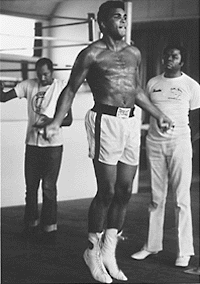 Muhammad Ali trains for “The Rumble in the Jungle” |
October 30. Ali and Foreman each responded quite differently to their stay in
Zaire. Foreman holed up in his downtown hotel while Ali and his people took
over a compound of villas about 40 miles out of Kinshasha. Foreman, who at this
stage of his life was a fearsome character and nothing like the affable
pitchman he later re-made himself into, stayed to himself and rarely gave
audiences to the press or mingled with the African people, with whom he seemed
uncomfortable. Ali was just the opposite, courting the press as always and
wandering into the countryside, meeting the people, and stirring a two-way
adoration. “The only time we’d see Foreman,” says Gast, “was a press conference
kind of situation where they’d say `George is going to be at such-and-such a
place and if you get there at four o’clock you get to ask your question.’ And
Ali was the opposite. Ali just opened up his villa, his life, he was just as
accessible as you could hope anybody would be. He was just anxious to talk. We
were able to spend hours with him. I mean, hour upon hour.”
Gast returned to the States with “approximately 300,000 feet of film or
roughly 170 hours.” None of that was footage of the actual fight either, since
that was contracted out to a different, closed-circuit satellite crew. Years
were spent haggling with dummy corporations to retain control of the footage
Gast shot and largely financed, and, of course, the post-production money that
was supposed to come from the festival gate proceeds was a moot issue. Little
by little, working either at night or in between other jobs, Gast began the
task of shaping the material. “It was over the years that the legend of Ali
started to grow and the focus of the film started to change,” explains Gast.
“And as I put different cuts together, I would show it to friends of mine in
New York City and I got a lot of encouragement from those people and they would
just tell me `More Ali. More Ali,’ and I kept on adding more Ali and I’d show
them raw footage… I have hours, just hours and hours of Ali just sitting and
rapping. And they’d all say, `You have incredible stuff’ and encouraged me to
keep on going on with it.”
By 1986, Gast’s lawyer Barry Sonenberg became more involved in the project and
invested $400,000 of his own money as completion funds. Sonenberg had, by this
time, become a successful manager of rock and rap artists and had given up his
law practice. It was Sonenberg who helped Gast satisfy numerous music copyright
questions and came up with the title When We Were Kings as a nostalgic
reference to the event’s eclectic gathering of royalty — from the blues master
B.B. King to the Godfather of Soul, James Brown, and from the heavyweight
champs, Ali and Foreman, to such self-invented rulers as President Mobutu and
Don King.
Still, they felt the film still needed something, an element that was not to
be supplied until 1995 by the director Taylor Hackford (The Idolmaker,
An Officer and a Gentleman, and Chuck Berry Hail! Hail! Rock ‘n’
Roll). Hackford believed the film would benefit from the insertion of
contemporary interviews with speakers who could provide knowledgeable
commentary about the Ali-Foreman fight as well as defining the significance of
Ali’s cultural and historical legacy. “I got a phone call from Taylor
Hackford,” relates Gast, “and Taylor said he had seen the film and was very
much interested in getting involved. A meeting was set up at which Taylor said
that he thought that the film needed to be `brought into the Nineties.’ Those
were his exact words. And he said the way to do it was to do some interviews.
And I was immediately horrified by that because David had suggested that five
years earlier and I didn’t want to do it.” But Gast eventually warmed to the
idea and interviews were conducted with filmmaker Spike Lee, writers and fight
witnesses Norman Mailer and George Plimpton, and Ali biographer Thomas Hauser
and then judiciously inserted throughout the edited film. The final touch in
“bringing the film into the Nineties” was the addition of a couple pieces of
contemporary music solicited from artists handled by Barry Sonenberg.
Spike Lee may come the closest to defining the Ali appeal when he describes “this beautiful specimen.
He was handsome, he was articulate, he was funny, charismatic, and he was
whupping ass too.” Lee goes on to point out the remarkable way in which Ali
fused politics and sports. “Very few black athletes have ever talked the way
Muhammad Ali talked without fear of something happening to them in their
careers.” Insightful commentary such as this blends with Gast’s absorbing mix
of concert footage, choice Ali moments, and archival footage. Thrilled to be
flying in an airplane piloted by black Africans, Ali holds forth on what makes
that such a mind-blowing event for a black American raised on Tarzan images of
Africa. Gast’s camera catches the candid and extemporaneous: Ali’s initial
disappointment upon learning the fight’s been postponed or his leading the
Zairians in the popular chant “Ali, Bomaye” [“Ali, kill him”].
Between George Plimpton, Norman Mailer, and Tom Hauser, the salient points of
the match are analyzed (this is the fight that spawned the Rope-a-Dope
strategy), but what they contribute is so much richer than mere fight
commentary. Plimpton describes the Conradesque quality of Zaire, which he still
longs to think of as the Congo, and the monsoons that flooded the stadium just
as the fight ended. Hauser conveys some of Foreman’s inadvertent missteps, as
when he debarked from his plane with his German Shepard — the same breed the
police of the Belgian Congo used to keep the natives in line. Mailer hits the
mark when he describes the image of Mobutu as that of a “closet sadist” and
relates that the bowels of the stadium where the event took place were
detention pens capable of locking up a couple thousand dissidents at a time.
When We Were Kings is also a fascinating commentary on the passage of
time. The precariousness of Mobutu’s current situation in Zaire only draws the
thread tighter. We see Howard Cosell before the fight solemnly intoning his
widely shared fear that the match-up would cause Ali severe bodily harm. Of
course, in time, we have come to see that the harm experienced by Ali would,
instead, be a cruelly cumulative deterioration that has affected every aspect
of his post-boxing life. Foreman, too, has undergone a complete metamorphosis,
a makeover so complete that we can barely see how the two Foremans were ever
related. Don King, for better or worse, is still Don King, but this glimpse of
the glad-handing, Shakespeare-quoting dealmaker during his first brush with
glory becomes an encapsulated study of the man.
So many compelling snatches of cultural history converge in When We Were
Kings, that it becomes easy to lose sight of the fact that, at its most
basic, it boils down to a drama of two men alone in a ring. And, as he had done
so many times before and since, Muhammad Ali ruled.
This article appears in March 28 • 1997 and March 28 • 1997 (Cover).
