


When people asked how to break into the video-game industry, the joke used to be that it’s easy: Just be in San Francisco in the Nineties. Now if you’re in high school, you can just be in Austin during the summer. According to GameCamp! founder Spencer Zuzolo, “The fact that GameCamp! exists is really a testament to the desire that people have to be in the industry.”
The camp is a weeklong immersion experience for students age 10 to 17 that started as a natural offshoot from Zuzolo’s normal work. While working at Ninjaneering, the game company Zuzolo founded, he’d do outreach and speak at conferences about how to break into gaming. Now the camp has grown to include spring-break sessions and multiple weeks across the summer in Austin and Lafayette, La. “It’s kind of surprising to me,” says Zuzolo. “I was just doing this as more of a community service, to be honest, when I started. But it turned out that there’s really a need for it.”
Over the course of the week, the students form groups to represent their own miniature game companies. In the mornings they study the theory behind game design, art, the industry, or production. In the afternoons they put it into practice. By Friday, they pitch their game ideas to industry representatives.
“We take kids and put them in a position to understand what the industry is about,” says Zuzolo, “what sort of positions are out there – like designer, coder, sound – and the camp gives them that experience and the exposure to that. Then what we do is help them develop that track through school and into college. For example, the student goes to the basic camp and then the advanced camp, and then, if they’re old enough, they can intern at the camp. And once they’ve graduated, if they’ve been to the camp and they’re qualified, we can actually hire them to work at the camp. The goal is that when they get through with college, they’ll have had two to six years of actual experience of meeting people in the industry, using the tools of the industry, learning what the standards are, learning the expectations of their actual job, and then working on real projects.”
Zuzolo’s quick to add, “We also play a lot of games. In the industry, that’s research.”
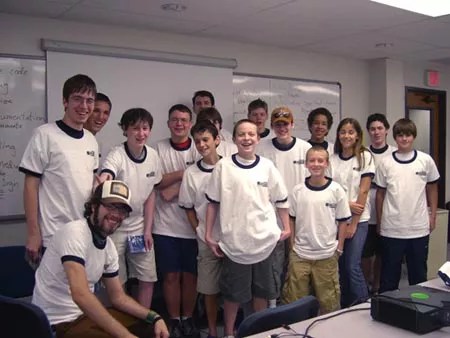
It’s not simple fun and games, though. Zuzolo calls it “directed play.” “Staff will sit down,” he says, “and start talking to the students as they’re playing games about the things we were teaching them, whether it’s design principles or art or artificial intelligence or whatever is going on in the game. And these kids will invariably have these fully in-depth discussions with you while being completely immersed in the game. The fact that they can multitask the way they do and be applying what they learned that day on the fly in just some random game that they’re playing is pretty amazing.”
While the camp might seem like heaven for every 13-year-old’s inner gamer, Zuzolo admits he sometimes has to work to sell it to parents. “A fair amount of people,” he says, “will never actually call to find out what it’s about because their immediate reaction is, ‘My kids can play games at home. Why would I want to send them to camp to do that?'”
But enough parents come around. “It’s great for them,” Zuzolo says. “There are a lot of parents out there who have kids who just play video games,” he says. “That’s what they do. And they don’t really know how to deal with them. They don’t speak that language. But they want their kids to be happy and learn. So when they see that we can motivate students to something bigger than just being a game player, they get excited. And the parents learn how to communicate with their kids better. We do career counseling with students, so we can sit down with parents and students and talk about what they’re trying to get out of the camp and how they can apply that in high school or going into college or a career.”
Though the camp is too nascent to really measure its real-world benefits, several students-turned-interns-turned-staffers are now pursuing degrees related to game design. While Zuzolo thinks it’s only a matter of time before the results bear out, he says one of the main goals of the camp is to make the challenges clear.
“We don’t mince words about what it takes to get in,” he says. “We don’t promise you that you’ll get into the industry. We promise to give you the best information about how to do it, and then you have to work your butts off.”
“That’s what we do,” Zuzolo says. “We package the information and make it easily accessible. And then we kick ’em in the pants and say, ‘Go work!'” 
For more information, go to Summer Camp Attack, www.austinchronicle.com/gyrobase/Guides/SummerCamps, or check out the GameCamp! Web site at www.gamecamp.org.
This article appears in April 27 • 2007.