


It used to be that a stork delivered babies. In Hirokazu Kore-eda’s near-future science fiction family drama, Sheep in the Box, it’s more likely to be a flying drone. At least, that’s what delivers an advertising hologram from REbirth to the Kotomes, Otone (Haruka Ayase) and Kensuke (Daigo Yamamoto). A happily married couple in the southern reaches of Tokyo, they’ve never really quite gotten over the death of their young son, Kakeru. But what if technology can bring him back? Or, at least, a generative AI copy of him in a metallic shell?
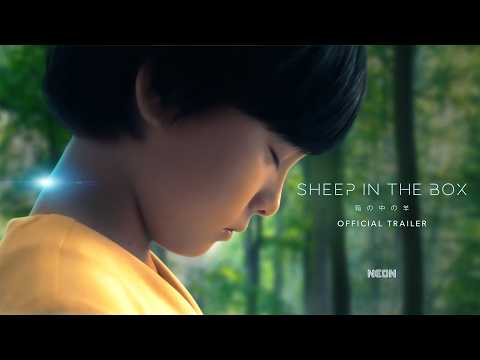
It’s far from a new idea, a robotic child in the home and heart of its adoptive parents. Indeed, it’s been so long since the 2001 release of A.I. Artificial Intelligence that it’s had time to be reassessed from one of Steven Spielberg’s worst films to one of his best. However, the difference here is that the robot is an act of mechanical resurrection. When Kakeru 2.0 (Rimu Kuwaki) arrives, he runs up to his human caregivers like he never left.
What REbirth offers isn’t a replacement child. It’s time. The time lost, the time to say goodbye properly, if only to a robotic duplicate of their lost loved one. That’s an offer Otone falls for quickly, embracing the new Kakeru quickly and adjusting the rules of the house around his needs. Not so forgiving is Kensuke, who is instantly annoyed that he can no longer eat in the house (it might upset the mechanoid) and distrustful of REbirth’s intentions. “People’s misfortune can be profitable,” he grumbles, even as the company offers them a free rental on the unit. Yet he still starts to fall for this simulacrum derived from photos and home movies. It’s in the way that he catches himself calling the machine “you” when talking about the “real” Kakeru rather than “he” that his yearning to be a father again is exposed.
Working from his own script, Kore-eda is barely pushing past the realm of current reality. Robotics firms might still be jealous of the convincing look of Kakeru 2.0, and the fact he doesn’t randomly fall over, but we’re already in the era of grief bots, where AI companies sell digital ghosts to those in mourning. Kore-eda’s greatest interest is in what it is that people want from such devices, and their true nature. The mechanical Kakeru is aware that he’s not a real boy, much as he behaves like him and Otone sees him as such. Indeed, the only flesh-and-blood person to really cut through the delusion is Otone’s somewhat-estranged mother (Kimiko Yo).
Much of Kore-eda’s filmography has centered on family, most famously in his “fluid family” trilogy (Like Father, Like Son, Our Little Sister, and After the Storm) in which strained bonds are the subject of his fascination. Alongside Shoplifters and Broker, Sheep in the Box arguably completes a new trilogy in which the focus is on constructed connections, of adoption, of building an unlikely nuclear family from the stray atoms of the universe. Yet for a film that should be touching the rawest of nerves, the death of a child, Sheep in the Box is oddly restrained, making one wonder exactly what there is left for the Kotomes to heal.
Kore-eda uses Kakeru as exactly what he’s intended for – as a sounding board for the bereaved parents to work through their unresolved emotions about their son’s death. Yet there are too many half-formed themes for Kore-eda to really crystalize his intentions. Subplots about a serial killer and a rogue engineer are left hanging like an undeveloped metaphor delivered by one of Kensuke’s colleagues (Min Tanaka) about the afterlife of trees. Moreover, Kore-eda’s grasp of the ethics of automata seems to have faded since his sentient sex toy fairytale, 2009’s Air Doll. Maybe if he’d grappled with any of those elements more fully, or trimmed them away, Sheep in the Box would feel less like an imitation of life.
Sheep in the Box
2026, PG, 126 min. Directed by Hirokazu Kore-eda. Starring Haruka Ayase, Daigo Yamamoto, Rimu Kuwaki, Nana Seino, Kanichiro, Hinata Hiiragi, Akihiro Kakuta, Kayo Noro, Mari Hoshino, Ayumu Nakajima, Kimiko Yo, Min Tanaka.
This article appears in July 31 • 2026.
