Time has been a constant theme of Richard Linklater’s films. Yet whether it’s the longitudinal filmmaking of Boyhood or the episodic growth of the Before trilogy, he’s looked at time’s passage as a lengthy process. In Blue Moon, he stops the clock, depicting the end of an era, of a partnership, of a man, in one moment-to-moment sweep.
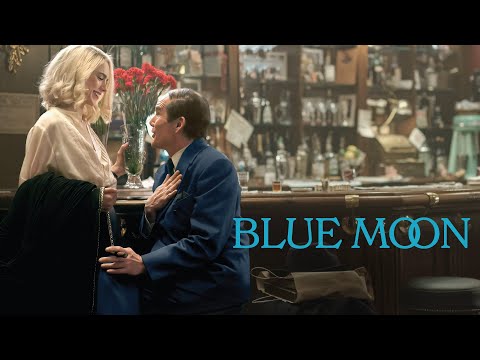
The script by Robert Kaplow (who previously wrote Me and Orson Welles for Linklater) is set at a turning point for the American stage: March 31, 1943, when Oklahoma! began its record-breaking and Pulitzer-winning Broadway run at the St. James Theatre. It’s a night of celebration for composer Richard Rodgers (Andrew Scott) and lyricist Oscar Hammerstein II (Simon Delaney), but it’s the end of an era for Rodger’s old songwriting partner, Lorenz Hart (Ethan Hawke). He’s the genius with whom Rodgers wrote endless standards of the Great American songbook, including “Bewitched, Bothered and Bewildered,” “My Funny Valentine,” and of course “Blue Moon,” but now he’s yesterday’s man. As he bends the ear of the barman (Bobby Cannavale, born for the role) and moons over Yale student and aspiring poet Elizabeth Weiland (played with blithe obliviousness by Margaret Qualley), he waits for everyone else to get to the afterparty for a musical he loathes. Hart has seen the future, and it is pablum made for the tasteless masses with no place for him.
It would be easy to consider Blue Moon as an offshoot of Linklater’s current fascination with the great American musical. After all, he’s in the process of adapting Merrily We Roll Along, with its book by one of Hart’s successors, Stephen Sondheim. But rather than the mere indulgence of a fascination, Blue Moon sees Linklater confronting the fears of the aging artist: of being cast aside, of losing old creative relationships, of becoming yesterday’s name.
It’s therefore a bittersweet note that is struck as Rodgers and Hart’s eternally memorable compositions are sprinkled through the evening, courtesy of the starstruck piano player (Jonah Lees) tinkling the bar’s ivories and hanging off every word as Hart self-destructs. Much as the audience’s heart will bleed for the writer, it’s also quickly clear why Rodgers is dumping this needy, catty, stick-in-the-mud in favor of the unctuous, almost bovine Hammerstein. The night is the end of Rodger’s old partner, and as a result Blue Moon is Linklater’s most melancholic film to date.
But much as Blue Moon is a eulogy for the death of a creative life, it’s also a testament to Linklater’s continued vitality as a filmmaker. There’s a new and deliberate formality, a lightness of dialogue, and even a new energy to his cinematography (there’s a subtle pull-out and pull-in from his longtime cinematographer Shane F. Kelly that takes the audience to the soul of Hart in mere seconds).
It’s also Linklater’s first sealed bottle drama since Tape, his overlooked exercise in tension from 2001. His only safety net seems to be casting old friend and collaborator Hawke as Lorenz Hart, but that’s his first big risk. Hart was short, bald, vulpine, and sardonic – none of the traits one would associate with Hawke, but he disappears into the sharp-tongued and sad genius.
Hawke’s is not the only act of transformation and period evocation here. Linklater clearly relishes recreating this era of Broadway, such as when famed photographer Weegee (John Doran) turns up to snap Rodgers and Hart on the stairs at legendary eatery Sardi’s. Meanwhile, in a stunningly understated performance, Patrick Kennedy resurrects famous essayist E.B. White, who serves as confessor and drinking buddy for the supposedly abstinent Hart. Like him, we bear witness to the loss of one legend in Hart, yet we also see the continued relevance of another in Linklater.
Blue Moon
2025, R, 100 mins. Directed by Richard Linklater. Starring Ethan Hawke, Bobby Cannavale, Jonah Lees, Margaret Qualley, Andrew Scott, Patrick Kennedy, Simon Delaney, John Doran.