


Naza is not simply a film about the ongoing Israeli bombing campaign against Gaza.
It is a warning.
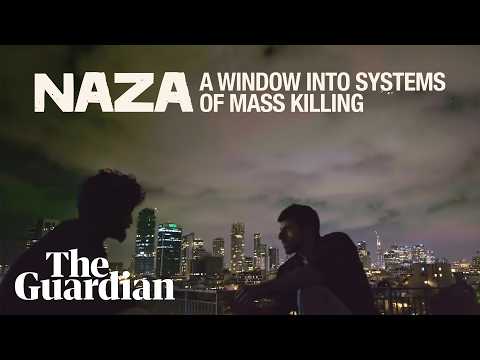
Starting in 2023, directors Yuval Abraham and Rachel Szor spent almost two years interviewing over 100 people involved in the Gaza offensive, from soldiers to drone operators to intelligence officers. For the film, 24 of them were interviewed on the rooftops of Tel Aviv by night. Around them, the city’s residents walk around their high-rise apartments, curtains open, exposed to external surveillance. Only in its closing moments is that concrete calm truly contrasted with the devastation in Gaza.
The title is weighted with meaning. At the simplest level, it is a contraction of nezek agavi, or collateral damage. It also sounds almost exactly like naza’a, an Arabic word meaning “to remove.” But it is also a name, meaning honesty. Naza blends all three into the year’s most powerful documentary.
First, the interviewees explain in great, technical detail how intelligence agencies collect vast amounts of digital data on the residents of Gaza. They did this under the pretense of accurately targeting Hamas targets and then set such high levels of “acceptable” civilian casualties that it’s irrelevant. One actual target for 15 naza, 15 family members, 15 neighbors? That’s fine under this policy, even if you don’t hit the original target.
Naza’a? That comes from the increasing realization that the offensive is nothing to do with eviscerating Hamas after the October 7 attacks, and simply about making Gaza uninhabitable for Palestinians.
And honesty? That’s in the risks taken by the 24 onscreen interviewees and the dozens more who were part of the research-gathering process. It shows how disgusted even those who were willing participants have become by what is being done in their name. Even as they are castigated in their home country’s press and by their own government, it’s clear that they are patriots of the best kind.
Abraham and Szor don’t ignore that there is still a threat to Israelis. As their sources speak, obscured by shadow and digital image and vocal manipulation, air raid sirens wail from incoming rockets. What the filmmakers are looking at is the scale and intent of the response. If it’s not genocide, then why does one of the interviewees call it such? If it’s not mass murder, then why does another confess to it? It’s not on the filmmakers when one soldier compares himself to a Nazi, or when they excerpt an interview of Benjamin Netanyahu promoting his book, Terrorism: How the West Can Win, in which he describes terrorism in exactly the terms in which the interviewees describe Israeli rules of engagement in Gaza. No wonder Bibi is so furious at this film. The directors have basically created the closing argument for the prosecution in any future war crimes trial.
Without stating it explicitly, Abraham and Szor make it clear that none of this happened just because Israel decided to interweave the AI-powered tactical software dubbed Lavender into its decision-making process. It is the end result of decades of policies, quite literally dating back to the day that the first cornerstone was laid in Tel Aviv, and the first phone line was connected in Gaza. The mindset to carry out this operation and the systems required for this scale of data collection were woven into those moments.
That’s why Naza is such an effective warning. It shows how supposedly impartial data can be used to enable bloodlust. Naza comes just as the Pentagon assembles a cadre of tech bros and political extremists including Elon Musk and VR gaming magnate-turned-military drone manufacturer Palmer Luckey for Project Meridian, their commissioned “future of warfare” white paper. Anything that Israel has done against Gaza could be used against any future American opponent. Or, more terrifyingly, us.
Naza
2026, R, 80 min. Directed by Yuval Abraham and Rachel Szor.
This article appears in October 9 • 2026.
