


Being an in-demand filmmaking professional can lead to a packed calendar. Take Greig Fraser, the Oscar-winning cinematographer behind the look of The Batman, Zero Dark Thirty, Foxcatcher, and more.
After wrapping up Dune with director Denis Villeneuve, it looked like he would finally be able to film The Creator, the sci fi epic he had been developing with Gareth Edwards, with whom he had lensed Rogue One: A Star Wars Story. But then Dune 2 suddenly was set to film, and he had to choose between two projects into which he had already invested a lot of time and creativity.
“Films are a tricky thing,” said Greig, “because they push and pull. … You don’t sign on a contract from March 1st to August 1st. It’s more like ‘this goes to the first half of the year,’ and because of Covid things were pushing and pulling, including the release of Dune.”
When Dune’s release got pushed from November 20, 2020 to October 20, 2021, pushing Dune 2’s production dates, Greig had to pick between passion projects. “It was really hard to tell Gareth, ‘Sorry, I can’t do it anymore.’”

It says something that Fraser is the first choice for two directors who are known as visual storytellers. Edwards is often his own camera operator, while Villeneuve recently sparked a minor firestorm for suggesting that cinema should turn rely on images, rather than dialogue, for storytelling. Fraser said, “There’s a thousand clichés that refer to pictures painting thousands of words, and you could argue the reverse and say that one word equals a thousand images. But [Villeneuve] is completely right, that the correctly-told sequence of images can absolutely cut out pages of exposition.”
However, he didn’t just walk away from The Creator. First, he recommended his close friend and mentee, Oren Soffer, as his replacement. Then, like so many people during the pandemic, he became a remote worker, serving as what Soffer called “an objective sounding board who was just looking at the images coming in and assessing them.”
“It was important to us that the audience never stepped out of it going, ‘Oh, they tried to make it as colorless as possible.’” Dune: Part Two cinematographer Greig Fraser
However, the Dune he came back to was slightly different than that of the first film. Or, at least, the way he shot it changed. “This is Paul getting to know the world better,” he said, and so he changed his lens package to, as he put it, “normalize” the look of Arrakis. “I’m a lens geek, obviously, and I study lenses and I feel like I know what they give me, emotionally. So I make decisions accordingly, based on that emotion that I want to give.”
That also meant using the changing nature of light across the day. He explained, “Arrakis is harsh, which is why those action scenes under the Harvester, blowing up the Ornithopter, it’s middle of the day. But we also want to see the beauty of the place,” and that’s why there were more of the intimate scenes filmed at sunrise and sunset. It all harks back to the opening scene of the first film, in which Chani (Zendaya) talks about how beautiful her home world is. As Paul becomes more one of the Fremen, the way Fraser filmed part two was influenced by the opening of part one, “that beautiful shot of Dune when the sun is low.”
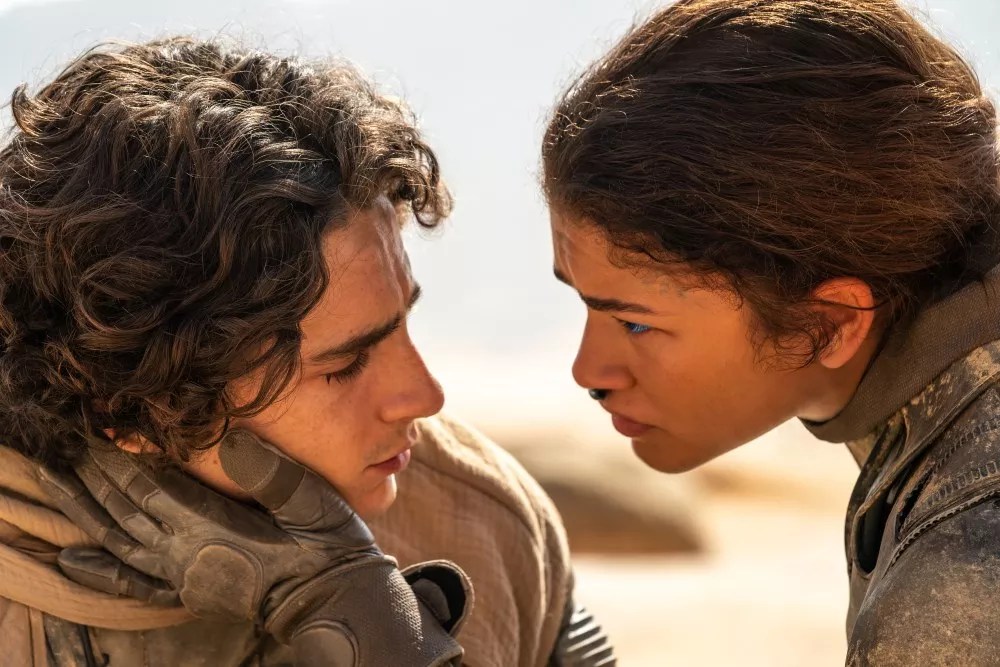
And an important part of that was to keep a vivid color palette. Just as Giedi Prime, the seat of the evil House Harkonnen, is pictured in stark black and white so Arrakis has to be more than just a bland beige smear. Fraser said, “It was important to us that the audience never stepped out of it going, ‘Oh, they tried to make it as colorless as possible.”
So rather than digitally desaturating the images, which would affect everything including skin tones, the team muted the colors by running the negatives through a chemical process called skip bleach.
That’s the same effect that was used in Jarhead, which Fraser noted creates “white, blown-out skies.” By stripping the blue from the sky, the whole world look different. He explained, “We all have this perception of the desert being blue sky, yellow sand, and a palm tree. The second you take the blue out, it changes everything, and allows you to add a little more color to the costumes which you may not even know is color.”
Dune: Part 2 is in cinemas now. Read our review and find showtimes here.
This article appears in March 1 • 2024.
