

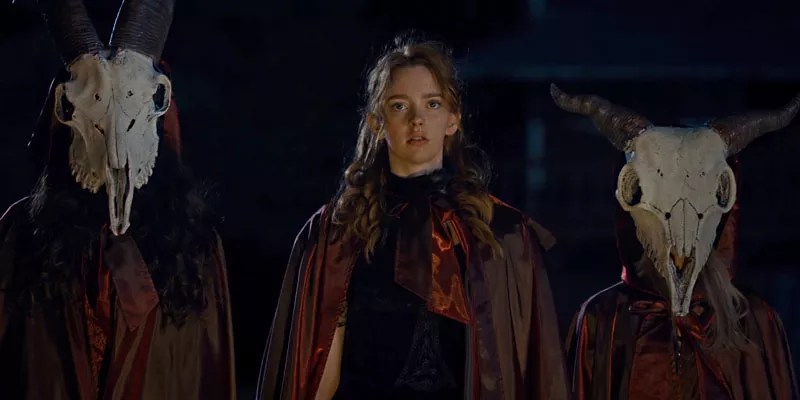
Supernatural Western. That phrase was all it took for Austin writer/director Aaron B. Koontz to head on the dusty trail to making his period horror The Pale Door. He said, “I said those words in front of a Lansdale, and he says, ‘You should make the movie,’ and then we go dinner, and the next thing I know we’re all working on it.”
The Lansdale in question was Joe, the endlessly prolific Texas author and master of mojo letters. He and Koontz were on a panel together at the 2018 Boomtown Film & Music Festival in Beaumont when Koontz mentioned the “gunslingers versus witches” pitch that had been rattling around in his head. No stranger to the Weird West (having written Dead in the West, about zombies on the High Plains, and the adventures of devil-plagued gunslinger Jonah Hex for DC Comics), Lansdale signed on as an executive producer; his son, Keith, who was also on the panel, became a third voice on the script with Koontz and longtime creative partner Cameron Burns, with whom Koontz had already produced PTSD shocker Camera Obscura and anthology horror-comedy Scare Package. Koontz said, “It was an honor to be on the panel, and literally one year to the day I was pulling up in my car to Guthrie, Oklahoma, to film The Pale Door.”
What appealed to Koontz about the Old West setting was “the antihero sensibilities of these cowboys … they’ll just kill you at the drop of their signature hat. And then you get to throw witches in there, and find a way to parallel their two backstories, and I’m off and running.”
The supernatural part was easy, but Koontz didn’t want this to be cardboard cowboys. Instead, he wanted the story planted in the grimy, dusty reality of the time and that included his band of outlaws. The brothers at the center of the bedeviled ruffians, led by hardened outlaw Duncan (Zachary Knighton, Happy Endings) and his greenhorn brother, Jake (Devin Druid, 13 Reasons Why), were based in part on the siblings at the core of the infamous Dalton Gang. Meanwhile fastidious Wylie (Pat Healy, The Innkeepers) was based on middle brother Bill Dalton, who planned and scouted the heists but stayed on the sidelines during their executions. Koontz recalled telling Healy, “‘You talk differently than everyone else, because you come [from] a different level of prestige. You came from a wealthy family.’ We had backstories for every single one of them and why they became outlaws, and you don’t have time to make all of that work, but you layer things in.”

He credited his co-writers with adding period and personality details: “The Lansdales helped a lot with that, creating who these people are.” So Wylie can’t stand loudmouth dimwit Truman (Noah Segan, Knives Out), while there’s an unspoken tension between steely gunsel Dodd (Bill Sage, a Lansdale veteran from SundanceTV’s Hap and Leonard) and raucous Brenda (Tina Parker, Francesca on Better Call Saul and Breaking Bad). Koontz said, “I told them, both of you have done it. You’ve totally hooked up. But neither one of you will admit it. You create these points of tension.”
Koontz even managed to slip in a little Easter egg all for himself – or rather, a cuckoo’s egg. He admitted to being “obsessed” with One Flew Over the Cuckoo’s Nest, and most especially with Will Sampson’s performance as Chief Bromden. He’d wanted to ensure that the gang was diverse, as a reflection of the historical reality of the time. (Brenda, for example, was inspired “in wardrobe and demeanor” by Laura Bullion, who wore men’s clothes when she rode with Butch Cassidy, the Sundance Kid, and Bill Dalton in the Wild Bunch). Koontz deliberately wrote the part of Chief to allow him to cast a less experienced actor in a major role, and that’s how he ended up auditioning Oklahoma native James Whitecloud. “I fell in love with what he was doing with his eyes,” Koontz said, and Whitecloud made it to the shortlist of three potential Chiefs. “At the end of the interview, he went, ‘Oh, yeah, Will Sampson’s my great uncle.’ I went, ‘What?’ and he said that ‘Yeah, he’s my great uncle, and I’m in acting because of him.’ So that was [Sampson’s] first major role, and this is [Whitecloud’s] first major role, and it’s magical for me that I could make that happen.”
The cast was set, now they needed a Western town, and they headed to Guthrie, Okla. It’s not because the city (pop. 11,783) is a film hub – although the drive-in movie sequence from Twister was shot there, and Dustin Hoffman’s character was diagnosed with autism in the Guthrie Clinic in Rain Man. It was because of a destination wedding venue. Koontz and Burns looked all across Texas, New Mexico, and Utah, but they settled on bucolic Rollins Creek Old West Town in sleepy Guthrie: not a ghost town, but that period feel of an authentic Western town where the paint was still fresh, with acres of woodland away from the nighttime glow of modern light pollution. Plus, Koontz said, “There was something in my dark sensibilities that I liked about doing these horrible things in this town where people proclaimed their love.”
There are a lot of ghost towns and Western-themed attractions, but what Rollins had that others don’t was depth. Koontz said, “These other Western towns I went to, they only had exteriors, but this had full interior spaces.” That included a two-story saloon that served as both the brothel location and sleeping accommodation for the crew. “I lived on that set for two months,” said Koontz. “I had the master bedroom, Cameron lived in my closet, and [cinematographer Andrew Scott Baird] was across the corridor.”
The location gave them everything they wanted. Well, almost everything they needed. First, they had to build their own church for the climactic showdown, where satanic forces are as deadly as a Peacemaker (“The things that happen in that church, the local churches in Oklahoma weren’t cool with,” said Koontz). Before that, they needed a second bar for the opening scenes, and this time they found the real historical deal: the Blue Goose Saloon in Snake River Junction. The building had been bought and restored by Orvel Robinson, a local history buff who constructed a complete town around it and now stages cowboy reenactments with his friends at the weekend. “They’re the extras in the saloon,” said Koontz. “They have all their own authentic Western gear from the 1800s.” Yet the original structure is riddled with history – literally. He said, “The [real] Dalton Gang ate and drank in that saloon. One of them was shot in that same saloon in the 1800s, and the bullet holes are still in the walls.”
The Pale Door opens Aug. 21 in theaters and on VOD. See Showtimes for review and listings.
This article appears in August 21 • 2020.
