

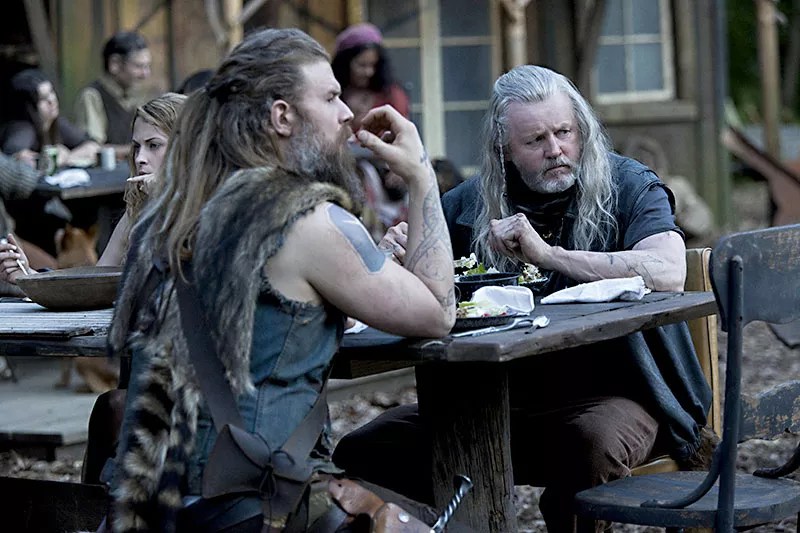
Everyone laughed – and rightly so – when the Oregon militia occupying the Malheur National Wildlife Refuge bleatingly begged for snacks and sodas. They’re a far cry from the Farrells, the isolationist Kentucky clan at the heart of WGN America’s new drama Outsiders. Throw away any Duck Dynasty preconceptions, and the Farrells are definitely no Dukes of Hazzard. They’re a throwback to a time long gone, the kind of backwoods folks that would make the Hatfields and the McCoys stick close to the roads. For series creator Peter Mattei, their tale is a metaphor for survival in abject, grinding poverty in a civilization with no heart. He said, “The real story of our times is income inequality, the rich and the poor, the haves and the have-nots, the one percent and the 99 percent, and all these things that we’ve been thinking about for the last few years.” Nowhere is that division more clearly shown than the Farrells’ Appalachia, where generations of poverty and unemployment have sent communities crumbling into dust. “It is so powerful to what extent these people are disempowered.”
A New York-to-Austin transplant (“My sister and family live in Austin, and I bought a house near Cesar Chavez three years ago”), Mattei presents his tale as a reflection of these divisive times. He said, “You don’t have to look very far in the news to see that a lot of people are angry, and in conflict with each other. So I came up with the idea of this clan that wanted to live according to their own rules, in a kind of primitive way that was maybe simpler and superior and maybe more noble than the way that the rest of us live.”
There’s an ambiguity about who the eponymous outsiders are. It could be the Farrells, a clan of Gaelic-descended outlaws shielded from modernity for the last century. It could be the residents of nearby Blackburg, the ailing Kentucky mining community that sits at the feet of the Farrells’ beloved Shay Mountain. It could be the mining company, pushing the Farrells off the land that the law says belongs to the corporation. Or it could well be Asa (Joe Anderson), a renegade Farrell who quit the mountain a decade ago and has crawled back with a prophecy hanging over his head that he will either save or destroy the family. The result is a shifting and seething sea of allegiances, with no one’s hands ever spotless. Mattei said, “If you look at a lot of angry struggles that are in the news these days, it’s usually a disempowered person blaming another disempowered person for their disempowerment, as opposed to really pointing the finger at the people who are really responsible.” In the story, he said, “it’s really like red and blue states. The Farrells and the people in the town have to get together and figure out a better way to live, but the powers that be are pitting them against each other.”
The steep slopes and dense woods of the Appalachians are as much a character in Outsiders as any actor, but initially Mattei wasn’t exactly sure where he wanted to set the story. However, he had friends who were part of the protest movement against mountaintop removal. Instead of digging mine shafts to reach coal, companies simply blast down whole hills and scoop out the seams. For them, it’s easier, cheaper, and less dangerous. For nearby residents, it can be an environmental and health disaster. Mattei said, “I just thought that would be an incredibly dramatic way to tell this story, and really epic. Not only were they being evicted from this mountain where they had lived for a couple of centuries, but they were being evicted so the whole thing could be blown up and dynamited. I thought that was a really powerful ticking bomb inside the story.”
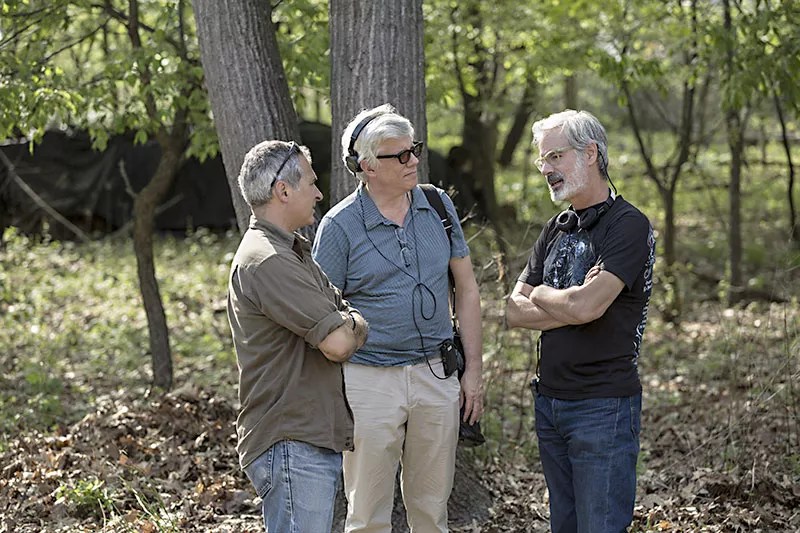
One of Mattei’s biggest challenges was to make the Farrells truly other, with their own culture, and his research became an experiment in theoretical anthropology. Mattei said, “Many indigenous communities are based in the land, and in the place that they live. The power they have to survive is based in that land.” As for the Farrells, Mattei took them back to their European roots, with traces of druidic practices, and the reverence for the oak tree and the wild places that weave throughout British folklore. He describes them as “a pagan group. They would have been living in very rural places where the church would have imposed its rules. But when they got to America, they would have dropped all that, and especially when they got to their mountain, they would have dropped the church. But they would have held on to their beliefs.”
His world building included creating a completely new language for the Farrells, called old tongue – a bastardized mish-mash of the Old World influences they took with them when they quit to the New World. He said, “I wanted them to speak some snippets of their own dialect that only they would know and so at first I just made it up. But as we got into it, we started creating a language out of Welsh, Scottish, and Gaelic.”
Mattei describes the process of forging the Farrells’ mountain as a collaborative effort with his entire crew, including a surprising insight from actor Ryan Hurst. Best known as the ill-fated Opie from Sons of Anarchy, as Little Foster he is the prince in waiting, ever eager to win the clan’s approval. However, he also gave insight into the patterns and symbols the Farrells ink into their skins. “He came forward and said, ‘Can I help with the tattoos?’ So we spoke about how the tattoos would be about nature, and which characters would have relationships with different animals and different plants, and we found a really cool tattoo artist in Pittsburgh who could help us.”
The culture is personified in brooding mountain man Big Foster, the new leader of the clan. As played by David Morse (Concussion, Treme), he is a mud-stained eternity away from his breakout role as the anxious and empathic Dr. Jack Morrison in seminal TV medical drama St. Elsewhere. Mattei said, “He’s one of the finest actors out there, and he was always on a fantasy list of the kind of actors that I wanted to work with.” Once on board, Morse helped reshape Big Foster away from being a modern barbarian chief, into someone more thoughtful. “He wasn’t going to come in and play this guy as a loud, angry son of a bitch. He’d be happy to do that, but he was always asking questions that grounded the character in a more sympathetic and authentic place.”
So even in his moments of brutality, Big Foster has a humanity. There’s even a suggestion that, as the last defender of the mountain, he may be in the right. But then the same can be said for Asa, and Little Foster, and the townspeople, and even the mining company. Mattei said, “That’s what I was always going for, lots of shades of gray, and not so much black and white.”
Outsiders premieres on WGN America on Tuesday, Jan. 26, 8pm.
This article appears in January 22 • 2016.
