

 |
years ago, Jim Bob Moffett and Gary Bradley were on the same side. Today, the two are squaring off in court.
Although their names are nowhere to be found in the pleadings filed in a
lawsuit filed in Travis County District Court — known as Circle C Land
Corp. v. Phoenix Holdings Ltd. — the case indicates a rift between the two
high-profile entrepreneurs. And while Moffett, the chairman of New
Orleans-based Freeport-McMoRan Copper & Gold, is rolling in gold — having
won a 15% stake in the gargantuan Busang deposit on the island of Borneo —
Bradley continues struggling to make ends meet.
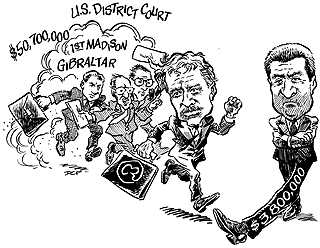
At issue in the lawsuit, which was filed early last month, is $3.8 million in
water and wastewater fees that the plaintiff insists are being improperly
withheld by Phoenix Holdings. Bradley is a partner and president of Phoenix.
The plaintiff, Circle C Land Corp. (CCLC), is a subsidiary of New Orleans-based
FM Properties (FMP), whose managing partner is Freeport-McMoRan.
The suit alleges that CCLC is entitled to “$3,803,069.00 in MUD reimbursements
currently available for distribution by the municipal utility districts for
improvements.” The Circle C Ranch development, located in southwestern Travis
County, is served by several MUDs, which collect water and wastewater fees from
local residents. The dispute came about because Phoenix bought part of the
development from FMP last year. FMP alleges that Phoenix is taking fees from
properties that were not part of that deal. For his part, Bradley says there is
“no bad blood” between him and Freeport. He says, “I don’t think anybody’s mad
or anything. If you sat down and read the contract, you’d say `I don’t
understand that either.'”
Moffett and Bradley began cooperating in 1992, when Bradley was trying to
stave off foreclosure on the 3,200-acre Circle C Ranch, which he has been
working on since 1981. First Gibraltar Bank of Dallas, representing the
Resolution Trust Corp., wanted to foreclose on the property because Bradley and
his partners defaulted on $118 million in development loans. Freeport-McMoRan
stepped in and guaranteed $42 million in loans that allowed Bradley to stay
solvent and avoid foreclosure on his Circle C project. With the loan guarantee,
FMP (which was spun off from Freeport in 1992) paid $10,000 for an option to
buy the bulk of the Circle C development, including 1,000 acres of commercial
property.
With that deal, Bradley and Moffett’s interests became one and the same.
Bradley was instrumental in helping Freeport advance its agenda at the Texas
Legislature. During the last session, Freeport’s lobbyists were able to pass
legislation that exempted their properties from Austin’s environmental
controls.
But while Bradley was able to escape Austin, he hasn’t been able to escape his
debts. In 1990, he was sued by First Madison Bank, which was seeking to recover
more than $100 million in development loans and $15 million in personal loans
that Bradley and his partner, James Gressett, received from the failed
Gibraltar Savings Association of Houston. First Madison began pursuing Bradley
after it bought some of Gibraltar’s assets.
In May of 1995, a few days before Austin Senator Gonzalo Barrientos began
filibustering against a bill that would exempt Bradley’s Circle C Ranch from
Austin’s water quality laws, a federal district court judge in Houston ruled
that Bradley and Gressett were liable for
$50.7 million in loans that the
pair got from Gibraltar. Bradley appealed that ruling to the Fifth U.S. Circuit
Court of Appeals in New Orleans. But last September, the appeals court upheld
the district court’s judgment.
Despite the judgment, Bradley continued to work to regain control over the
Circle C project, which he had surrendered to FMP in 1992 in exchange for the
loan guarantees. In late 1995 FMP sold Circle C’s residential lots to Bradley’s
group for $15.8 million. Then last September, FMP agreed to sell the 1,000
acres of commercial property at Circle C to Phoenix for $34 million. Bradley
was supposed to make a $2 million non-refundable deposit by January 8 to allow
the deal to go forward. But he didn’t make the payment, and by missing the
deadline, Bradley and his partners in Phoenix — whom he has refused to
identify — lost $1 million in earnest money.
Bradley told the Chronicle that the reason for missing the deadline was
simple. He didn’t want to move forward until the lawsuit against the Southwest
Travis County Water District that was filed by the city of Austin late last
year was resolved. The city’s lawsuit, which is still pending, sought to
overturn HB 3193 — the state law exempting
Circle C from Austin’s water
quality regulations.
“The city had filed a lawsuit,” said Bradley. “We didn’t want to go forward
until the lawsuit is resolved. Somebody that has my financial problems to begin
with isn’t going to be able to get a lender interested with a lawsuit filed.
The partners were ready to go, loans were in place, but the lawsuit interrupted
all of that.”
Bradley was hoping to lure a shopping center to Circle C. He was also planning
to attract other commercial ventures to the property, which he believes offers
a lower-cost development option when compared to land located within the
city.
In addition to the loss of the $1 million in earnest money, there are other
indications that Bradley is having financial trouble. Last April, he sold his
5.7% ownership interest in the NBA’s Houston Rockets for an undisclosed amount
to Rockets’ owner Les Alexander, who was quoted by the Associated Press at the
time as saying, “Gary wanted to sell.”
Bradley’s sale of the Rockets share is intriguing. In 1992, he tried to raise
$80 million in order to buy the team from Houston car dealer Charlie Thomas.
Bradley tried to close the deal with two different groups. One included
embattled Houston torts lawyer John O’Quinn; the other included heavyweight
boxer Evander Holyfield. Both deals fell apart. In 1993, still hoping to gain
control of the team, Bradley went to court to try to block the sale of the
Rockets to Alexander, a former bond trader.
Since 1992, Bradley has been gradually selling off his interest in the
Rockets. That year, the AP reported that he owned 25% of the team. A year
later, they reported his ownership at 20%. Last year, it was 5.7%. Could it be
that Bradley has been selling off his interest in the team to raise cash to pay
off his debts?
Bradley admits to having financial trouble ever since Gibraltar failed in
1988. “Since when is that news?” he asked. “Isn’t being broke and being in a
lawsuit with Freeport enough for today?”
Bradley says the federal suit against him is still “plodding along.” He said
his attorneys have appealed the case to the U.S. Supreme Court, but he adds,
“I’m not optimistic about how that is going to turn out.”
Regarding his sale of the Rockets, he said, “I was fortunate to win two
championships. After I won two rings, I was trying to make as much money as I
could.” He said the Rockets “aren’t getting any younger and the [Los Angeles]
Lakers are going to be tough in the west. I thought it was the right time to
get out.”
Mike McKetta, a lawyer with the law firm Graves Dougherty Hearon & Moody,
has represented Bradley for several years. But McKetta withdrew as Bradley’s
attorney in the current lawsuit because two lawyers in his firm are likely to
be called as witnesses in the case. Asked if Bradley was having financial
problems, McKetta said, “I started hearing those rumors in the late Eighties. I
think he’s done a fine job with that residential development out there.”
Roy Minton, who is representing FMP in the case against Phoenix, also refused
to discuss Bradley’s finances, and said that the case at hand hinges on the
contract between the two entities. “I think the contract is clear,” said
Minton, who expects depositions to begin some time next month. If the case is
not settled, he believes the case could go to trial some time in September.
Bradley wants to avoid the courtroom. “Lawyers on both sides said `We just
don’t know what that [the language in the contract] means.’ That’s where we
are,” Bradley said. “I just hope we get it settled out. I hope not to have a
trial.”
As for his relationship with Moffett, Bradley said the mining magnate doesn’t
call for advice on the Busang project. But, he said, “We still talk every once
in a while.”
The next hearing on the lawsuit is April 3.
This article appears in March 28 • 1997 and March 28 • 1997 (Cover).