




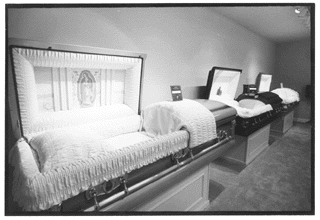
 |
last piece of property you’ll ever need will probably be the most expensive.
Much has been written about Austin’s high real estate prices, but dollar for
dollar, it’s cheaper to buy a lot to build a place to live than it is to
purchase a plot of land to plant yourself when you’re dead.
For example, a high-dollar undeveloped lot on Island Cove, a scenic drive
overlooking Lake Austin, is listed at $714,285 per acre, according to local
real estate sources. With 43,560 square feet in an acre, you’d be paying about
$16.40 per square foot. In a more affordable part of town, a lot on Craigwood
Drive, just east of U.S. Highway 183 off Martin Luther King Jr. Boulevard,
recently sold for $5,953 per acre, which boils down to just under 14 cents per
square foot.
Burial plots in Austin, on the other hand, start around $15 per square foot
and can run up to $47, depending on where you choose to stake out your final
nest. Add in the cost of funeral services, a casket and tombstone, then you’ll
find at least one reason for the old axiom: You can’t take it with you.
But for many, taking it with you is not important, says Eric Pierce Futch, a
funeral director at Cook-Walden Funeral Homes, a subsidiary of Houston-based
funeral giant Service Corporation International (SCI). What is important — and
more often for the family of the deceased than the departed themselves — is
leaving behind some record of a life.
“I don’t think it’s an accident that we’ve had burial ceremonies for 5,000
years. People have gone to great lengths to be remembered,” Futch says,
pointing to the Pyramids and the Taj Mahal as two examples of the extravagance
some have taken with their grave sites.
Where Do You Go When You’re Gone?
One of the nicest bone orchards in Austin is the Texas State Cemetery on EastSeventh and Navasota — a beautiful wooded glade featuring sculptures by
Elisabet Ney and Pompeo Coppini. This historic site, established in 1851,
recently has undergone an extensive restoration project to make it even more
lovely. Aside from the scenery, you’d share the ground with several famous
neighbors, including such notable Texans as Stephen F. Austin and W.A.A.
“Bigfoot” Wallace. But you must be a state official to qualify for a plot.
Those without the money or family able to pay for burial may be eligible for a
simple, unassuming grave in the Travis County International Cemetery, a
six-acre lot located at the corner of Axel Lane and Wilcab Road in East Austin.
Juanita Vargas, social services supervisor for Travis County Human Services,
says that the county maintains the cemetery, and the funeral home handling the
service “is paid just a flat fee, basically to cover their minimum expenses.”
The county pays for about 100 burials a year, Vargas says.
While there are dozens of family graveyards and church cemeteries in Austin
and Travis County, you usually have to be a member of that family or church to
make a reservation. For other folks, the choice falls to the city-owned or the
privately-owned cemeteries.
The City of Austin owns five cemeteries: Austin Memorial Park, Evergreen,
Oakwood, Oakwood Annex, and Plummers. Kay Ann Yaklin, superintendent of
operations for Austin-based Intercare Corp., says her company has operated the
cemeteries for the city since 1990. Currently, she says, grave sites are for
sale only in Austin Memorial Park and Evergreen, but the owners of empty plots
in the other cemeteries occasionally put their land on the market.
The price for a space at Evergreen, which lies on East 12th Street off Airport
Blvd., is $770, or $22 per square foot for an average 42-inch-by-10-foot plot.
Prices are the same throughout the cemetery, Yaklin says, whether or not the
grave has a nice view. “There’s no distinguishing amount if it’s next to a
tree, a road or a water sprinkler,” she says.
At Austin Memorial Park, on the west side in a nice plush area bounded by
Hancock Drive and the MoPac Expressway, burial space runs about $950, or about
$27.14 per square foot. Yaklin says the city has a contractor to maintain the
grounds and graves. Gene Bagwell, president and owner of Intercare Corp., says
that Austin Memorial Park, which covers 85 acres, is about 30-35% occupied,
while Evergreen’s 30 acres are around 70% full.
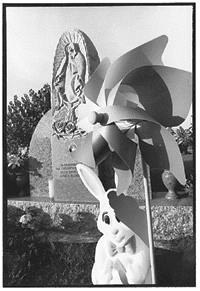 Easter/Palm Sunday decorations at the Assumption Cemetery in South Austin |
St. Edward’s University, offers both a nice view of the city and some of the
more affordable prices in town. According to grounds foreman Sergio Aguilera,
about half of the Assumption’s 16 acres is full. Costs for a 40-inch-by-9-foot
space run $450, $550, or $600 (about $15, $18.33, or $20 per square foot,
respectively), depending on the location, Aguilera says. Gravesites that have
walkways behind the headstone, where the family can plant a tree or place a
bench, are naturally more expensive, he says.
If the family desires an upright tombstone, instead of a flat monument that
fits flush with the ground, prices run $750, $850, or $1,000 (about $22.50,
$25.50, or $30 per square foot, respectively), once again based on location.
These spaces are 40 inches by 10 feet. Assumption also has a mausoleum, where
bodies are stacked vertically like drawers in a file cabinet, at prices ranging
from $2,250 to $5,000. Care for the grave or mausoleum space is figured into
the cost, Aguilera says.
Onion Creek Memorial Park lies about 10 miles south of downtown Austin, not
far from the Onion Creek Country Club. General Manager Bob Thoreson says the
prices for a 44-inch-by-9-foot space in his cemetery runs $775 for a plot with
flat monument to $895 for a grave with an upright tombstone. Prices include
perpetual care. “We periodically run prearrangement specials where we have a
special on the adjoining spaces,” Thoreson says. “For example, in the flat
marker section, we’re currently running a prearrangement package for two spaces
at $900.”
Thoreson says about 7.5 acres of the 9-acre lot are available for new
customers, and that Onion Creek does not have a mausoleum but is considering
building one.
`Cadillac’ of Cemeteries
SCI’s Cook-Walden is the biggest private cemetery provider in Austin. It’salso the most expensive. SCI maintains three graveyards in the area: Forest
Oaks in Oak Hill — which is at 60% capacity on its 16 acres — and the
two-cemeteries-in-one Memorial Hill/Capital Parks, which lies just west of
Pflugerville, and is currently filling only 25% of its 35 acres. SCI, the
largest “death care” provider in the world (see main story), operates some 250
cemeteries around the country and nearly 3,000 funeral homes around the globe,
says Cook-Walden funeral director Futch.
Cook-Walden offers several interment options, but a single burial space at one
of the company’s graveyards runs $1,755, including the perpetual care fee. For
a 45-inch-by-10-foot space — that comes to $46.80 per square foot — about
twice as much as city-owned cemeteries. For a lawn crypt, which is similar to
the grave but has cement walls underground and can hold one or two caskets, the
price is $1,995. That’s prime real estate, but Futch says you get what you pay
for.
“It’s like a Cadillac, a Lincoln, and a Volkswagen,” he says, comparing
Cook-Walden’s prices to the other cemeteries.
The options that Cook-Walden provide are designed for those who buy a plot
before they actually need it. First off, Cook-Walden is a one-stop “death care”
shop, handling the preparation of the corpse, funeral arrangements, burial, and
care for the grave from here to eternity. There’s a travel protection plan, so
if you die anywhere outside of a 75-mile radius of your home — including any
foreign countries — Cook-Walden will handle the arrangements to get your body
back where it belongs. And there’s a relocation plan that allows you to
transfer your plot to another SCI-owned cemetery if you move to another part of
the country.
“If you buy at some cemeteries and circumstances alter to where you have to go
to another state or something, by and large you’re out of luck,” Futch says.
“If you get an opportunity to go to Denver or Florida or California, it’s nice
to say, `Hey, I can take it with me. I can transfer to one of their other
locations.'”
The Cook-Walden cemeteries are nice, well-maintained park-like affairs, but
are devoid of the charm of many other local cemeteries. That’s mostly because
of the lack of upright tombstones — or memorialization, as Futch calls them.
That’s partially to prevent vandalism — “It’s no fun to spray paint a flat
marker,” he says — and to ensure uniformity among graves.
“You’re never going to have to worry about somebody putting the San Jacinto
monument up next to you,” Futch says. “You’re never going to have to worry
about clutter, you’re never going to have to worry about toppled monuments.”
(What Futch doesn’t say is that it’s cheaper for SCI to maintain flat markers
since they don’t require as much trimming and weeding).
Cook-Walden also offers a mausoleum. Price for a space in the indoor
mausoleum, in which the name plate faces inside the building, is $4,595. Spaces
for the outdoor mausoleum, where the memorialization faces outside, prices
range from $3,295 to $3,895. The bodies are stacked five high, with the top
level being the least expensive and eye-level costing the most.
The Cremation Option
With land prices what they are, more and more people these days are decidingto have themselves cremated after death. The ashes can be scattered to the
winds, or the urn can be kept in an honored spot in your home.
Some choose to have their urn buried or kept in a niche in a mausoleum. Yaklin
says that at the City of Austin cemeteries there are small burial spaces —
which also double as graves for children — where cremation remains, or
“cremains,” can be interred. These spaces go for $150.
At Assumption Cemetery, niche spaces for cremation urns are priced at $850.
Onion Creek Memorial Park offers two options: burial spaces which run from $475
to $695 and include urn and marker, or a “columbarium,” a “miniature mausoleum
for cremated remains.”
“The package that we have includes the niche, interment urn, a bronze
name-and-date plaque that actually bolts onto the granite face — as opposed to
stick-on letters — and the perpetual care fee,” Thoreson says. “The total
package for the columbarium is $895.”
At Cook-Walden’s cemeteries, niches in the mausoleum for cremated remains run
from $1,300 to $1,700, with prices depending on the position of the
niche and the style of memorialization. Futch says Cook-Walden also is planning
a cremation garden, which will resemble a nature trail and rock garden where
the urns are designed to look like stones to fit in with the landscaping.
This article appears in March 28 • 1997 and March 28 • 1997 (Cover).