

 |
than perhaps
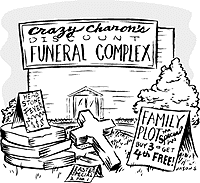
any other industry, the funeral business depends on image.
In promotional materials, cemeteries are portrayed as peaceful oases where
the grass is always neatly cropped. Likewise, funeral homes are made to appear
serenely prosperous.
Don’t buy it. The funeral industry has become an increasingly cut-throat
business where profits, not service, are the barometer of success. And while
most funeral homes are still family-owned, big consolidators are snapping up
independent funeral homes by the dozen. As the big companies increase their
market share, independent owners are being pressured to sell out to the
consolidators.
The biggest funeral provider in Austin is Cook-Walden; it dominates the “death
care” business in the Austin area, and it’s getting bigger. Cook-Walden has
begun construction on what will be its sixth funeral home in the region. The
new $2.1 million facility will be located in Pflugerville between two of the
company’s cemeteries, giving customers the option of one-stop shopping.
But very few of Cook-Walden’s customers realize that their “local” funeral
home is actually just one small part of the world’s largest funeral
conglomerate, Houston-based Service Corporation International (SCI). Last year,
SCI’s Austin subsidiary did 40% of the funerals performed in this city,
according to one local funeral home that tracks the industry by counting the
deaths reported in the local daily. Cook-Walden also operates the Condra
Funeral Home in Round Rock and the Davis Funeral Home in Georgetown.
Cook-Walden is leading the local market even though, like many other SCI
funeral homes, its prices are often substantially higher than those of locally
owned funeral homes. But that’s Cook-Walden’s advantage: Few people shop around
when using funeral services. For one thing, there’s very little time to
bargain-hunt; if you are a traditionalist, the body needs to be refrigerated or
embalmed, services have to be set, a member of the clergy has to be contacted,
relatives informed, an announcement in the newspaper placed, clothes found,
food cooked, a “party” arranged — the list goes on and on. And aren’t funeral
directors good at making customers feel that haggling is just a little gauche
at a time like this? The effect of all this pressure is that many people skip
doing any homework and take the first deal that is offered. No doubt aware of
this phenomenon, SCI spends a lot of money advertising the Cook-Walden logo,
and it’s the most recognized name in the Austin market.
Now operating 2,800 funeral homes, 250 cemeteries, and 137 crematoria, SCI had
revenues last year of $2.29 billion, and it handles about one of every 10
funeral services in the U.S. — some 230,000 funerals per year. The company has
buried some of America’s most famous personalities, including John Lennon,
Howard Hughes, and Jacqueline Kennedy Onassis.
SCI has advantages that other businesses would die for: Its profit margin in
1995 was 11%, nearly twice the average of American companies as a whole; it is
recession-proof; profit margins can be as high as 80%; everyone needs the
service; logistics and the high price of entering the market keep foreign
competitors at bay; customers rarely compare prices; and best of all, many
customers pay in advance.
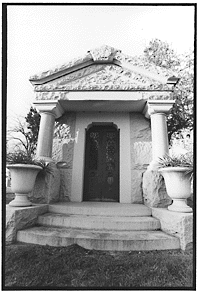 Mausoleums, like this one in central Austin, are too expensive for most families |
their stock, which now trades at about $30 per share, nearly doubled the
performance of the Standard & Poor’s 500 Index. SCI’s founder and CEO
Robert Waltrip once said, “People that don’t buy our stock just don’t like
money.” He’s right; SCI is not a cash cow, it’s a cash herd — a quiet herd
which just happens to wear a dark suit and drive a hearse.
Over the past four decades, Waltrip has parlayed a single funeral home on
Houston’s Heights Boulevard into the McDonald’s of the funeral business. SCI
dominates the death-care market in the same way McDonald’s dominates the fast
food industry. But unlike McDonald’s, which must contend with vegetarians and
health food devotees who don’t want their product, everyone is a potential
customer for SCI. And while the allure of McDonald’s is the relatively cheap
fare, Waltrip’s customers think nothing of plunking down huge chunks of their
savings. And just as Ray Kroc brought mass-production techniques to the
hamburger business, Waltrip realized that the funeral business consists of a
series of steps that can easily be simplified and made more profitable.
“Things about this business are the same as in McDonald’s,” Waltrip
explained during an interview last year in his office atop SCI’s headquarters
on Houston’s Allen Parkway. Both businesses have a set of fixed costs. By
buying in quantity and warehousing commodities — like coffins and embalming
fluid — needed by the various outlets, SCI reduces its costs and increases its
profits. Once the company covers its fixed costs at a given location, up to 80%
of additional revenues go straight to the bottom line. “What we are able to do
is very simple,” says Waltrip. “And it didn’t take a genius to figure it
out.”
So Waltrip began the consolidation of a moribund industry that, until he
launched SCI, consisted almost entirely of family-owned funeral homes. Today,
SCI has a spate of imitators, including New Orleans-based Stewart Enterprises
and Vancouver-based Loewen Group. But SCI is more than three times as big as
than Loewen and 10 times larger than Stewart.
In Austin and elsewhere, SCI cuts costs by allowing several mortuaries to
share the same fleet of hearses and limousines. The company also tries to
centralize its embalming, warehousing, and accounting operations. This
practice, which SCI calls “clustering,” reduces overhead and saves on labor
costs.
The new funeral home in Pflugerville showcases another element in SCI’s
strategic plan. The new facility, which will be called Cook-Walden Capital
Parks, will be flanked by two of the biggest cemeteries in the region:
Cook-Walden Capital Parks and Cook-Walden Memorial Hill. Putting the funeral
home at the cemetery reduces SCI’s overhead, and it gives their sales force an
advantage when selling cemetery plots and crypts.
SCI already has dozens of funeral home/cemeteries, facilities that SCI’s
insiders call “combos.” And while the combos reduce the company’s costs, SCI
rarely passes those savings on to customers. In fact, SCI’s funeral prices in
the Houston area have been cited as some of the most expensive in the nation by
Karen Leonard, a representative for the Funeral and Memorial Society, a
national, non-profit consumer organization. Leonard estimates that SCI controls
70% of Houston’s funeral business. And a survey of Houston mortuaries completed
last August by the Arizona-based Interfaith Funeral Information Committee found
that nine of the 10 most expensive funeral homes in the city were operated by
SCI.
SCI’s prices in Austin are generally lower than what the company charges its
clients in Houston. For instance, the basic services, or cover charge, that SCI
charged last year at its Pat H. Foley funeral home in Houston was $1,550.
Cook-Walden charges $1,125.
Still, a comparison of price lists shows that SCI’s prices are generally
higher than those of locally owned funeral homes (see chart). For instance,
whether you choose burial or cremation, Cook-Walden is the second most
expensive provider among the five funeral homes we surveyed. For a direct
cremation, with no ceremonies or viewing, their price of $1,365 is on the high
end of a scale ranging from $775 to $1,660. And for the combination of basic
services and embalming, where prices range between $1,000 and $1,475, Cook
Walden comes in at $1,420. (Note that none of these prices include a container
— casket or urn — or other optional services you may require.) On the other
hand, a couple of the other businesses are higher on specific services, and
casket prices at some local funeral homes are also higher than those at
Cook-Walden.
John Amey, who began working in the Austin funeral business in 1955 and now
owns two mortuaries in Austin — Wilke-Amey-Clay and Amey Funeral Home — says
he gets many customers from Cook-Walden who are irritated over the company’s
pricing. He calls SCI’s prices “highway robbery,” adding that whenever SCI buys
a funeral home, “The first thing they do is cut expenses and raise prices.”
Houstonian Barbara Baker does not have fond memories of dealing with SCI. On
June 2, 1995, she pre-paid SCI’s Forest Park-Lawndale funeral home for a
cemetery plot and funeral for her ailing mother. A month later, her mother
died. But, she says, SCI officials refused to honor her contract even though
Baker showed them her receipts. And she says Forest Park-Lawndale officials
refused to proceed until she signed a new contract. “Their excuse was they
don’t keep copies of pre-paid funerals,” recalls Baker, who added that company
salespeople tried to sell her flowers, cards, monuments and other items. When
she refused to buy any of them, she says, salespeople became rude. She adds
that the company also forgot to run an obituary for her mother in the paper.
Baker later wrote letters of complaint to every member of SCI’s board of
directors. She says that none of them ever responded.
“The only restitution we got was they sent me a check for $100,” says Baker.
“I sent it back and said my mother’s life is worth more than $100.”
Ironically, Baker says that she continues to be harassed by SCI salespeople
trying to sell cemetery plots. “They call me constantly,” said Baker. She said
her husband recently threatened legal action against the company to get the
calls stopped. Baker says of SCI, “Their interest is only in money and in
making it as fast as they can and they do not offer any services to make
anybody feel any better.”
SCI officials in Houston and Austin were contacted by the Chronicle and
asked to comment for this story. They did not respond.
This article appears in March 28 • 1997 and March 28 • 1997 (Cover).