




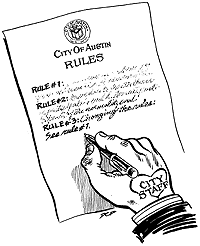
 illustration by Doug Potter |
city
official, Hector Fabela, has filed a “whistleblower lawsuit” against the city.
If what he alleges is true, the tale of his harassment provides an introduction
into how a few key bureaucrats wield power at City Hall. According to Fabela,
they are members of an elite club that illegally influences the awarding of
lucrative government contracts, and is not afraid to use its power to cripple
the lives of nonconforming employees.
Fabela is a former acting director of the Department of Small and Minority
Business Resources (SMBR). His lawsuit, filed February 13, alleges that Fabela
suffered an inexplicable wage reduction and faces imminent dismissal because he
blew the whistle on illegal procedures by other city supervisors. In an
interview with the Chronicle last week, Fabela said that he informed
City Manager Jesus Garza that Purchasing Officer Sue Brubaker and Assistant
City Manager Marcia Conner had violated the city’s minority procurement
ordinance, only to become Garza’s scapegoat in last year’s airport terminal
debacle, even though he was only marginally involved. Garza would not comment
on the lawsuit. “We’ll deal with the issue in court,” says Garza.
Fabela’s former place of employment, SMBR, awards minority status to
qualifying businesses, thus increasing their eligibility for city contracts.
SMBR helps determine who gets what contracts, and Fabela, 50, says that the
powers-that-be, like Brubaker and Conner, were hell-bent to control it. Fabela
was hired as SMBR’s assistant director in January, 1994, when it was still
known as the Office of Minority Business Affairs (OMBA), and was a division of
Brubaker’s Purchasing Office. OMBA was founded about ten years ago through the minority procurement ordinance, which was designed to procure
minority participation on city projects. Fabela’s task was to ensure that such
participation occurred as proposed. Through his attempts to enforce the
ordinance, he says, he quickly learned that breaking it is part of City Hall
culture.
Here are the principle events that led to the lawsuit, as told by Fabela:
Three months after being hired, Fabela got his first lesson in city
“management.” He was appointed to a committee of city staff that was to
recommend a company to provide insurance, bonding, and technical assistance to
small and minority businesses hoping to work at the new airport. The stakes
were in the millions. Amid intense competition, the process was flawed from the
outset, claims Fabela. According to the ordinance, brokerage house Marsh &
McClennan should have been disqualified from bidding on the contract because it
was late in filing the necessary paperwork. But Fabela says that Brubaker
advised him that all was hunky-dory, and that accepting late paperwork is
standard practice. “I couldn’t believe that she didn’t have any respect for the
ordinance,” says Fabela. For her part, Brubaker says she does not recall that
particular instance, but she admits that “it wouldn’t be against practice or
law” to give companies slack on filing papers.
The committee also flouted the recommendation process, Fabela says, by twice
changing its vote on the recommendation. That’s when Fabela delivered a letter
of complaint to Garza detailing what he thought were a number of illegal
breaches in procedure. The council, and city watchdog Leonard Lyons, heard
whisperings and demanded a copy of the memo. None was produced. Fabela says
that’s because Garza had ordered that the memo be burned. In fact, Fabela says,
he and SMBR certification supervisor Chuck Woods complied with Garza’s alleged
request by burning the memo in Fabela’s backyard barbeque pit. (Woods, who
still works for the city, says that Fabela’s story is completely false.) In the
wake of the flap surrounding possible irregularities in the process, Garza
ordered the airport project rebid as three separate projects.
In the fall of 1995, Fabela became SMBR’s acting director; his duties were
increased to overseeing both compliance and certification of minority
businesses. It was at about that time, says Fabela, that a Capital Metro
representative asked him to certify a list of minority businesses for a joint
Capital Metro/City of Austin rail line project, and to do it within three days.
Fabela refused: The city certification process required a 30-day public input
process. But four days after the meeting, Fabela says, a fellow employee
informed him that Brubaker and Conner had certified the companies without his
knowledge. Fabela says he complained to Garza, who promised to handle the
matter, but did nothing. (Again, Garza will not comment while the case is
pending.)
After a similar incident in January 1996 in which bidders were allowed to file
late paperwork with regards to a project at the Ullrich water treatment plant,
Fabela sent a protest letter to Jim Clarno, the project manager at Ullrich, and
ordered that the bidders comply with the law. Garza caught wind of the memo,
Fabela says, and called a meeting with Fabela. A crowd of bureaucratic
intelligentsia was on hand. Among those in attendance, Fabela recalls, were Public Works chief engineer Leno Rivera, Assistant City Manager Conner, and
Brubaker by phone. Fabela says that Garza told him to desist with such memos,
and to allow some “leeway” with the new ordinance.
Fabela says that in return for pointing out illegal activity, he was made the
fall guy in the bungled awarding of the airport terminal contract, the most
lucrative project in city history. City staff had recommended that
Pelzel-Phelps — a joint venture of a locally owned business, Pelzel &
Associates, and the national construction firm of Hensel Phelps — build the
terminal for $100 million. On June 16, 1995, SMBR certified the joint venture
as a minority business, since Hispanic-owned Phelps was a 51% partner in the
venture. But the Austin American-Statesman raised questions about
whether Phelps, with far more experience and capital, would indeed do the
majority of the work. City staff ruled that the joint venture should not have
been certified, and Garza ordered the project rebid. In an article in the
Statesman last spring, Garza placed the blame on Fabela, and added that
Fabela had been removed from his post. “I think there are issues that need to
be dealt with that just require a different level of expertise,” Garza was
quoted as saying.
Garza must have meant a lower level of expertise. Fabela’s replacement
was Water and Wastewater engineer Reynaldo Cantu, whom Fabela says had no SMBR
experience, leading Fabela to think that Garza and Brubaker wanted a minion at
the helm. And despite Garza’s slap in the face, Fabela says he had absolutely
nothing to do with the certification of Pelzel-Phelps. Indeed, the company was
certified as minority-owned on June 16, 1995. At the time, Fabela was still an
assistant director overseeing compliance, not certification. Documents show
that Director Jimmie Flakes awarded the certification, and that Assistant City
Manager Joe Lessard had reviewed and approved the certification. But it was
Fabela who took the beating.
Lending credence to his pleas of innocence, Fabela’s punishment, at least
financially, was a mere slap on the wrist. Instead of firing him, Garza moved
him to an easier job at the Parks Department at the same $60,000 annual salary.
However, in the summer of 1996, Human Resources Director Joe Canales cut
Fabela’s pay by $6,000 a year. Fabela protested to Garza’s office that he had
not been notifed about the cut, and threatened to hire counsel. In January,
Garza asked Fabela to resign by April, and handed him a release form to sign
which included a promise from Fabela not to sue the city under the Texas
Whistle Blower’s Act. Fabela refused and retained local attorney Joe James
Sawyer, who met with Garza and Assistant City Attorney Charles Griffith.
Fabela, who was also present at the alleged meeting, says that he was asked how
much he would accept to resign. Fabela’s lawyer offered $125,000, half the
maximum penalty allowed under the Whistle Blower’s Act. A February 6, 1997
letter from Griffith to Sawyer offered Fabela $30,000 to resign. Instead of
taking the money, Fabela filed suit against the city on February 13. A court
date has not been set.
Fabela is now working out of Central Maintenance, taking inventory at the
Parks Department for $54,000 a year. Not bad for an inventory job, but with the
lawsuit, he hopes to collect $250,000. He also wants a statement of apology
from Garza. Most importantly, he hopes the suit will at least slow the alleged
scofflaws and skullduggery among upper-level city managers.
He suspects that things have worsened since his departure, noting that after
he left, the number of employees at SMBR has been reduced from 19 to 12, and
that it was moved back to Brubaker’s Purchasing Office, where, Fabela claims,
she and other upper-level managers can now better control what goes on there:
“They finally got what they wanted.” Now if they could only get the
canary to stop singing…
Keel Throws Weight Behind Davenport MUD
The Davenport Municipal Utility District has a new ally, State Rep.Terry Keel. The former Travis County sheriff has filed legislation that would
prevent Austin from annexing the MUD for at least another five years. The MUD
has requested city sewer service, but refuses to link the deal to annexation.
At least three councilmembers — Beverly Griffith, Daryl Slusher, and Gus
Garcia — don’t want to subsidize the MUD’s development without benefitting
from its property and sales taxes. Eric Mitchell is the swing vote on whether
to provide service sans annexation.
A proposal to do just that has already passed the council on first reading.
The second of three required votes will be held today, March 27. Third reading
will be at a specially called meeting on Monday, March 31.
This article appears in March 28 • 1997 and March 28 • 1997 (Cover).