

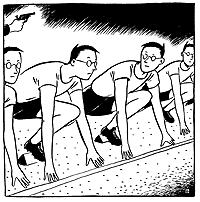
 illustration by A.J. Garces |
my brother Vinnie put it, “In this country, you’ve got 250-plus million people who can’t seem to
agree on anything, but Monday morning comes along and they all agree it’s time
to go to work.”
For all our talk of individuality, most of us get up at roughly the same time,
eat the same things for breakfast, and (as our traffic jams prove) go to work
at the same time. The demands of our employments are numbingly similar. Then we
get off work at roughly the same time, hit the same rush hour, get home at the
same time, and our homes are filled with roughly the same stuff. Eat the same
food again, have the same family fights, indulge in similar entertainments, and
the lights go out in most of our homes within an hour of each other.
As for our precious intimacies, the feelings experienced as most importantly
and uniquely our own — no matter how private our subjective sense of love may
be, humanity has been telling pretty much the same love stories the world over
for all of recorded history. Our spirituality? Every monotheist is pretty much
like every other; likewise the polytheists: and, mono or poly, the behavior of
these devotees varies little — especially when it comes to killing and
repressing each other to prove that their particular god is the true goddamn
divinity. Study any century or country you like, of any culture or race: The
implements and buzz-words may be different, but the wars are constant and the
suffering is brutally identical.
As for gender: In my lifetime, women have been heads of state in Israel,
India, Pakistan, and England, with no appreciable change in the behavior of
realpolitik. (The same was true for Cleopatra, Elizabeth I, and Catherine the
Great, to name a few.) Women in the workplace haven’t changed the rules of
work. Women now compose half the delegates to our political conventions, and
we’ve seen what an edifying difference that’s made in our political life —
none, zero, zip. Men still commit about 90% of our violent crimes, as they
always have, but all those bad boys got half their DNA from their mothers, as
they always have. And their crimes are pretty much the same in every era,
everywhere.
Every snowflake may be unique as it flutters to earth, but you’d never know
that by looking at a snow-covered field. As a writer I’ve exposed my most
private feelings and experiences, only to receive letter after letter about how
what I’ve written is exactly the same as the experience of complete strangers
with supposedly different backgrounds, different DNA, different everything.
(I’m not complaining, actually. I think that’s wonderful.)
All of which is to say: Individuality is a vastly overrated quality. There’s
really very little of it out there. I’m not saying that’s good or bad. It just
is. We are far more alike than different. Even our individual, prideful
insistence that we are so very different, is a trait we share in
common.
Looked at in this light, the whole idea of cloning seems an enormous
redundancy.
As Robert Wright wrote in Time: “My next-door neighbor — or the
average male anywhere on the globe — is a 99.9% accurate genetic copy of me.”
Contemplate that: 99.9% identical DNA between all men, and between all women.
And the difference between men and women is only a sliver less: about 99.8%
identical. In short: We begin life as virtual carbon copies of each other. And
we continue through life in much the same way. For most practical purposes,
we’re already clones.
I am not trying to minimize the importance of that tiny difference which gives
each a separate face. If I believe anything in my bones, I believe in the
sanctity of the individual. I am only pointing out that our obsessive concern
with individuality is, to put it mildly, lopsided.
I suspect that the reason we insist on our individuality so vehemently is
precisely because we are so much alike. If we didn’t stand up for our shreds of
uniqueness, we would be swamped by our inescapable sameness. Our specialness
may be tiny, so small that you can barely see it under a super-microscope, but
it gives us that sense of self without which we spiritually and emotionally
cannot bear life.
How important is the tiny? Consider this: A human being of your own gender is
99.9% your DNA clone; a human being of the opposite gender, roughly 99.8%. But
a chimpanzee — yes, any chimpanzee — is about 99.6% the clone of any human
being. We share more than 99% of our DNA with the chimps. Thus “tiny” is
so important that an infinitesimal variation is enough to determine the huge
difference between the history created by chimpanzees and the history created
by human beings.
Most of us naturally created, almost perfect clones feel revulsion, even a
kind of panic, at the idea of lab-created perfect clones. Some express their
fear as a religious objection; with most, it’s purely instinctive. One George
Annas, identified by The New York Times as “a health law professor and
ethicist” (I have yet to understand what an “ethicist” is), recently told a
Senate subcommittee that cloning a human being would be tantamount to “moral
terrorism.” If that ain’t panic, what is?
Why should natural 99.8% clones fear manufactured 100% clones? It’s not as
though the clones’ DNA would be any less human than ours. So what are we scared
of?
I suspect our panic — or, at the least, our unease — has two roots. First,
there’s the question of identity. We are so much the same, in so many ways,
that our identity as individuals is our most fragile and precious possession.
So much so, that when an individual’s identity becomes severely disrupted, the
person is considered clinically insane. That’s how big the tiny can be. For all
the fantasies of recreating Albert Einstein, and for all the ego-tripping of
the few who desire to replicate themselves, the idea of perfect duplicates —
scientifically created and controlled — is profoundly threatening to what
small shreds of identity we’ve each been able to concoct and preserve. And the
notion that our little natural identity will be left to fend for itself, while
some faceless far-off officialdom selects a favored few to be duplicated
according to standards that we can’t control — well, it’s difficult to imagine
a scenario more threatening.
But, secondly, we are also intimidated by the power of the tiny. For, in fact,
there’s no way to make an exact human clone. As a scientist friend explained to
me, DNA in embryos is very susceptible to influences. Scientists use the term
“gene expression.” You may carry a gene — say, a gene that makes you
susceptible to cancer — but it doesn’t follow that this gene will be
“expressed” or activated. The expressing of a gene depends upon factors,
influences, outside the individual. “Depending on initial conditions,” my
friend said, “there’ll be different degrees of gene expression; for instance,
people who carry the same genes don’t necessarily have the same eye color.” The
factors are so many and so variable, and the genes (especially when in embryo)
are so susceptible to influence, that the possibilities of tiny changes are
almost infinite. And, as we have seen, a tiny change can have enormous
consequences, making for entirely different outcomes.
Take identical twins — since the scientists say that cloned human beings
would be, genetically, the same as identical twins. My brothers are identical
twins; they have 100% the same DNA. Until they were teens, no one outside our
family could tell them apart. Yet as soon as they were born, right out of the
chute, they were entirely different people. Even as infants, one was aggressive
and rebellious and one was far more accepting. My scientist friend says that
this is because of their different experiences (due, he thinks, to different
positions) in the same womb.
All wombs are different; even the conditions within one woman’s womb will vary
from year to year. So a human embryo, brought to term in a different womb, is
going to be a different person, even with identical DNA. In matters of DNA, the
tiny is all-important, and even a clinically controlled womb is going to
produce tiny differences with unimaginable consequences. Most of us don’t know
the scientific particulars, but our century has shown us that science always
creates more than it intends. From every scientific development springs
something disturbing and new. Given the history of our century, we can’t be
blamed for fearing what the tiny yet enormous difference in cloned human beings
will produce.
Well. We’re going to find out. Because if it can be done, it will be done. (My
friend was enthusiastic about setting up a human cloning operation in China,
far from American restraints; he even spoke of the possibilities of cloning the
dead.) And so our small, threatened shreds of personal identity will seem
smaller still, and will surely be more threatened. We will be faced with having
to stand up for ourselves even more fiercely, in a world even more hostile to
individuality. As always, the test tubes will test us. We are weary of being
tested by technology, but that seems to be the condition and challenge of the
21st century. We have no idea where we’re going, and that is awful for so many
who don’t know who they are; who feel unique, but don’t feel their uniqueness
respected; who are so alike, yet so alone, and are so often torn apart by that
paradox.
This article appears in March 28 • 1997 and March 28 • 1997 (Cover).