

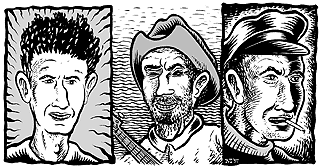
 illustration by Roy Tompkins |
the Library of Congress bought Woody Guthrie’s songbook, he sent a letter to Washington
commenting on the songs: “They’re awfully easy to sing, and you can sing them
drunk or sober, it don’t matter, just a matter of personal choice. I tried them
both ways.” He thought the House and Senate might enjoy trying a few choruses,
and why not send some lyric sheets to Capitol Hill?
He’s just telling a hayseed joke, but whatever the smart-aleck tone you know
that if somebody opened the door, Woody would’ve led the sing-along himself.
John Steinbeck ardently admired Guthrie; nevertheless, he called him “harsh
voiced and nasal,” and described “his guitar hanging like a tire iron on a
rusty rim.” This scrawny man was a hick and a sometime huckster, packing a
guitar and an attitude. He never shied from forcing a rhyme; he crammed his
lyrics into time signatures half their size or stretched them like the last
length of wire on a 30-acre fence. The Depression and a rupturing American
landscape made him a legend. And that makes him dangerous. He fits too easily
into the notion that suffering is good for you. We use his windblown face and
careful eyes like a memento: the poetic martyr who takes hard times and makes
them into art.
That’s one story anyway. Call it the Uber-Woody, the one whose broad strokes
shadow the rest: the Ramblin’ Woody, the Schoolhouse Woody, the Working Man’s
Woody, Lonely Woody, Woody with Pete Seeger & the Weavers, the Bowery
Woody, Dylan’s Woody, Yodeler Woody, Bad-Boy Woody, Patriotic Woody, Judy
Collins channeling Woody, Woody the Poetic Bum, Gospel Woody, Careless Woody,
Woody Bound for Glory. There’s plenty more, yes. Jimmy LaFave tipped his hat to
this last week on KUT’s Phil Music Show, citing Guthrie’s influence on
the new album, Road Novel.
So when Austin’s Live Oak Theatre at the State brings on “the Texas premiere”
of Woody Guthrie’s American Song, I want to know: Which Woody is this?
The answer is a cagey one. This musical revue, compiled by Peter Glazer with
text from Guthrie’s own writing, lyrically invokes all of the Woodys you can
list. If it has a preference, it’s for a Woody of the Human Spirit, a voice
that includes but transcends all the particulars of any one man’s life.
Director Allen Robertson says the show was never intended to be a life story.
“It’s a sketchy bio at best,” he says. “It’s more musical and emotional. We’re
presenting the spirit of the songs, Woody’s vision for America, and the
inspiration behind it.” Robertson, who is well-known as a music director but
wears several badges for this production, says he “never cast for a real
Woody.” Instead, Jeff Waxman’s arrangements and the dramatic frame yield
various incarnations of the artist: a Father Time figure, a Great Plains
drifter, a rowdy in New York City, a mother character, a redheaded daughter
with abiding optimism. “We’re not going for an authentic representation of what
Jungle Camp was like,” Robertson says. “We’re making reference to that image as
part of the larger picture.”
In neatly boxed segments, American Song sketches Woody Guthrie’s
passage from Okemah, Oklahoma through the Dust Bowl migration, up to the street
corners and bars of the Bowery, gesturing finally at the singer’s fatal
diagnosis with Huntington’s Disease. At the show’s end, each of three actors
delivers a line describing the symptoms of a collapsing nervous system. It’s a
blunt but effective shorthand for the 15 years that Guthrie took to die.
Woody Guthrie came to know suffering intimately, but he wasn’t born into
strain or poverty. His father had actually done well in real estate. Charley
Guthrie was prey, though, to all the bad luck of a brutal era. He built a
six-room house, a mansion by Okemah standards, then watched it burn down days
later. The growing oil boom that turned Okemah into a city ruined Charley’s
real estate career. Woody’s sister Clara died in a fire while she was ironing
next to a kerosene can. American Song includes this detail, but not
Woody’s comment that “some people said she set fire to herself, some said she
caught a-fire.” Fire, like Huntington’s Chorea, would haunt the Guthrie family:
Woody’s father died in a fire and his daughter Cathy, full sister to the famous
folk-singing Arlo, died in an apartment fire in 1946.
Maybe it’s best that for American Song Guthrie only has relations with
The People, the great corporate body that sets Ma Joad to talking to herself.
Chronicling Guthrie’s real relationships is like a synopsis of the hardest-luck
B-movie ever made. His mother died in an insane asylum in Norman, Oklahoma; two
of his children by his first marriage were killed by Huntington’s; three other
children died young in car wrecks. He was married three times — to Mary
Jennings, Marjorie Mazia, and Anneke Van Kirk, none of whom are mentioned in
American Song — and basically deserted all three wives. (In the last
case, Woody brought Anneke to live at Marjorie’s house until Anneke disappeared
and Woody himself had to be hospitalized.)
Maybe the songs were Guthrie’s way of saying, like Sasha in My Life as a
Dog, “You have to compare.” He looks around and finds people suffering on
such scale that his own pain recedes. And if he praises The People but doesn’t
always get on so well with persons, who can’t understand that? The songs do
make something different out of loneliness and despair. “I Ain’t Got No Home,”
with a hundred thousand bodies and a hundred thousand more pressing in, still
manages to lift above the crowd.
That’s why American Song can get away with so much in its soft-focus
Woody. This old-style Liberal Woody — a Pete-Seeger-meets-Barbara-Mandrell
Woody — has only the vaguest associations with organized labor, brushes off
communism with a joke, and casts the seeds of cathartic cheer like a minstrel
Johnny Appleseed. But the songs can carry just about anything. Boni Hester’s
turn in “Deportee” owes a debt to Dolly Parton as much as to Woody, but the
soaring melody and Hester’s shine-eyed intensity make some magic. It’s a warm
bit of middle-class pathos, and so what? Middle class folk is folk, too. “Let
the music come from you,” Allen Robertson has said to his actors. He wants each
person to look for an honest connection with each song, and watch for the
danger signs: “We have got to stay away from the Six Flags Revue. If you start
to feel like you’re waving through the lights and saluting the crowd, stop me.”
The show veers close to hokum at times, but usually clips by. If this
production does equal its stellar preview performances, the kudos will go to
the talented cast. Steve Fromholz serves as something of a center, but it’s a
real ensemble production, with actors playing several different instruments
each (a guitar, a mandolin, a banjo, and a dobro in Fromholz’s case) and
singing in a range of styles and keys. Billy Henry, a successful studio
musician, says, “This is the toughest kind of work. You’re singing, you’re
dancing, you’re following the blocking, you’re trying to harmonize, you’re
playing an instrument.” Henry’s brown-vested Woody was my favorite incarnation
of the three men. Gretchen Kingsley showed a professional grace that looks
easier than it must be. At a preview performance, I thought William Walden
showed a boyish charm, but he pushed too hard on opening night. Still, Walden
plays a good fiddle, so here’s hoping he’ll settle into the scene. “This show’s
only gonna get better,” Fromholz said after Friday’s show. He could be right.
However many Woodys there are out there, and regardless of how different ones
get on my nerves, the music works. By going for a vaguely Liberal Woody, one
awash in the great abstraction Humanity, you clear a space for simply grooving
with the songs. Guthrie claimed he hated songs that dwelt on suffering. A song
was a way out of suffering. The People, Guthrie knew, have little use for
academic documentations of their plight. They’re looking to get over their
suffering. In his best songs, Guthrie cites the pain and invokes the
transcendence simultaneously. He’s something of a Liberal along with everything
else.
At any rate, The People aren’t likely to flock to Live Oak. They’re in illegal
camps off South Lamar or walking the streets at 12th & Chicon. This is a
show for Austin’s progressive class. They will get what they’re looking for at
Woody Guthrie’s American Song. During rehearsal, Steve Fromholz promises
his director to earn “This Land Is Your Land” as a sing-along finale. “They’re
gonna sing or I’ll kick their ass,” Fromholz shouts. “That’s what Pete Seeger
would say,” Walden replies, then he retrieves his fiddle from stage left and
waits for the sound check. After a first round, the old familiar song turns
onto a verse I had never heard before, certainly not one we ever sang in second
grade, and one that makes a smart-aleck Woody Guthrie worth putting up with:
In the shadow of the steeple
By the relief office I saw my people
And as I stood there and watched them hungry
I thought, was this land made for you and me?
Behind those lines, The People are saying, “Damn right, Woody — `was made for
all of us.'” Believe it, keep singing.
Woody Guthrie’s American Song runs through April 20 at the State Theatre. Call
472-5143 for info.
Brett Holloway-Reeves is a freelance writer living in Austin.
This article appears in March 28 • 1997 and March 28 • 1997 (Cover).