

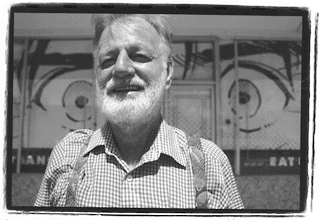
 photograph by Bruce Dye |
Butler Yeats, looking earthward from Byzantium, said, “That is no country for old men.” He
meant our country, the world of the living, pulsing with the fury and
mire of human veins. Yeats was a grand old man, but it’s hard to forget — as
he assented — that while you’re waiting for your soul to clap its hands and
sing, you have things to do. Days to get through. Muscles that spasm or do
nothing at all. Lungs that won’t fill up.
For all his readiness to sail away, though, Mr. Yeats never rushed his
departure. If anything, he wanted more than most to hold on. Not let a drop of
fury and mire get away. That’s the sweet thing about reading Yeats. You can
dredge up a tremendous energy, lean into mortality, and prolong it.
There’s an alternative, not as apocalyptic but just as romantic. You can let
things drop away. People come in, they leave. Houses, jobs, bad cars that stay
broke down, all that passes by. Four-year-olds die of cancer and wicked men
survive. You also survive. You train yourself from early on. You move and
people fade, people fade and you move.
This is the impression I get talking to Albert Huffstickler. His poems feel
that way, too. With titles like The Walking Wounded and Working on My
Death Chant, readers are forewarned. “Surely goodness and mercy will follow
me/through the streets of Austin this hallowed evening,” he writes, “with my
dead hovering near and my sink stopped up…” He’s not one to rage against
the dying of the light. No, he doesn’t feel contented exactly, but he’s not
wasting breath cursing about it. He’s doing what he’s always done, letting it
pass. Even the full-scale “Tribute to Albert Huffstickler” at this year’s
Poetry Festival, that too will pass. He says, “It’ll be nice to get a few
strokes. But then I’m gonna be ready to hole up a while,” and he sort of
smiles.
He’s sitting where he always sits, in front of the Hyde Park Bakery on Duval
and 45th. He lives in a one-bedroom apartment catty-corner to the bakery.
People pass by and say, “Hey Albert,” or if they’re feeling hip, they’ll call
him “Huff.” He’s a neighborhood fixture, the old man with suspenders and
whiskers, the poet, the solitary man whose profile is part Charles Kuralt, part
Edward Hopper, part Dennis Hopper. Jenny W., a student living in the area,
says, “I’ve never actually met him, never been introduced — I can’t remember
how I found out or guessed that old man was he…. But I can tell you it’s cool
to have a neighborhood poet. I see him walking around fairly often, sitting
outside the coffee shop across from the Fresh Plus…. I’ve also read a number
of his poems that are about sitting in front of Fresh Plus, so maybe that’s why
this sticks in my mind.”
The thing about Huffstickler is whatever you think of him, he’s not that guy.
He’s that one and several more. With his bloodshot stare and dusty skin, he
looks like he ought to be on the Drag, wheedling you for 73 cents. But he
doesn’t drink. “Maybe a beer with Mexican food.” He sampled the requisite
marijuana and mescal in the Sixties, but drugs have never been his passion and
once, under a doctor’s care, they were nearly his death.
He’s worked as a dishwasher, porno writer, and day laborer, at whatever was
necessary for shelter and food, until he started a hitch with the UT Library
system in the early Seventies. This poet of the road-trip would stay at the
university for over 20 years, but his heart still wandered. “I had trouble with
work. All my life. I didn’t like it. I had trouble with time… and my battle
with time, that meant I didn’t make much of a living. When I got on with the
Library, I made peace with the job situation, but I never really resolved it.”
He adds, a little defensively, “I used to be embarrassed about it. But kids
now, they don’t care. They just slough along, spare-changing for what they can
get. They’re not ashamed.”
Huffstickler came to Austin in 1964, hung around a while, then started
traveling. “I was writing dirty books then, little erotic novels. I did that
for several years, till the market fell out on them. I think the Women’s
Movement had something to do with that.” (In a self-portrait for Atom
Mind, he wrote, “The market was glutted.”) Churning out a book a month,
Huffstickler toured the western U.S. and Canada. His agent forwarded cashier’s
checks to the most recent address, and Huff kept going. When he got tired, he
came back to Austin.
Maybe it was his upbringing that made him so restless and yet resigned to
loneliness. He’d like to say he was born in Laredo, Texas, but writes it was
“Fort MacIntosh actually, which lay within the confines of Laredo.” His father
was career Army, fought in both World Wars, and died of cancer shortly after
WWII. Albert, his sister Martha, and his brother Jack learned quickly not to
let their roots get deep. He remembers his father as a drinker, “kind of
nauseating.” The Huffstickler kids didn’t have friends over because with Daddy
drinking, “We never knew what he was going to pull.” His mother had been an
elementary schoolteacher, but after she married she stopped working and simply
endured. The children, as they got old enough, went separate ways. Jack joined
the Air Force like their father, and like their father died in middle age.
Martha was a housewife who had little contact with her poet brother until he
had back surgery about 10 years ago and she started sending him $100 a month.
By his own admission, he’s set a pattern of failure in relationships. Both his marriages ended in
divorce and none of his lovers have remained except as memories, and those
better kept at a distance. “Can you name one of the women you’ve been with that
you’d want to get back with?” he asks. “Because I can’t think of a damned one.”
(No, I admit, I can’t either.) Huffstickler has two daughters, but doesn’t
discuss them. “Let’s don’t go that route. I was never the exemplary father.” He
was an absent father. In 10 pages of printed autobiography, he never mentions
the girls. But he dedicated his most comprehensive book, Working on My Death
Chant, to his daughter Margaret. Doesn’t that indicate some depth of
connection? “I felt like I owed her something,” he answers, closing the
subject. He doesn’t say what, and won’t say how the poems will suffice. Part of
why he writes, Huffstickler explains, is “there’s not that much in my real
history I’m that proud of. Lots of things that are nobody’s business.”
The poems, on the other hand, “They’ve been my link back to the world — of
people, things, particularly people — from that very far out vantage point
that is my base.” The poems are his real history set into type, told honestly
if somewhat selectively. The speakers are recognizable — a dishwasher in a
Flagstaff diner, a man alone in a room with a mess of paper and ashtrays — and
the other characters are always just about to fade:
I’ve loved her now
for six years.
She’s twenty-five
and I’m sixty.
I’ve never touched her.
She’s never asked.
The severed relations and bungled feelings are always vague in Huffstickler’s
rendering. It’s not clear what happened for the persona to have wound up
so insoluble. He just doesn’t mix well with other people. It’s like something
from James Wright, whose voice is more controlled but in the same tenor as
Huff’s: “I had a bad time with a woman.” That’s all a reader’s going to
get. The poet doesn’t go there.
Huffstickler’s other game with history is using the poems to dig out a history
he never had. “Being in the Army,” he says about growing up, “we were separate
from the Depression. We always had plenty to eat, a place to stay, clothes… I
realized at one point I didn’t know much about the time I grew up in.” A
self-guided reading tour ensued, yielding up poems like “How the 30s Became the
40s.” The character is standard Huff, a quiet loner in a listless love affair,
who decides post-middle-age to volunteer in the Army. Then the last lines of
the poem:
Who would have believed that, after fifteen years in the same
office,
he would die in the war,
a shell snatching off his head like wind tugging a
thistledown?
This is the sudden flash that makes up Huffstickler’s virtue. You’re coasting
through rows of harmless lines and bam! you come upon a shell snatching
off somebody’s head like wind tugging a thistledown.
Frankly, there are lots of harmless, disappointing lines in between the
explosive ones. But as someone once said about Allen Ginsberg, “He’s an old man
and he wrote too many poems. You expect some slack.” Huff throws his age around
in other ways. No young man could have written these poems — there are too
many drunk Indians and stranded women for our progressive day. I ask about the
Woman Question and Huffstickler mentions his character Hennessey, from a series
of prose sketches (The Hennessey Papers) he wrote with Marc Smith.
Hennessey drives a motley-skinned Toyota on a dead-end trip to the Pacific
Ocean. Hennessey has had a bad time with a woman. “With him,” Huffstickler
says, “it’s a question of relating to anyone at all. It happens to be about
women because they’re the ones who demand to be related to. If you don’t relate
with a man he’ll go on and say, `Fuck it.’ A woman won’t. She’s gonna make you
relate to her.”
Younger poets are like that, too. Whether they’re begging for praise, or
stomping at tradition, they’re in your face, making demands. Huffstickler, who
turned 70 last December, once introduced a reading by pronouncing, “The problem
with today’s generation is they confuse noise with passion. Passion doesn’t
have to be loud or noisy, and noise is seldom passionate.” Phil West of
Austin’s Poetry Slam Team remembers, “It was like being called out and
unintentionally praised at the same time. On one level, it’s sort of the
stereotype of the cranky guy on the stoop saying, `You kids today… in my day
we had to walk 12 miles in the snow to write poetry.’ But on another level,
it’s missing the whole point of being bombastic.” Yes, West admits, there’s a
whole lot of noise coming from barroom bards. “But to dismiss loud passion as
bad passion across the board is pretty narrow, and admits to a certain degree
that you don’t really understand what poets are doing today.”
On the other hand, there’s been a fistful of poems written about Albert
Huffstickler by younger Austin poets, eight of whom will read at the April 2
salute hosted by W. Joe Hoppe. This contingency sees Albert Huffstickler as
their elder, if still unacknowledged, statesman. He may think, “It is in the
writing, behind the scenes, that I’m most at home.” But to his adherents he is
a presence. Poetry Festival organizer Christina Sergeyevena says, “I’m so moved
when I hear him do a reading. It isn’t even so much the words as individual
words as it is the voice. There’s something in the voice. It makes me want to
write, and makes me want to see more of him.” Besides promoting the big night,
Huffstickler fans are lobbying to have the legislature name him Texas’s
official poet laureate. The book jacket for Working on My Death Chant says he already is. But that was an overzealous designer who “extrapolated” the
proclamation a few years back when Huff was named Austin’s Un-Official
laureate.
Besides, proclamations are like those little magazines that publish people’s
poetry. They send you a copy, then it’s goodbye and good luck. Huffstickler is
more interested in getting a major book deal to supplement the chapbooks he
distributes locally. He’s looking for grants (has applied for a Guggenheim and
to the NEA), and needs a few more years to live and write. He still hasn’t seen
the Grand Canyon, despite tripping around it several times, and whatever the
fallout from 70 years of human mire, he’s still watching people pass.
“Everybody who comes through the door,” he quips, “is Me in disguise.”
Before we part, Huffstickler says, “Send me some poems.” He sounds convincing, like he means it. I nod and
take a copy of the Hyde Park newsletter, Pecan Press. There is not one
but two Huff poems inside. He thinks about a woman from 50 years ago who used
to come into the diner where he waited tables:
out of nowhere Mildred appears, benignly
drunk, beckoning across the years,
“Bring me some oysters, Huff. I want
to get some lead in my pencil.” Peace,
Mildred. You’re not by yourself.
This article appears in March 28 • 1997 and March 28 • 1997 (Cover).