

TARTUFFE: LONE STAR FOLLIES
John Henry Faulk Theatre
through April 5
Running time: 2 hrs
When it comes right down to it, saying “There’s a sucker born every minute”
doesn’t cover the half of it. There may be three or nine or 60 suckers born
every minute, maybe more, ’cause the truth of it is there’s a little bit of
sucker in every one of us. Deep inside each of us is some part that wants so
badly to believe in something — the passion of a lover or the presence of
aliens among us or the promise of eternal life, something — that when
some charmer comes along and assures us of the truth in our belief, we’re
likely as not to swallow their sweet patter and even ask for more.
That was true in 17th-century Paris, France when Moli�re wrote
Tartuffe, and it’s true in 20th-century Paris, Texas, where Third Coast
Repertory Company sets its new production. As conceptual takes on classic texts
go, this one fits about as comfortably as a pair of old Wranglers, partly
because of the timelessness of Moli�re’s observations, partly because
the obstinacy of his characters — who believe what they dang well want to,
damn the facts — fits the legendary bullheadedness of Texans (see Salvage
Vanguard’s The Battle of San Jacinto), but mostly because the Third
Coast crew just wants to have some fun with the concept. In his program notes,
director Paul O’Connell alludes to the play’s archetypal characters and
commedia dell’arte spirit. He sees in it not so much a pointed stab at
hypocrisy as a broad poke at human frailty, and that’s what he gives us, Lone
Star style: a burnt orange Orgon who runs a big ranch but still clips coupons
out of the Sunday paper; an East-Tex Elmire whose fashion sense is straight
from Neiman-Marcus; a Cleante who likes a pinch between his cheek and gum as he
ponders philosophical matters; and a Dorine who sneaks Marlboros when she isn’t
straightening her employers’ house up or lives out. These Moli�re
characters spice their rhymed couplets with “fixin’ to” and “y’hear.”
Causing the royal ruckus in this ranchhouse is the sly Tartuffe, played here
as an oily Latino revivalist. In the role, Manuel Zarate makes no pretense at
subtlety — debasing himself with overwrought humility and trembling vocals —
and it’s clear why everyone but Orgon and his mom see right through this ham.
But the play still holds together because of Skip Bandy’s portrayal. His Orgon
is uncomplicated, plain, and accepting; he’s really a hound dawg of a fella —
if you tell him you’ve thrown the stick, by god, he believes you’ve thrown and
he’s off to hunt for it. We can buy his endorsement of even an over-the-top
Tartuffe like Zarate’s, plus it gives more room for outrage to Tashya
Valdevit’s sultry Elmire, Gabriel Martinez’s volcanic stepson, and Andrea
Osborn’s Dorine, whose Gallic extravagance is a hoot. (And Troy Schremmer’s
bug-eyed furtive scribbler and gregarious old coot are hoots, to boot.)
Not every European classic can survive the transplant to Texas soil, but this
one does and thrives. It makes that message that everyone’s a sucker not so
gol-durn bad. — Robert Faires
THE BATTLE OF SAN JACINTO: RIDE OF YOUR LIFE
Hyde Park Theatre
through April 5
Running Time: 1hr, 15min
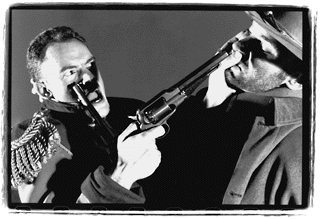 (L-R) Dan Dietz as Santa Anna, and Joseph Meissner as Sam Houston in The Battle of San Jacinto |
my face. I want to leave the show ready to puke because I have been flipped
upside-down one time too many and to know that if I hadn’t kept my hands and
feet close to my chest the whole time, they might have been snapped off by
passing machinery. Not to say that I don’t enjoy a nicely done merry-go-round,
but there is nothing like the bracing thrill of a dangerous ride.
The Battle of San Jacinto is such a beast, and it is amazing what a
change of location has done for the theatre company producing it, Salvage
Vanguard Theater. No longer forced into the Electric Lounge, Salvage Vanguard
has been able to transform Planet Theatre’s cafe into an East Texas frontier
bar, complete with tables, stools, and a house band, and to wisely use the
cafe’s myriad of structural quirks for intense effect. They have also turned
this famous Texas battle into a multimedia affair, using film, slides, and live
musicians to bring Ruth E. Margraff’s script to life.
It would appear that this new space has also invigorated director Jason
Neulander. He has orchestrated a symphony of movement, an undercurrent of actor
vocalizations, and strong visual images. Molly Rice gives a stand-out
performance as the Yellow Rose of Texas. Her Rose is powerful and compelling
while she manipulates the rank frontiersmen who have wandered into her bar. Dan
Dietz, as the opium-sucking, skirt-chasing Santa Anna, is as magnetic as Rice,
despite his gringo Spanish. Together, these two actors make this a ride for the
strong of heart.
It is not excitement without substance, however. Margraff and Neulander do
make some compelling points about the horror of this particular battle while
still producing distinct and memorable characters that comment upon our views
of the differences between the sexes. But it is not a flawless work, and some
of the dense layers of movement and text that this team has produced obscure
some of the meaning that they have fought to discover.
The roller coaster still works, even if, in some spots, you only get mere
glimpses of the scenery instead of a full picture. At all times, though, you
are complicit in this vital drama, powerless to escape being swept up in the
action. And it leaves you weak in the knees for hours after the ride has come
to a complete stop. — Adrienne Martini
ART PATTERNS: UNDILUTED BACHARDY
Austin Museum of Art
at Laguna Gloria
through April 15
 We Are All Alike (Indian Head I), 1995 by Paul Giovanopoulos |
is very pretty. Very nice. A small, carefully selected assortment of paintings,
prints, and sculpture by nationally recognized and regional artists illustrates
one of the elementary principles of design in art: pattern. The show is called
“Art Patterns.”
Pattern, according to the family gallery guide produced for the exhibition, is
the repetition of lines, shapes, colors used in works of art for different
purposes. It is the repetition of an image or motif. Paintings by the likes of
Alfred Arreguin, Bruno Andrade, Sydney Yeager, and Miriam Shapiro, and prints
by Sol Lewitt and Frank Stella are lovely to see. California artist Liza Lou’s
amazing display of ordinary objects rendered in brightly colored shiny beads
steal the show. Julia Hart, museum education associate, says that the artist
has created entire domestic environments made of beads and is currently working
on a “backyard installation” complete with beaded grass, clothesline, and
clothes. I wondered what that would have looked like inside the first floor of
the museum, walking inside a patterned environment, rather than staring at
art-swatches of pattern.
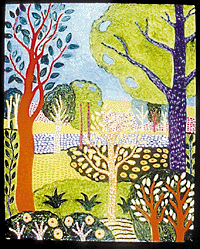 Mythic Dream, 1995 by Bruno Andrade |
been designed by a recent addition to Austin’s art community, artist Johnny
Walker. He has taken the anthropological point of view and painted the walls
with patterns from a variety of cultures. It’s fun to try to guess their
origins (which are listed to one side on the wall). He’s also included one of
nature’s familiar patterns — a butterfly — and a scientific entry — the
evolution of the universe. In this room, children can make patterned prints,
drawings, and arrange plastic objects on shelves to create patterns. Adults
seem to enjoy the hands-on activities too, and the museum staff and volunteers
don’t stop them if they want to play.
This is an exhibition for children of all ages with its formal downstairs
presentation of “real” art and its upstairs arts and crafts. And, with a nod to
the staff led by Acting Senior Curator and Curator of Education Kathryn
Davidson, I couldn’t be happier about being introduced to Liza Lou’s work, or
seeing Tony Berlant’s house, or the Al Souza cut-up comics. But…
But the show seems to dangle tentatively between being didactic and fun. In
our MTV/video/computer-laden world, pulsing with sound and light, is there more
we should be doing to pry children and mom and dad off the sofa and keep them
coming back to the museum? Are we missing opportunities to join rhythm with
pattern, to trace the patterns in our own environment (now you know why I love
Liza Lou), to literally taste and touch and hear and wallow in design? I
don’t know. It’s just a question that came to me as I walked out quietly past
the signage for the exhibition — an exploded version of Laurel Butler’s
delicate leaves and swirls — and through the patterned gates.
— Rebecca S. Cohen
This article appears in March 28 • 1997 and March 28 • 1997 (Cover).