

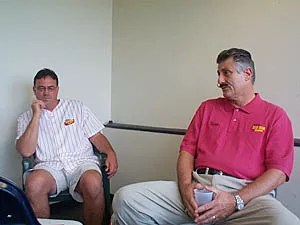
[Editor’s note: This interview originally ran in our Community Listings section on Aug., 13, 2004 but was not archived. Now that we have our new sports blog it finally has a home. Enjoy.]
The Austin Chronicle was fortunate enough to get a chance to speak with Hall of Fame baseball player Rollie Fingers during his recent visit to the Dell Diamond. Fingers was in town as part of the Rolaids Bat and Win $10,000 Game where lucky Round Rock resident Sean Young faced three pitches from Fingers with the opportunity to win $10,000. Young hit a solid single to center but whiffed on the other pitches, walking away with a cool grand.
Austin Chronicle: Sean, how did you come about this opportunity today?
Sean Young: It was actually just a promotion they were doing down here; my son and I just got out of the gift shop, and we saw the box and he mentioned to me we should sign up for it to win $10,000 and to hit against this guy.
AC: And you won!
SY: And I won … yeah.
AC: Have you been hitting the batting cages?
SY: I hit a little bit today but I haven’t been doing all that much just because I’ve been travelling quite a bit, but hopefully it’ll be enough.
AC: Have you played much baseball?
SY: I played up until about my sophomore year in high school; then I just concentrated on primarily basketball.
AC: Rollie, I’ve got a couple questions for you. First up, what are your thoughts on the designated hitter?
Rollie Fingers: I’m not real crazy about it, I signed as an outfielder so I enjoyed hitting, I had an opportunity to hit from 1968 to 1972 and I got a few hits, a couple home runs in the big leagues, and when they put the DH in that kinda took the wind out of me cuz I wanted to hit. I went to San Diego as a free agent in the National League so I got to hit for four years, which was great. Then I went back to the American League and I had to finish out with the Brewers and the DH but I’m not a real big fan of the DH. I think it takes a lot away from the game as far as managing goes.
AC: It’s a whole different style of play really.
RF: Oh yeah, it makes managing a lot easier when you don’t have to juggle that pitching staff around.
AC: What are feelings on the roles of the relief pitcher today as opposed to when you were playing?
RF: It’s a lot different; now it’s more specialized. Nowadays they are grooming guys in the minor leagues to become closers. When I came up I came up as a starting pitcher and went to the bullpen and that is more or less how it was. Nowadays you got your long man, you got your set-up man, and you got your closer. When I was playing I was all three. I’d come in in the fifth inning, the sixth inning and pitch three or four innings to get a save. Nowadays your closer only has to pitch one inning; a lot of times it’s a three to nothing lead or a four to one lead in the ninth inning with nobody on base. These guys today don’t come into situations where the games on the line, ya know, a couple guys on base, one out, a one-run lead. They don’t have that. They usually come in with a situation where there’s nobody on base at the start of an inning, very seldom will come in the middle of an inning. So it’s a lot different.
AC: You did pitch a lot more innings per year than maybe the contemporary closer. Did you have a different regimen?
RF: No, I just had the type of arm where I could go out and throw everyday. I pitched seven straight ball games at one point.
AC: Oh, really.
RF: That was going two, three innings at a time. I just had that type of an arm. I enjoyed the work. I needed a lot of work to stay sharp. If I laid off a long period of time or only threw one inning maybe in a week or so, I wouldn’t be sharp. So I needed a lot of work. That’s why I enjoyed throwing a lot of innings.
AC: It was beneficial for you to pitch a lot.
RF: Oh yeah. You were always stronger and the control will go down if you don’t get out and throw more. I was more of a control pitcher. I mean I threw the ball hard; I threw the ball in the nineties, but I relied more on control than anything else because of the situations I came in. I couldn’t afford to be falling behind hitters, walking hitters, and hitting hitters, so I had to know where I was throwing the ball.
AC: Do you think Eric Gagne’s save streak is an unbreakable record?
RF: Um, no, not really. Not the way they do it today. It’s possible. I know it never would have happened when I played simply because he would have been coming into situations … if he was a closer in the Seventies he’d be coming into ball games in the sixth inning, the seventh inning with two guys on and you’re not gonna go out there 80 some times and do the job. I mean you’re lucky to get 10, 15 saves in a row back then because the game situations you come in. I don’t want to take away from his record. To go out there that many times and do the job even if you got a three-run lead and pitching one inning in a night, it’s still 80-some saves. But for it to be broken, yeah, I think that one’s possible.
AC: What’s your opinion on Pete Rose getting into the Hall of Fame?
RF: I don’t think it’ll ever happen. If he would have admitted what he did when he did it they may have slapped him on the wrists and said don’t do it again, and that would have been the end of it. But he kept lying and lying. And you know Pete, he’s still continuing to gamble and he doesn’t want to get away from it, so he’s his own worst enemy. When you throw the words “gambling” and “baseball” together they don’t mix. Even if he were to be eligible to go in, I don’t think there’s enough sportswriters out there that would vote for him right now. Simply because of the fact that he did gamble not only while he was managing but while he was playing.
AC: How about Goose Gossage, do you think he deserves to be in the Hall of Fame?
RF: I think he belongs in the Hall of Fame. Bruce Sutter, both these guys pitched during the same era that I did. They got over 300 saves. They were the type of pitcher that went out and did the same thing I did. Pitched three or four innings to get a save. And they were both dominant at their positions during the times they played. They didn’t have a short career, they had a long career. Goose pitched over 20 years. Sutter probably pitched 17, 18 years just like I did. They are both deserving to go in.
AC: Do you feel that major league baseball needs a salary cap?
RF: [Laughs] I think they need something. Revenue sharing, whatever. They do need something. It’s tough for a lot of the smaller market ball clubs to compete. Especially with your George Steinbrenners and your Ted Turners. They got all that TV money from their own TV. It’s tough for a Pittsburgh or a Milwaukee or Kansas City to compete with these guys because of that. They’re gonna get the best players. They don’t care what it costs. They want that World Series trophy in their office, and they don’t care what they spend to get it. I think they definitely need something, but I don’t know if a cap is it. I think they need to do more revenue sharing.
AC: What do you like to do in your free time now?
RF: Play golf. Play with my kids. I don’t wanna punch any more clocks …
AC: Strike this guy out?
RF: [Laughs] Nah, I want him to hit it. I’m gonna try and hit his bat if I can.
AC: So you got your scouting report?
SY: He’s got a nasty slider.
RF: I struck out too many guys, I hit too many guys. I don’t need to do any more of that.
AC: So, do you have any predictions on this year’s World Series?
RF: I always look right around the first of September to see what ball club has the healthiest pitching staff. That’s what’s gonna win in September. The healthiest pitching staff. If Oakland can get their stuff together they’ve got a pretty good pitching staff. St. Louis, the Cubs got a good pitching staff if they can stay healthy. I think one of those three teams right there. I think St. Louis has probably got the best ballclub out there.
AC: Who would you like to see win the World Series?
RF: I’d like to see Oakland.
This article appears in August 13 • 2004.