




|
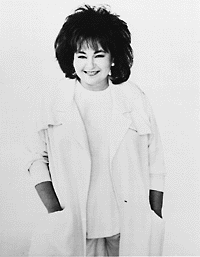
Rosanne in 1989’s She-Devil, one of her few forays into film. |
lingered until Memorial Day but the collective breath of relief from TV-watching
audiences: The annual May sweeps are over. Nowhere was that more evident than in the
most recent Nielsen ratings, which demonstrated that the NBA Finals dominated and summer
doldrums began with a battery of re-runs.
For some of May’s season finales, it was a series finale. That would
include ABC’s Roseanne, whose closer left more than a few die-hard viewers cold and
unsatisfied. If you followed the finale for the 1995-96 season, Dan Conner (John Goodman)
suffered a heart attack. In this finale, after a sequence of strange little scenes
spoofing old TV shows, the entire 1996-97 season was revealed to be a dream sequence.
Dan, you see, really did die last year, and aspiring writer Roseanne invented an
alternate world for herself and her family. At the end, the star stepped out of the
action, and Roseanne began a rambling monologue about the spiritual power of being a
woman. The point of it completely eluded me.
The show itself had lost me long ago. Like CBS’s Murphy Brown, this
once-vibrant series had overstayed its welcome. It wasn’t the name changes of the star, it
wasn’t her questionable propensity to go public with every aspect of her life, and
it certainly wasn’t for lack of general talent that the show’s bright light faded.
John Goodman and Roseanne (first Barr then Arnold then solo) once made a
great TV couple. Dan Conner was Ralph Kramden without the misogyny, a husband with
dreams and aspirations but a well-rooted sense of the limitations of his life.
Roseanne Conner was unlike any TV mom before her. As she and Dan faced economic and
personal upheaval, the adolescence and maturation of their children, and other
stumbling blocks in life, it wasn’t an underlying commitment to some great ideal that kept
them together, it was their sense of responsibility to their children and to each other that
made them characters worthy of respect.
This seems to be a much loftier aspiration for a series than the
dumbed-down fare generally offered up by the networks or the Touched by an Angel-type
shows that are so often touted when the subject of family viewing and setting good
examples for children comes up. It’s true that Roseanne lost me as a viewer
around the time she started waitressing, not long after the Becky-switch of
actresses playing her oldest daughter occured. (Was I the only Sixties viewer psychicly scarred
by the lack of explanation in the Darrin Stephens-switch on
Bewitched?)
Even if Roseanne lost its impetus long ago, it still maintained its
moments, and without being a regular viewer, I still tuned in over the years just to
check in with the family that now felt like neighbors you were glad you moved away
from but missed because they were so entertainingly disruptive. John Goodman will
do well in his film career to find a role with as much heart as Dan Conner. Of the
actors playing their kids, Sara Gilbert (Darlene) emerged as the one to watch
(though don’t look to Poison Ivy for indicators). Even the co-stars on the show were
notable: the marvelous Laurie Metcalf as Roseanne’s sister Jackie; Sandra Bernhard’s
overbearing performance as Roseanne’s friend Nancy; a pre-ER George Clooney as
Jackie’s lecherous boss; Sixties blues-rock belter Bonnie (Bramlett) Sheridan’s
stepping into a waitress uniform one season; Tom Arnold’s brief turn as a friend of Dan’s
during his equally brief marriage to the star; Estelle Parsons as Roseanne’s acerbic
mother; and Martin Mull as the gay boss of the restaurant where Roseanne worked. This
was a show that once had magic.
Some of that magic lives in re-runs. We forget about that sometimes
because reruns seem so secondary — viewing afterthoughts. But sometimes the true test of a
TV show’s durability lies in its re-runs. It’s hard to offer a defense for the
popularity of a flatulent series like Saved by The Bell but the charm and brilliance
of The Mary Tyler Moore Show seems eternal. (Will Saved By The
Bell create the same kind of fashion nostalgia for the Nineties on Nick at Night in 20
years that Rhoda now does on the network for the Seventies?)
Last week, I wrote about the pleasure of watching TV with friends, and the
kind of bonding it creates during a show’s lifespan. I will forever associate
L.A. Law with my best friend E.A. Not only did we watch it religiously, we
once rented a VCR for our room at the Hyatt during one SXSW to watch it on tape because
while we were too busy seeing Dash Rip Rock to watch it live, we had to see it
before the night was over. It was the episode in which Rosalind Shays (Diana Mulder)
plunged to her death. E.A. and I had a huge fight over the phone during the last
episode of the series but its impact was already in place: E.A. was in law school and
is now a practicing attorney.
Televison shows become our good friends, too. If we’re obsessive enough,
we’ll tape all the episodes and watch some over and over again. They become our own
little schedules of re-runs, there at a moment’s notice. If you’re sappy like me,
the Christmas episode of My So-Called Life still rates 3 hankies after repeated
viewings. When the WJM gang sings “It’s a Long Way to Tipperary” on the last
episode of Mary Tyler Moore, I sing too. In fact, that’s where I learned the
words. (Murphy Brown could take a cue from MTM on graceful exits.) Newhart
was another brilliantly conceived finale, wickedly skewering the whole dream
sequence clich� with the best, most original flourish yet. Roseanne
deserved something better, something more thoughtful.
Fan Mail from Debbie Smith sends me running to
http://www.inquisitor.com/90210/ for a peek at this delightful, detailed, and lovingly mean website dedicated
to Beverly Hills 90210. Sample quote from the final synopsis: “I don’t think I
have ever in my 20 years of watching soap operas seen anything as ridiculous
as Valerie, standing on the bluffs outside the hotel, with a cellular phone in
her hand, leaving a suicide voicemail message for her mother!” Amen! And
see you at the Peach Pit next season, Debbie!
This article appears in June 6 • 1997 and June 6 • 1997 (Cover).