

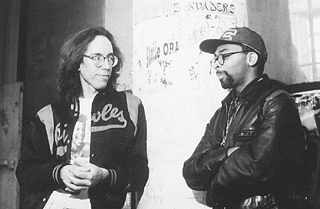
 John Pierson talks with Spike Lee |
friend of mine called last Saturday night to ask if I could settle a film question that was bugging
another friend of his. This friend of my friend had just finished watching a
videotape of Fargo and, having dutifully read the tag at the beginning
of the Coen Brothers film that identifies the story as being based on true
events, my friend’s friend felt righteously ripped-off when the closing credits
claimed in standard legalese that no similarities to actual persons or events
were intended. “What’s up with that?” they indignantly wanted to know.
It just so happened that they couldn’t have posed a more timely question. I
was armed with juicy info and ready to expound. Had the call come only a few
hours earlier, my response would have been quite different. But because I had
watched, that very afternoon, a preview cassette of the first episode of John
Pierson’s new television show Split Screen, I turned out to be
well-versed on the subject. The Coen Brothers conundrum is one of the first
topics investigated by Split Screen.
Written, produced, and hosted by Pierson, Split Screen is a
half-hour-long magazine-format show about the world of independent film.
Pierson describes the show’s mission in the initial prologue: an exploration of
“the art, the heart, and the enterprise of the American independent film.”
While spotlighting the work of both known and unknown filmmakers, the program
is also marked by its playful irreverence and Pierson’s widely recognized
talent for debunking myths and half-truths. Pierson is quick to point out that
the show is “not just about the indie film world. It’s also meant to suggest
what’s entertaining about that world.”
John Pierson should know. He has been one of the essential players in the
ground swell of American independent filmmaking over the last dozen years.
During that time, he has served as a producer’s representative and/or provided
completion funds for at least a couple dozen key indie film projects, amongst
them She’s Gotta Have It, Working Girls, The Thin Blue
Line, Slacker, Roger & Me, Laws of Gravity, Go
Fish, Clerks, and Crumb. He is also the executive producer of
Kevin Smith’s soon-to-be-released romantic comedy Chasing Amy. His track
record, acumen, and perspective are exceptional. Last year he published
Spike, Mike, Slackers & Dykes: A Guided Tour Across a Decade of
Independent Cinema (Hyperion), an anecdotal and entertaining account of his
experiences in the indie film world that nevertheless analyzes and distills
much of what he has learned about the business along the way. Never one to pull
his punches, Entertainment Weekly recently described Pierson’s book as a
record of the “nuts, bolts, and screwings” that go on behind the scenes. The
paperback edition of Spike, Mike was just released in January. (This
weekend, Pierson will be in Austin as a SXSW Film Conference panelist.)
Pierson’s irreverent attitude and genuine passion for film spills over into
Split Screen. Perhaps it’s not coincidental that the show has something
of the impertinent flavor of TV Nation, the short-lived weekly
television zine ringmastered by Pierson’s old Roger & Me cohort
Michael Moore (the Mike in Spike, Mike, Slackers & Dykes). Split
Screen‘s “The Real Fargo” episode is a good example of that approach:
sending a filmmaker to Brainerd, Minnesota to ferret out the truth about the
conflicting Coen Brothers’ assertions. There’s also a touch of Pee-wee’s
Playhouse to the show. We get to tour Pierson’s office, view his souvenirs,
and meet his mailman Bob, the real carrier who delivers Pierson’s daily load of
films and tapes and becomes a weekly “regular” on the show. To film some of
these segments, Pierson turns to a cadre of young and little-known filmmakers
scattered throughout the country.
The show also includes interviews with well-recognized filmmakers. The first
episode of Split Screen begins with a reflective conversation between
Pierson and Spike Lee, recorded a couple of years ago on the street in front of
what used to be the Bleeker Street Cinema, the New York City arthouse where the
two used to work in the Seventies and first met. The absolute highlight of the
opening episode is “The Gruesome Twosome” segment, a funny and incisive
dialogue between John Waters and gore maestro Herschell Gordon Lewis in which
the two shockhounds compare notes on how to excite audiences and circumvent
censors.
In Episode Two, Pierson follows around Richard Linklater and Eric Bogosian for
the eight hours before, during, and after the world premiere of subUrbia at last fall’s New York Film Festival. It also includes a clip from Linklater’s
first feature film, It’s Impossible to Learn to Plow by Reading Books,
shot on Super-8. Yet another upcoming episode has Pierson joining filmmaker
Kevin Smith to host the show from the New Jersey Quick Stop made famous by
Smith’s Clerks.
“The whole idea,” says Pierson, “is to get people like Wyre Martin, a
Minnesota filmmaker who made that Fargo piece and have him do the story
locally, and to have P.H. O’Brien — you know, the car crash kid [the show
“mascot” who tells of intentionally wrecking his car to collect the insurance
money to finance his film] — he did this brilliant Errol Morris-type story in
North Redding, Massachusetts where they want to build this film studio, and
then Brian Flemming does the “Screenwriting: An Exact Science” piece. That, to
me, is why the show exists. Not to do Spike and Rick. I mean, that’s good too.
But I love these other pieces. I keep thinking it’s like those NEA regional
grants that went away.”
It seems as though Pierson is continuing to do what he does best: creating
opportunities for talented filmmakers from the margins and barbecuing some of
the indie film world’s most sacred cows. Along the way, Pierson hopes that “we
can use this kind of material as a jumping-off point to make this whole world
interesting and accessible and fun and entertaining.”
So, if finding out the truth about the truth of Fargo is the kind of
thing that gets you going, either watch the show yourself or phone up a friend
of a friend. Odds are, the friend will be watching.
Split Screen’s initial run of six shows will air Mondays at 7pm on the
Independent Film Channel (beginning March 10) and repeat on the IFC’s sister
station Bravo on Fridays at 9:40pm (beginning March 14) as part of Bravo’s “IFC
Fridays” lineup.
This article appears in March 7 • 1997 and March 7 • 1997 (Cover).
