

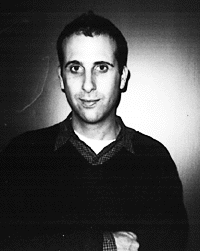
 Tim Perell |
1990, when I lived in New York, my college buddy Tim Perell and I spent a lot of time at the
movies. Every Sunday afternoon, in fact, we would walk downtown to the Angelika
Film Center — kind of like the Village Cinema, only with better food and
snootier ticket-takers — and take in whatever independent film was playing.
That year we saw, among other flicks, Mystery Train, Drugstore
Cowboy, Longtime Companion, Black Rain, Last Exit to
Brooklyn, The Unbelievable Truth, Henry: Portrait of a Serial
Killer, After Dark, My Sweet, The Cook, the Thief, His Wife &
Her Lover, and, our favorite of all, Bail Jumper. “Totally
excellent,” Tim recalled when we talked recently, reminding me that Martha
Plimpton sat in the row ahead of us, gabbing with a friend.
For me, the movies were an avocation, but for Tim they were a vocation — or
would soon be. Back then, he was a fledgling A&R scout for Warner Bros.
Records, but over the next four years he would work for indie film guru John
Pierson’s completion fund, Islet, on films such as Just Another Girl on the
I.R.T.; earn a Master’s degree at the Royal College of Art in London, where
he produced seven shorts, including the last film made by Derek Jarman; and
read for Miramax, recommending, among other green-lightable projects, a script
based on a little-known novel called The English Patient and the Stevie
Ray Vaughan bio Caught in the Crossfire by Joe Nick Patoski and Bill
Crawford (whose option was recently picked up by the studio for a second time).
Then, in early 1995, Perell co-founded Eureka Pictures, and, ever since, he’s
produced low-budget indies of the sort Hollywood has taken to co-opting. To
date, his films include: The Myth of Fingerprints, which debuted at this
year’s Sundance Film Festival and opens across the country in September; the
forthcoming Louis and Frank, directed by Alexandre Rockwell and starring
Rosie Perez, Steve Buscemi, and Tony Curtis; and Breathing Room, a
romantic comedy that opens Friday at the Texas Union Theatre.
Actors act and directors direct, but what exactly does it mean to be a
producer these days? “Every one does something different,” Perell says. “Me,
I’ll work with a writer-director” — he prefers to work only with
writer-directors — “on developing a script. They’ll write a draft, give it to
me, and we’ll meet extensively for up to a year to discuss it. Then I’ll raise
money — I’ll find investors and structure the deal. Then I do casting, I see
dozens of cinematographers and costume people, I hire a crew, etc. The creative
impact comes through the choices you make. Then I turn around and do the deals
with the actors’ agents. That’s my favorite part of making a movie these days
— the deals are so detailed and the agents are so aggressive that it becomes a
lot of fun. My least favorite part is the actual making of the movie — when
you’re actually shooting it. It becomes about problem-solving, juggling the
egos of the cast and crew, staying on budget. It’s incredibly demanding
physically. But then everyone goes away and you get back to the good stuff,
like editing, finding a composer. Then I spend, like, every day for months
yelling and screaming at the distributor: They’re not spending enough money,
the ads are all wrong, the theatres the film is showing in are all wrong. It
never stops.”
In the case of Breathing Room, for instance, Perell and director Jon
Sherman spent the spring and summer of 1994 working together on the script.
Then Perell and his partner, Howard Bernstein, put together a prospectus for
investors. “We knew it would be a low-budget film, so the odds were stacked
against us,” he says. “About 400 films of this size and scope are made every
year, and only about 20 or 30 see the light of day. It’s idiocy or hubris to go
ahead. All you can do is find enough money to start shooting and then keep
raising money.” When it came time to hire a crew, Perell focused on people who
would accept “step-up work” — who would work for little or no money in
exchange for experience: For his casting directors, he hired two young women
who worked as assistants to other casting directors, meaning they knew every
agent and actor in New York.
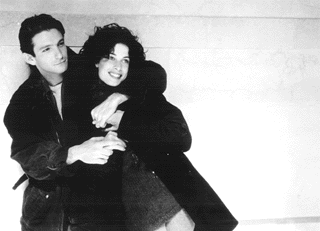 Dan Futterman and Susan Floyd in Breathing Room |
stars or any of the indie staples,” Perell says. “No Parker Posey, no Martin
Donovan, no Adrienne Shelly — not because we didn’t value them as actors, but
because we wanted fresh faces. We wanted the film to feel very real and
honest.” After spending three to four months auditioning “every great New York
actor” for the male lead, Perell settled on Dan Futterman, who was then in the
Broadway company of Angels in America and, later, was cast by Mike
Nichols as Robin Williams’ son in The Birdcage. For the female lead,
Perell quickly narrowed his choices down to three. One was Calista Flockhart,
an experienced actress who had questionable chemistry with Futterman — yet the
pairing was not that far-fetched, for Nichols eventually cast her to play
Futterman’s fianc�e in The Birdcage. By contrast, the actress
Perell ended up hiring, Susan Floyd, had less experience but instant chemistry
with Futterman; in fact, they fell in love while making the film.
Breathing Room was shot in 1995 — but during editing the production
ran out of money. Perell called his old friend John Pierson, who was with
Miramax at the time, but the studio had just released Pulp Fiction and
was heading in a star-driven indie film direction, so he couldn’t do a deal.
Before too long, however, Perell convinced his executive producer to come up
with more money, and he hired a crackerjack sales agent (the veteran indie
producer James Schamus of Good Machine). Still, things didn’t go as planned.
Although Perell and the filmmakers heard Breathing Room was going to be
shown at Sundance, it didn’t make the cut. “We were devastated,” he says. “Our
entire sales strategy revolved around Sundance, which now is the only place to
go to sell a small movie.”
Breathing Room eventually found a home at Arrow Pictures, the tiny
distributor that handled My Life’s in Turnaround and the Jim
Jarmusch-Sam Fuller documentary Tigrero: A Film That Was Never Made, and
it received generally good reviews following its limited release last fall…
before, ironically, it was pushed off arthouse screens by The English
Patient. But Tim Perell’s not complaining; for an up-and-coming producer,
release is all you can ask for. “My objective is to return money to the
investors,” he says, “but it’s as important to be one of the 20 or 30
independents that get out there — so you get to make more films. Anyway, we
had a great opening weekend at the Angelika. It was a tremendous thrill.” n
Breathing Room opens at the Texas Union Theatre Friday, Feb. 28
and plays at different times daily through Sunday, March 9. Check “Showtimes”
this issue or call 475-6666 for schedule. Co-producers Tim Perell and Howard
Bernstein and director/ co-writer Jon Sherman will all be on hand to introduce
the film Friday, Feb. 28 at 7pm and conduct a brief Q&A following the
screening.
Evan Smith is the deputy editor of Texas Monthly
This article appears in February 28 • 1997 and February 28 • 1997 (Cover).