

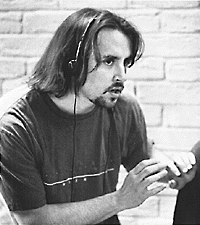
 Richard Linklater |
which, by that unspecified future date, will certainly be associated with
dozens more movies and other projects), they will all cite subUrbia —
the new Linklater film opening in Austin this Friday — as a transitional key.
In terms of working methods and subject matter, Linklater’s fifth feature film
represents something of a departure from his previous work.
subUrbia marks the first time that Linklater has directed a movie whose
story and script he did not originate himself. The screenplay was written by
Eric Bogosian, who adapted from his own stage play this story about a long
night in the life of a group of 20-year-olds who hang out in a convenience
store parking lot. On the surface, a match-up between the sensibilities of
Bogosian and Linklater is not a union that would strike anyone but the men
involved as obvious. Bogosian’s dark vision of the vile behavior of which human
beings are capable seems an odd mix for Linklater’s more humanist world view in
which every character has his or her reasons for acting as they do.
Additionally, bringing subUrbia to the screen presented Linklater with
another first-time creative hurdle: how to adapt for film a work that was
conceived for another artistic medium. Now, not only were the words originating
with someone else, but also the staging and set-pieces needed to be rethought
for their conversion from stage to film. It’s in this regard that Linklater’s
contributions to Bogosian’s screenplay adaptation are, no doubt, the most
telling.
Another first for Linklater in the making of subUrbia was the need to
commission music written specifically for placement in the movie. As in every
Linklater film, music plays a large part in subUrbia. But this time, the
director had more to do than select appropriate songs from already existent
work. New music had to be scored specifically for the movie and Linklater can
now also include among his collaborators the members of Sonic Youth, who
composed three new songs for the movie.
However, in addition to the series of Linklater “firsts” that subUrbia embodies, those previously mentioned future historians will also, undoubtedly,
be struck by the consistency of Linklater motifs evident throughout
subUrbia. Ingredients that have been key throughout his career thus far
— the tight ensemble work of young actors; the importance of time as a central
narrative structure; and the strong sense of place (although in this case, the
place is a more generalized concept, such as Suburbia, USA, than a specific
city) — all remain central organizing principles in subUrbia.
Linklater’s relationship with Bogosian goes back a while. By all accounts, the
two have had a mutual admiration society going for quite some time. On the
occasion of Bogosian’s Austin premiere of his one-act play, Wake Up &
Smell the Coffee, Linklater conducted a lengthy one-on-one interview for
The Austin Chronicle (Nov. 3, 1995). Last year, when pre-production work
stalled on Linklater’s film, The Newton Boys (a historical tale about a
gang of Texas bank robbers, which is currently set to begin shooting in a
couple of months), the timing became right for Linklater and Bogosian to mount
subUrbia. The lessons Linklater learned from the collaborative process
will, no doubt, carry over into The Newton Boys.
“Some of our favorite films are obviously not written by the person who
directed it,” Linklater reminds us by way of explaining how the collaboration
between himself and Bogosian began. “And yet a Taxi Driver, or
some Nicholas Ray movie, like In a Lonely Place, seems so personal or
obsessive or whatever. When I saw subUrbia on stage, I started having
those feelings inside me. I saw it as a film, and I felt I knew the characters,
or I was the characters. It really dredged up all this stuff in me that
never went away. So I was like, `Okay, this is how this works!’ You find your
way into something.
“Like the way I feel about Newton Boys, too. From the first time I read
this article about them in The Smithsonian, I was like, `This is my
story to tell.’ It’s inside you trying to get out. So it was fun doing that.
And Eric was really great. When I first came aboard when it worked out that we
were making a film, he was already working on it as a screenplay. He thought it
could be a film, too, and it was kind of half a play, half a film at that
point. Then I came aboard and worked on it with him. A lot of it was editing
and technical… the play would have been a three-hour movie. So it was cutting
it down and picking where we could get on with it. Still, it’s two hours, so
it’s plenty long.”
As for the specifics of their working relationship, Linklater continues, “We
got along fabulously. We never argued about anything. People think, `Oh, you
and Eric, you’re probably so different. He’s this really blowhard, tough-guy
kind of thing and you’re this laid-back dude.’ And I’m like, `Nah… actually,
we sort of meet in the middle.’ Like, I’m probably a little more scary than I
come off, and Eric’s actually this really sweet, sensitive artist dude. He’s a
great actor and he plays these heavies and these blowhard kinds of guys but at
the end of the day, he’s kind of a moralist. Eric is trying to have people
treat each other better and right the social ills. He really wants to right
wrongs and things like that, much more than I care about in certain character
ways.”
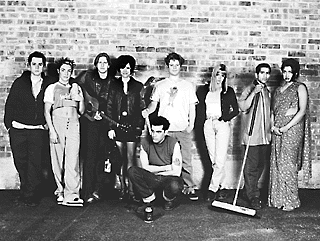 The cast of subUrbia |
his other films. “A little bit… little bit,” he begrudges. “But I feel all
that,” he continues defensively. “There are really a lot of dark shadings to a
lot of my stuff. Dazed isn’t just this light, fuckin’ teen comedy.
People are beating each other. There’s a lot of abuse. It’s sad. Mitch [Wiley
Wiggins] becomes a little teenage boy jerk by the end. So those dark shadings
are definitely a part of me.”
While Linklater convincingly argues examples, none of them compares with
subUrbia‘s pervasive darkness on the edge of town. Interestingly, that
ability to explore the other side is what Linklater has discovered to be the
primary benefit of creative partnership. “I think that’s what collaborators do.
Like Eric. They push you in directions that might not be your first impulse.
They take you where you obviously want to go, but you just need some help
taking the plunge. It’s as if they’re on the other side beckoning, `C’mon,
you’ve got to go; you’ll like it.'”
Comic elements mix with the tragic in subUrbia. Ultimately, Linklater
says that he doesn’t regard the film as a complete tragedy because “life goes
on. [The characters] could be OK, and they’re 20 — this isn’t the end
of the world for them. I was really fucked up at 20, just like they are. You
kind of find your footing, make your life, and maybe you can get it together…
and I think a large percentage of them will.
“People think Tim [Nicky Katt] is the bad guy,” he observes, “but to me it’s
Buff [Steve Zahn]. The court jester was the most scary because he was this
breed of complete amorality. He had no empathy. Zero awareness. And yet people
come out of the movie saying, `Oh, he’s my favorite character,’ and I say
`Really? Do you think when he hears what happened to Bee-Bee [Dina Spybey],
will it cross his mind that maybe he had something to do with it?’ Certainly
the character doesn’t think so but it concerns me that audiences don’t think so
either. And I have that close-up of Bee-Bee looking at him flirting with Erica
[Parker Posey]. I couldn’t be more explicit about that. And that’s another
thing you can do in a film that you can’t do in a play: You can really define
these relations and thus Bee-Bee can be that much deeper as a character.”
As far as subUrbia being yet another Linklater film about disaffected
youth, the director swears, “This one’s the nail in the coffin. This was my
final one in what I call my `hangin’ out quintet’ — my first five films. This
was a good one to end with because it’s a good transition and I like the final
kind of tragic elements. It was a good one to go out on. I think I’ve covered a
pretty thorough bit of my own personal experience through these in a sort of
realistic way.”
One aspect of Linklater’s career that’s likely to remain consistent through
the years is his remarkable ability to draw fine ensemble performances from
young, relatively unknown actors. Recently, the director has been recognized
for launching the careers of overnight celebrities Matthew McConaughey and
Ren�e Zellweger, both of whom appeared in Dazed and Confused. The
ensemble work in subUrbia is certain to further Linklater’s reputation
as an actors’ director. Already, Amie Carey, who makes her feature film debut
in subUrbia, can be seen weekly on TV’s Chicago Hope and other
cast members are poised to break out.
“The rep?” Linklater laughs when asked for his thoughts. “It’s just, I’ve been
lucky to create these showcases for young actors. There’s a lot of talent out
there, there’s always talent out there, and I just use some of those people.
But I didn’t create them. I’ve provided a showcase for some people to show
their chops. But that’s fun. There’s not quite enough opportunity for young
people. They’re out there regionally too. That’s what’s kind of cool about
what’s going on with Matthew and people like Ren�e and others. It’s good
to have those reminders that great actors can come from anywhere and indeed are
out there. And if there’s any benefit to that, it’s when people come to make a
movie in Austin, they’ll do more casting here. Instead of bringing in their
whole cast.
“We’re casting Newton Boys now,” offers Linklater as a means of
illustration. “I just met 20 actors who blew me away today. They’re great.
We’ve got our main brothers but then everything else, it’s all pretty much cast
from Texas. People in L.A. think you just can’t do anything outside of there.
Like, how would you edit? C’mon, man. We’re finishing films here. We’re
doing everything. We’re way ahead. Unfortunately, we still need their money.
There are no real financing entities here in Texas that are going to give you a
few million bucks to make a movie. It’s kind of sad.
“I’ve been telling people this every chance I get: Hey, great people are
making films (of course people are always going to make films), but what’s
wrong with the independent film world is that there are not any new
distributors, and there are not any new theatre chains.” He offers the
following illustration. “Say you’re a rich kid from NYU and you’re 25. Instead
of taking $400,000 and making a film that you’re not really ready to make and
won’t get into Sundance anyway, why not take that money and start a company? If
you just want to be in the film business but you’re not really a filmmaker,
start a Miramax. Everybody wants to be Quentin; why don’t they want to be
Harvey Weinstein [Miramax chief]? He’s the one writing all the checks.”
When it’s suggested that the business end is not where the romance of
filmmaking lies, Linklater passionately argues, “It should be. Believe me,
those guys have got the life, man. They make so much more money. They’ve got
everyone kissing their feet. And they get to go to all the festivals, and get
to hang out. Whatever the glamour thing is, distribution has all that. That’s a
given.”
And that’s another quality that remains consistent throughout Linklater’s
career: his attention to the infrastructure. Whether he’s founding a local
treasure like the Austin Film Society, establishing the Texas Filmmakers’
Production Fund (which impressively gave away $30,000 in grants to filmmakers
during its first year of operation), or arguing for alternative channels of
distribution and exhibition, Linklater understands that the act of going out
and making movies is just one of the numerous pieces of the puzzle.
This article appears in February 21 • 1997 and February 21 • 1997 (Cover).
