

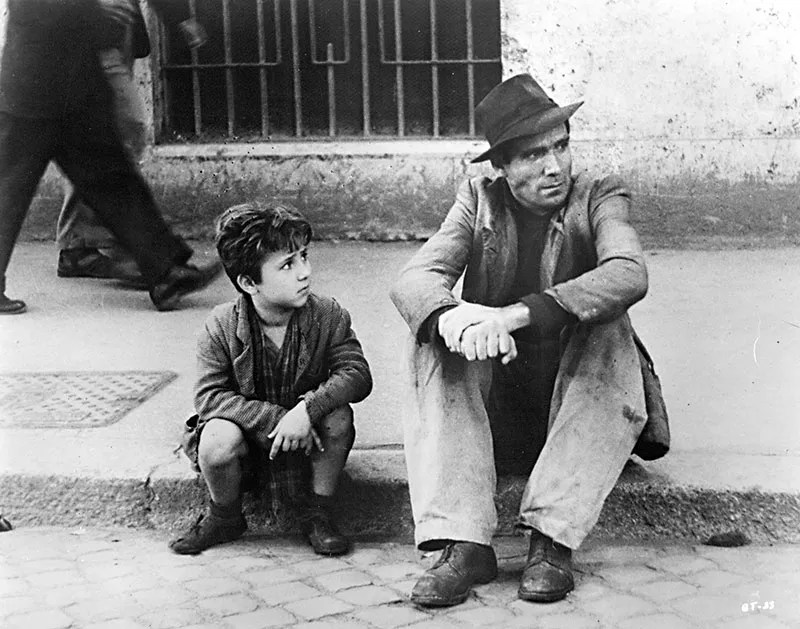
There’s a scene in The Player, Robert Altman‘s brilliant evisceration of Hollywood, where soulless studio exec Griffin Mill (slimily embodied by Tim Robbins) hits up a screening of Vittorio de Sica‘s Bicycle Thieves in order to suss out a potential stalker (baby-faced Vincent D’Onofrio). The two chat awkwardly in the lobby, with Mill asking the young writer if he’d like to write the remake. “You’d probably give it a happy ending,” D’Onofrio’s character replies. “No, we’d keep it pure,” Mill lies.
It’s one of endless barbs thrown at the studio system in that wonderfully acerbic film, but the key word here is pure. As far as the history of cinema goes, there are few films as pure as Bicycle Thieves (né The Bicycle Thief, long story). A masterpiece of the Italian neorealist movement, this film tells a simple and heartbreaking story of an unemployed man, Antonio, (Lamberto Maggiorani) who gets a job gluing up posters in post-World War II Rome. The only problem is that the gig requires a bicycle, a bicycle that he has already pawned to feed his wife Maria (Lianella Carell) and sons. Selling their bedsheets to get it back, the fates seem to be in his favor. But on his first day on the job, the titular criminals abscond with his bike and he spends the rest of the film hopelessly searching the piazzas and markets, his desperation palpable. When it becomes all too clear that he will never retrieve his bike, he is reduced to stealing a bike himself, and is immediately caught. The narrative may be sparse, but Bicycle Thieves is one of the most vibrant and alive films committed to celluloid.
That is in no small part due to the nonactors filling the frame. Neither Maggiorani (a factory worker by trade) nor Carell (a journalist) had ever been in front of the camera. As to the indelible performance from the son Bruno (Enzo Staiola), well, de Sica found him just loitering on a street corner and cast him on the spot. It is one of those films that was made from a convergence of kismet or fate: de Sica’s obsession with neorealist storytelling, Luigi Bartolini’s original novel Ladri di Biciclette, and the vibrancy of 1948 Rome in all its splendor, but much more telling, all of its poverty. The vertigo-inducing shelves of linens on which the family’s sheets are stored become just one more addition. The mobs of workers are trying to feed their families, but jobs are scarce. There is a scene in a restaurant where Antonio takes Bruno for lunch, defeated by the search for his missing bike. While Antonio gets drunk, Bruno becomes preoccupied by the table of a rich family, and he begins mimicking the well-to-do boy’s eating habits. A small scene, but one that speaks volumes on the gulf of the haves and the have-nots. But de Sica lays no judgment. In fact, to say that Bicycle Thieves is one of the greatest humanist films is an understatement. This is a film that lights the soul.
Paramount Summer Film Series presents Bicycle Thieves at Stateside, Friday, Aug. 3, 8:35pm. For more, go to www.austintheatre.org.
This article appears in August 3 • 2018.