





Real Stories of the Donut Men It would seem that the pairing of producers Elizabeth
Avell�n and Rana Joy Glickman is a match made in indie film heaven. In
an American independent scene which has of late been turning out more and more
“calling cards” for Hollywood, their commitment to daring and challenging
cinema is heartening. Their latest project, Real Stories of the Donut
Men, which they produced with Pamela Cederquist, makes its world premiere
at the SXSW Film Festival this year. Directed by Australian Beeaje Quick, it is
an outrageous Warholian palette of pop culture and post-modernism akin, as
Glickman sees it, to the essence of what Devo was to the 1980s, and a prime
example of the independent spirit toward which Avell�n and Glickman
aspire. There aren’t many film people out there who would have the courage to
back a first-time director from the brush who showed up in America with nothing
but a few bucks in his pocket and the obsession to make a film, much less
possess the skill and vision to pull it through.
The two producers first hooked up on the set of Robert Rodriguez’s From
Dusk Till Dawn. Avell�n (who is married to Rodriguez) was
co-producing the film, and Glickman was on hand producing the behind-the-scenes
documentary Full Tilt Boogie (which will also be premiering at SXSW this
year). Both already had extensive and successful experience in the independent
film world. Avell�n had founded Los Hooligans Productions with Rodriguez
and gone on to co-produce his groundbreaking El Mariachi and
Desperado. Glickman had line-produced some 10 independent features,
working with Eric Stoltz, Joel Castleberg, and others. Their time together on
Dusk’s set was special in that it allowed them the opportunity to watch
how the other worked in the capacity of a producer, and they obviously liked
what they saw: the emphasis on art over commerce and of humanity over the
dollar. They also realized they tended to gravitate to the same kind of
material, the kind based in freedom of artistic choice rather than in mandates
of commerce.
Their first collaboration was as producer’s reps on another directorial
debut, Julie Davis’ I Love You… Don’t Touch Me!, which proved a
success when they secured a distribution deal with Goldwyn Entertainment
Company after its premiere at this year’s Sundance Film Festival. As Glickman
says, their joint projects serve as an opportunity to “get away from the boys
for a while.” She emphasizes that the fact that they are two women running
things side by side in a traditionally male-dominated arena really simplifies
things. They instinctively know to protect each other, as well as protect each
other’s families. “We each have three babies,” Glickman says jokingly, but in
all seriousness. “Mine are Real Stories of the Donut Men, Full Tilt
Boogie, and God Said, Ha! [directed by Julia Sweeney,
executive-produced by Quentin Tarantino, and currently in post-production].
Elizabeth’s are Real Stories of the Donut Men, Robert, and Rocket [their
son]. And we look out for each other’s babies.”
But more than anything, though, their collaborations are about the freedom to
bring daring cinema to the screen — cinema that can make a difference — and
having a damn good time while doing so. Their next planned project will be to
produce yet another directorial debut, Pamela Cederquist’s Landfall.
Here’s hoping their collaborations continue a long time into the future.
Independent filmmaking needs their kind strength, experience, and vision. —
Jerry Johnson
Dobie II, 3/9, 9:45pm; Dobie III, 3/10, 7:30pm; Union, 3/14, 3:30pm
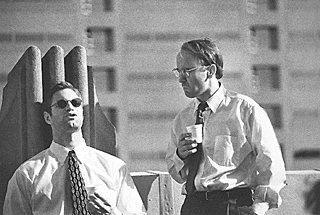
In the Company of Men In the Company of Men is bound to become one of the
most talked-about movies of the year. As disturbing as it is well-made, this
low-budget indie is a thoroughly original piece of work. It was recognized as
such when it debuted in January at the Sundance Film Festival where it was
honored with the Filmmakers Trophy, the award selected by all the competing
filmmakers.
Shot in 11 days on a shoestring in Fort Wayne, Indiana, the pared-down visual
style of In the Company of Men perfectly complements the movie’s
narrative and emotional economy. There’s nothing extraneous about
writer-director Neil LaBute’s film, even though he modestly explains how he
tried to “make all the economic choices look like artistic ones.”
The movie is a dark drama about contemptible behavior. One can hardly think of
a film in which the protagonists have been allowed to be as overtly
misogynistic as In the Company of Men‘s Chad and Howard. It’s a
repellent sight as these two corporate managers hatch an idle plot to
emotionally abuse an unsuspecting woman. But by the movie’s conclusion,
however, we are made to see how their behavior is part of an even larger
cultural misanthropy which engenders corporate and social violence in a variety
of forms.
The movie runs the risk of being misunderstood from all sides: outrage from
viewers who confuse the message with the messenger and mistake the movie’s
overt misogyny with its message, and enthusiastic support from denizens of the
feminist backlash who see these guys up on the screen and find reassurance from
the fact that there are jerks out there who are worse than themselves.
Does LaBute worry that his film will be misinterpreted? For him, it was “a
risk worth taking,” although the first-time filmmaker is also quick to point
out, “What did I have to lose? You’re never going to please everyone. Even the
people who made Independence Day have to know that. They made a stinkin’
amount of money but that doesn’t mean that everybody liked it. They did give it
the old college try. I’ll give ’em that.” He continues more reflectively, “If
you don’t run that risk, it’s hard to really ever say anything.”
On a personal note, the filmmaker points out that In the Company of Men is a work of fiction. “I have trouble watching documentaries more than I do
this,” claims LaBute, “because I know those are based, some way, in fact. I
could barely watch Paradise Lost. I was so upset. Here, I’m making this
junk up.”
LaBute is looking forward to screening the film at the SXSW Film Festival.
After the Sundance experience of screening the movie for what he calls largely
a “business audience,” he is curious to see how audiences here respond. What
he’s hoping to find in Austin are “folks who like movies” and have “no
itinerary other than just wanting to not be wasting their time.” —
Marjorie Baumgarten
Alamo, 3/7, 8:00pm; Dobie III, 3/10, 10:15pm
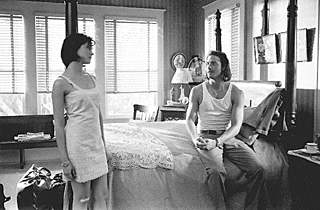
Still Breathing “It’s my first feature,” relates director James Robinson. “I’m
old, though. I’m 41 now, and I started making films when I was 11.”
For someone so willing to concede his age in a time when Hollywood has
enshrined youth more than ever before, San Antonio native Robinson has crafted
a remarkably buoyant, ageless film that redefines the term romantic comedy in
purely Texan terms. It’s at once achingly sweet and savagely funny, poignant
and at times downright hilarious, but, above all, it effortlessly connects with
viewers’ hearts, reaffirming what we’d like to believe above all else: that one
true love does exist, and we can find that person after all.
Brendan Fraser’s turn as the eccentric San Antonio street artist Fletcher
McBracken is done with polished ease — it’s easily his best role to date, and
Joanna Going’s cynical Roz Willoughby is a luminous, doe-eyed creation —
half-L.A. scam artist, half-true believer.
When Fletcher has a vision of Roz — the vision — he travels to Los
Angeles to find her, woo her, and convince her that he’s the one. Tough,
bitter, and damaged by life in the fast lane, she takes him for a fool, and
then finds herself back in San Antonio, meeting his family (All About
Eve‘s Celeste Holm is the matriarch every family should have), his friends,
and suddenly doubting the dusty house of cards that has been her life thus
far.
“Being in L.A.,” says Robinson, “you start becoming this commercial kind of
leech, and as a filmmaker I wasn’t even making any money off being a commercial
leech.
So I decided to write a movie that I could shoot for almost nothing
in San Antonio, and I decided to write it as if it were going to be one of my
favorite films, regardless of who made it.”
And did Robinson have a vision of his wife Denise Pizzini, whom he met while
she worked as set designer on Like Water for Chocolate) �
la Fletcher McBracken?
“No, unfortunately I didn’t,” he says, laughing. “But I did grow up as a
little kid thinking that there was one person. I kind of bought into that as a
kid, thinking there was one person for me. I used to worry: What if she was in
Siberia, or Bangladesh, or the Congo? How was I going to find her? Later, I
gave up on all that stuff. Sadly.”
You wouldn’t know it from Still Breathing. From its lush, love-fogged
cinematography to its haunting, lyrical score, the movie plays like one long
valentine to the sometimes archaic notion of true love. It’s a tiny, lustrous
gem with a wonderfully large heart. — Marc Savlov
Paramount, 3/15, 7:15pm
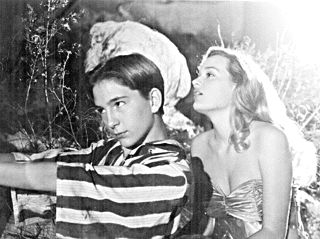
Redboy 13 “I’m afraid this movie isn’t classical film fest material,”
cautions Redboy 13 director-writer Marcus van Bavel. “What it is,
truthfully, is an episode of Rocky and Bullwinkle with live actors.”
Van Bavel’s description of his exuberantly wacked-out sci-fi/secret agent
adventure parody is facetious but apt. The 35-year-old Austinite came of age in
the Cold War era when phrases like “Comintern,” “Defcon 3,” and “NORAD” filled
the air, James Bond was the sine qua non of pop culture coolness, and
even Saturday morning cartoons reflected a general infatuation with all things
espionage-related.
Redboy 13 pays nostalgic tribute to those classic schoolboy fantasies
with a 10-year-old title character who freelances for a CIA-like intelligence
outfit. Whenever mad scientists or sinister foreign dictators threaten the
country, dark-suited spooks appear at Redboy’s suburban grade school to press
him into service. Special dispensations from the Joint Chiefs of Staff free
Redboy from conflicting obligations such as homework and shopping errands for
Mom.
Fans of the broad yet inspired satirical writing of Terry Southern (Dr.
Strangelove), Buck Henry (Get Smart), and Jay Ward (Rocky and
Bullwinkle) will find plenty to savor in van Bavel’s bizarre yarn, which
pits Redboy and comrades with names like Col. Calcan (veteran Sixties TV actor
Robert Logan) and Sgt. Hurter against arch-villain Dr. Heimlich Manure. In a
droll twist that alludes to recent geopolitical changes, the post-Cold War
heroes periodically grouse about all the red tape now required just to
authorize a simple assassination or coup.
For a movie described by its maker as “no-budget,” Redboy presents a
surprisingly lush visual tableau incorporating eye-popping CinemaScope
photography and ingenious digital animation by van Bavel himself. “I’ve messed
with computers for years, so this was a natural way to partly compensate for
our lack of funds,” van Bavel said. “I wrote the software myself to do the
modeling, rendering, and animation.” The seemingly omnicompetent van Bavel (who
works full-time for a local semiconductor company) also rigged special lenses
for his vintage Mitchell 35mm camera and built a 3,600-square-foot geodesic
dome soundstage near Bastrop. If that weren’t enough, he also played three
roles in the film.
David Boone, known to local film buffs as the director of the cult indie
feature Invasion of the Aluminum People, co-produced and recorded sound
with a suitably apocalyptic roar. He also appears to be having a good time
performing one of the key roles.
Those who remember van Bavel from his UT days as an electrical engineering
major and wannabe standup comic (his first feature was a marginally successful
document of that era called The Texas Comedy Massacre) might be
surprised at the lengths he’s going to pursue his filmmaking dreams.
“I want to make this work, and I want to do it in Austin,” van Bavel says
firmly. I’ve got two other films in the works right now, and if Redboy
13 is any kind of success, we’ll be moving right ahead with them.” —
Russell Smith
Paramount, 3/7, 7:00pm; Paramount, 3/10, 9:30pm; Dobie III, 3/14, 5:30pm
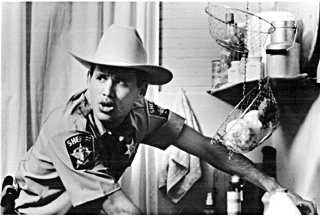
Purgatory County Murder, Mama, and emus. Just another day in Purgatory County.
Matricide, Texas style. Director George Ratliff’s Plutonium Circus won
raves for its documentary depiction of life in and around the Amarillo-based
Pantex nuclear weapons facility, and for good reason: His eye for the telling,
slightly off-kilter details of small-town Texas life pointed out the
absurdities of the situation without poking fun. Purgatory County, his
debut feature, is graced with the same keen, bloodshot eye, aided and abetted
this time out by cinematographer Phil Curry (subUrbia) and a cast of
talented unknowns.
It’s a Nineties noir Western, set in a one-horse podunk populated by
the ineffectual sheriff Duane (Trent Turner), his psychotic brother Perkins
(Terry Rogan), Perkins’ scheming wife Liz (Sallie Guy), and the town
overlord-cum-diner-habitu� Lucky (Don Cass). And then there’s Mama (Patt
Vee), a bedridden, chain-smoking chunk of funlessness that makes Mother Bates
look like Mother Teresa.
“It’s kind of a revisit to the Western, actually,” says Ratliff. “I think it’s
coming from the same roots as a Western comes from, but it’s a new look at
it.
“I was faced with making a low-budget movie and I knew I wanted to do a
true-crime kind of story, but those had all been done, so we kind of went with
the exaggerated tall tale type of story that had been whispered from ear to ear
to ear until it reached me. All the elements of the small Texas town are still
there, though.”
Fans of the Coen brothers may find a kindred spirit in Ratliff’s tale,
although the film eschews their penchant for tidy resolutions and overly
clich�d characters. Instead, Ratliff cranks up the weird factor.
Purgatory County is populated by oddballs and losers, sure, but the film
looks and feels almost Lynchian with its spare settings and rumbling
soundtrack. The tension — comic and otherwise — builds from the first scene
until the film’s explosive final shot. It’s a season in hell, but more fun, and
with much better music. — Marc Savlov
Dobie IV, 3/7, 7:15pm; Dobie IV, 3/10, 7:45pm; Paramount 3/14, 5:00pm
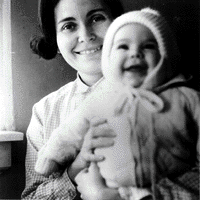
A Healthy Baby Girl A Healthy Baby Girl is a case study in how a personal
crisis can become a political awakening. This personal documentary chronicles
the experiences of filmmaker Judith Helfand and her family after she had a
radical hysterectomy at the age of 25 to remove the clear-cell cancer that had
developed as a result of Judith’s mother having taken the synthetic estrogen
DES (diethylstilbestrol) during pregnancy. Between 1938-1971, DES was commonly
prescribed to pregnant women to avert the threat of miscarriage, even though by
1952 DES had already been identified as ineffective for that purpose as well as
being a known carcinogen. Years later, daughters of these women began to be
diagnosed with abnormal cervical cell growth and the rare form of vaginal
cancer that was found in Judith Helfand.
During her recuperation from the surgery, Judith returned to her old bedroom
in her parents’ home and, as a means of coping with her flood of feelings, she
picked up a movie camera and began recording. What she documents is a story
that’s much larger and more universal than her own individual saga. A
Healthy Baby Girl is a portrait of a family in turmoil: parents suffering
from a kind of guilt that no amount of logic or hindsight can assuage and the
ways in which this disease tangles the eternal parent-child knot.
In the Helfands’ case, they managed to use the experience to bolster their
awareness of each other and of the long-term social consequences of chemical
engineering. As the filmmaker says, “When we talk about the environment, it
seems very abstract, very far away. Not only will it happen to somebody else,
it’ll happen a long time from now. So what I’m trying to do is ground a very
harsh reality with a very simple story about a family and what happened to me
and my mom.”
The DES story, for Judith, serves as a model for our national problem with a
host of other toxic pollutants. She wants the movie to serve as a rallying cry
for any number of other critical environmental and political issues. Thus,
local screenings are coupled with outreach programs in which she tries to find
“a local issue of toxic emissions or endocrine-disrupting chemicals, or some
kind of environmental exposure that has some sort of one-to-one link to DES.
Unfortunately, that’s very, very easy because right now, our country is facing
a real serious environmental crisis in terms of industrial and toxic emissions,
whether by pesticide exposure or exposure to chemical solvents, DDT, Agent
Orange, or because of a medical waste incinerator.”
Yet, the most moving and eloquent section of A Healthy Baby Girl may
also be its most humorous. Judith’s mother sums up how one family’s personal
heartache has been transformed by its larger social relevance. She quotes from
letters she and her husband sent to the White House and comments, “Daddy said
vagina to President Bush.” Somehow, it doesn’t get more fundamental than that.
— Marjorie Baumgarten
Dobie II, 3/7, 10:15pm; Alamo, 3/10, 8:00pm
A Century of Cinema
To celebrate the 100th anniversary of the birth of cinema in 1995, the British
Film Institute called on filmmakers from around the world to create
documentaries about the histories of their respective national cinemas. Some of
the greatest directors of all time responded to the challenge. The result was
hardly a dry collection of scholarly histories of the kind that you might see
on educational television. Instead, it sprung to life as a startlingly eclectic
collection of personal essays forged by each filmmaker’s distinct passion for
the cinema.
Each episode provides a unique perspective on the relationship between cinema
and its audience: from Stanley Kwan’s (Rouge, Actress) “psychoanalysis”
of Chinese cinema to Stephen Frears’ (My Beautiful Laundrette,
Dangerous Liaisons) tongue-in-cheek defense of cinema that is “typically
British”; from the late Krzysztof Kieslowski’s (Blue, White, Red) view
of Polish cinema as a repository of collective consciousness to Martin
Scorsese’s (Taxi Driver, Raging Bull) individualistic journey through
American cinema; from Donald Taylor Black’s study (narrated by Gabriel Byrne)
of the displaced subjectivity of Irish films to actor Sam Neill’s exposure of
the dark undercurrents in the cinema of New Zealand; from Nagisa Oshima’s
(Boy, In the Realm of the Senses) moving account of his own
relationship to the Japanese cinema to the one and only Jean-Luc Godard who,
with co-director Anne-Marie Mieville, uses this occasion not to celebrate
cinema’s birth but to mourn its death. In all, these works form not merely a
document on the subject of cinema; they are cinema, in and of itself. —
Jerry Johnson
The Century of Cinema series is a co-presentation of the Austin Film
Society and the SXSW Film Festival. All screenings are in Dobie II and begin at
8pm; SXSW Film Festival admission procedures apply.
Chinese Cinema: Kwan’s Creation Workshop
Monday, March 10
Japanese Cinema: 100 Years of Japanese Cinema
Polish Cinema: 100 Years of
Polish Cinema
Tuesday, March 11
British Cinema: Typically British
French Cinema: 2×50 Ans de Cinema
Fran�ais
Wednesday, March 12
Irish Cinema: Ourselves Alone?
New Zealand Cinema: Cinema of
Unease
Thursday, March 13
American Cinema: A Personal Journey with Martin Scorsese
Friday March 14
This article appears in March 7 • 1997 and March 7 • 1997 (Cover).