

D: Mathieu Kassovitz; with Vincent Cassel, Hubert Kounde, Said
Taghmaoui.
VHS Home Video
Waterloo Video, 1016 W. Sixth

This powerful, black-and-white, French film shot in a Parisian
cit� (housing development) follows three racially diverse friends
from the projects — a Jew, an Arab, and a black — through a 24-hour period
after an inner-city riot. Vinz, the Jew, finds a policeman’s gun that becomes a
special trophy since a friend of theirs who was beaten by the cops lies in a
hospital room in critical condition. Anger motivates these young men as they
tear through the streets — a driving force of pure emotion — contemplating
taking away what has been taken away from them. Hate is an intense
illustration of a vicious cycle whose by-products are violence and mistrust.
Most disturbing is the notion that it’s a certain lower-economic class of
people who keep playing out this mini-war in their own communities until
virtually nothing is left. At times, it appears unrealistic that practically
every encounter these boys stumble upon turns aggressive, but this structure
also helps build to a potent ending. — Jen Scoville
Pee-wee’s Playhouse, Volume 5
D: Stephen R. Johnson; with Pee-wee Herman, Gilbert Lewis, Phil Hartman,Lynne Stewart, Shawn Weiss, Diane Yang, Natasha Lyonne.
VHS Home Video
Finally, someone wised up. This past year MGM/UA agreed to re-release eight
volumes of CBS’ brilliant but doomed Saturday morning television show
Pee-wee’s Playhouse. Aside from the clever packaging (placed side by
side, all eight video boxes make a picture of Pee-wee Herman wearing his
whimsically decorated bicycle helmet), these videos each contain two episodes
as opposed to the chintzy single-episode tapes originally released through
Hi-Tops Video. Rumor has it that more side-splitting episodes will be
forthcoming but, for now, fans can settle back and watch Pee-wee reinvent those
kooky Playhouse kids Cher (Yang), Elvis (Weiss), and Opal (Lyonne) with “Secret
Names.” Then, they can put on their best clean underwear to watch Pee-wee
invite all of the Playhouse cohorts to help him celebrate friendship in
“Party.” After all, as Pee-wee says, “You don’t need a reason to have a party.”
— Alison Macor
Tempest X3
for Sony PlayStationInterplay Software
Anyone who played arcade games back in the early Eighties remembers the
original Atari vector-graphic shooter, Tempest. A player spun his “man”
around the edge of an irregularly shaped well of enemies and attempted to
destroy them before they could reach the top. Great fun. And now an improved
version is available for PlayStation, which includes the original game, Tempest
X3 (which has a nice techno soundtrack), and a two-player mode. The action is
fast and furious and becomes challenging in a hurry. The only problem is the
lack of mouse support for the game, which would have made control much easier.
Still, plenty of nostalgic action for fans of the original. — Bud
Simons
The Celluloid Closet
D: Rob Epstein and Jeffrey Friedman; with Lily Tomlin, Susie Bright, QuentinCrisp, Tony Curtis, Harvey Fierstein, Whoopi Goldberg, Tom Hanks, Shirley
MacLaine, Armistead Maupin, Susan Sarandon, Gore Vidal.
VHS Home Video
Vulcan Video, 609 W. 29th
Based on the book by the late Vito Russo, The Celluloid Closet not only
sheds light on the subtext of homosexuality in Hollywood movies, but also
reminds us of the dozens of blatantly homosexual and gender-bending characters
that have graced the screen since the beginning of film time. Academy
Award-winning documentarians Epstein and Friedman show us not only the films we
are expecting to find, such as The Hunger, Making Love, and
Some Like It Hot, but also little-known gems from the early part of the
century portraying homosexuality as an accepted, if not acceptable, social
phenomenon. Scriptwriters, actors, and directors alike bemoan the censorship of
the past and let us in on how they skirted the watchdogs and brought relevant
sexual subtext to the screen. Gore Vidal’s description of filming aspects of
Ben-Hur without inciting Charlton Heston’s homophobia is worth the cost
of the rental all by itself. This is not a film just for homosexuals and their
friends, this a film for anyone interested in Hollywood and the history of the
20th century. — Kayte VanScoy
WarGames
D: John Badham; with Matthew Broderick, Dabney Coleman, John Wood, AllySheedy.
VHS Home Video
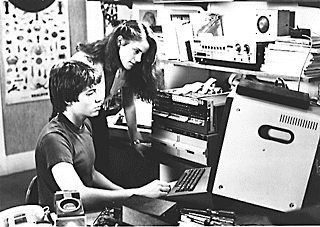
With the enormous selection of crummy techno-paranoia movies on video shelves
these days (The Net, Virtuosity, and Hackers are among
more recent titles), the discriminating viewer will eschew a flashy cover or a
big star and rent one of the classics. Not only was WarGames the first
film of the new computer age to tap into fears about the dangers of technology
at the hands of mad geniuses, but it’s easily the best as well. It’s also the
movie that put Broderick and Sheedy on the movie map, and the picture was
nominated for three Academy Awards in 1983, including one for Walter Parkes and
Lawrence Lasker’s brilliant screenplay. At the time, WarGames also
sparked an almost inconceivable interest in computer hacking among juvenile
tech-heads (I was one of them), and the movie’s effect on Hollywood and the
American consciousness can still be seen today. While these days, Microsoft is
a more frightening reality than lone hacker types, the resonant phrase, “Shall
we play a game?” still retains its power.
— Christopher Null
This article appears in March 21 • 1997 and March 21 • 1997 (Cover).