

D: George Stevens; with Elizabeth Taylor, Rock Hudson, James Dean, Carroll
Baker, Jane Withers, Chill Wills, Mercedes McCambridge, Dennis Hopper, Sal
Mineo.
VHS Home Video
Waterloo Video, 1016 W. Sixth
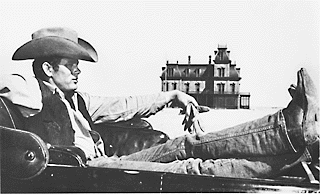 Giant |
Giant, at the SXSW Film Festival this week, then revisiting this
grandfather of Texas movies is just exactly what you’ll be inspired to do. Giant (1956) is still a big enough movie to represent the Lone Star State
worldwide, a responsibility it shares with a certain long-running, night-time
soap whose resemblances to the film aren’t coincidental. Based on Edna Ferber’s
best-selling novel, the epic begins back East as Bick Benedict (Hudson) is in
the market for a horse. He returns home to the barren lands of his West Texas
ranch with a stallion and a new East Coast wife (Taylor) on his arm, a
strong woman who adapts quickly to the ways of the Texas rancher but doesn’t
let him quash her cheeky individuality. Though the politics of the story are no
longer correct, the film is successful in capturing just how different
(and how vast) Texas was — and still is — from the rest of the country. James
Dean, in his final role, plays the ornery ranch hand-turned-oil baron Jett Rink
with rugged handsomeness (until he’s badly made-up to look old at the end). On
a side note, Giant remained Warner Bros.’ highest grossing film until
1978, and was recently re-released for the big screen. Look for the new video
version, a restored print complete with footage from the making of Giant and the film’s New York premiere. — Jen Scoville
Trainspotting
D: Danny Boyle; with Ewan McGregor, Ewen Bremner, Jonny Lee Miller, KevinMcKidd, Robert Carlyle, Kelly Macdonald.
VHS Home Video
The fact that Bob Dole denounced this movie is almost reason enough to rent
Trainspotting, and it doesn’t surprise me in the least that this
surreal, metaphor-filled picture about the terror of heroin addiction was lost
on the wizened ex-candidate. Director Boyle, who proved himself a virtuoso at
working with the camera in 1995’s Shallow Grave, took the craft of
jarring cinema to a new level with this follow-up, the biggest hype of 1996,
complete with its own trendy advertising campaign. The film’s title refers to a
popular British hobby — sitting by the railroad tracks while counting trains
and collecting other useless railway information. In following
Trainspotting‘s motley crew of characters, an attempt to romanticize the
druggie lifestyle is nowhere on Boyle’s agenda. Instead, McGregor’s Renton
leads us through the real war on drugs as experienced by the boys on the front
line. Trainspotting is full of jolting visuals, quirky humor, and
unfortunately some indecipherable dialogue, so stay near that rewind button.
— Christopher Null
He Walked by Night
D: Alfred Werker; with Richard Basehart, Scott Brady, Whit Bissell, JackWebb.
VHS Home Video
Vulcan Video, 609 W. 29th
This 1949 noir classic filmed in a documentary style is said to have
been a precursor of the Dragnet radio and television series, and even
includes a baby-faced Jack Webb as a police lab technician. One-dimensional
characters and dry storytelling sans soundtrack do not detract from this
film’s appeal, but instead serve to draw the suspense closer to the surface, a
suspense resulting, in part, from the uncredited direction of Anthony Mann,
whose eclectic filmography spans several genres and includes noir classics such as T-Men as well as Westerns and grand epics such as
1961’s El Cid. There is nothing left wanting, however, in the rich
vision of legendary noir cinematographer John Alton. The shadowy life of
cop-killer and crafty thief Ray Morgan (Richard Basehart) meets its sorry end
lit by the beams of police flashlights in the cavernous dark of a Los Angeles
sewer. Framed by Alton, this flat, hard-boiled narrative is luminous with
glamour. — Kayte VanScoy
Denise Calls Up
D: Hal Salwen; with Alanna Ubach, Timothy Daly, Caroleen Feeney, DanGunther, Dana Wheeler-Nicholson, Liev Schreiber, Aida Turturro, Sylvia
Miles.
VHS Home Video
Vulcan Video,
609 W. 29th
Seven friends, seven phones, and six degrees of separation are the crux of
this silly tale about adults so modern and so urban that they never actually
meet in person, but only communicate electronically. They court each other,
comfort each other, and experience both the miracle of birth and the tragedy of
violent death over the telephone. It is an unlikely precept and strains to
stretch itself out over the course of the short movie, but it also hits home.
Watching these poor souls experience life through their laptops, cellulars, and
fax machines will depress you enough to send you rushing out to embrace the
first real person you meet just to affirm that, yes, you are human. Denise
Calls Up is like one of those urban myths you don’t believe but will love
retelling. — Kayte VanScoy
Destruction Derby 2
for Sony PlayStationPsygnosis
This game is two things. Beautiful and ridiculously difficult. British-based
Psygnosis has recently produced sequels to their early PlayStation hits
Wipeout and Destruction Derby. Some critics complained that
Wipeout XL was far too easy, but no one will make similar protestations
about Destruction Derby 2, which is hard enough to drive the average
gamer to toss his controller across the room. The graphics and sound are
fabulous, although a rear-view mirror would have been nice, and the many tracks
offer a pleasing variety for any fan of driving games. But no prospective buyer
should expect to pick this up and master it quickly. Still, it’s a great,
rambunctious ride for those who can enjoy vehicular mayhem without the need to
finish at the head of the pack. —
Bud Simons
This article appears in March 14 • 1997 and March 14 • 1997 (Cover).