

(“Scanlines” wishes to thank Encore Movies & Music, I Luv Video,
and Vulcan Video for their help in providing videos and laser discs.)
|
|
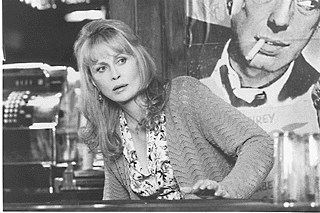
Fast Money
D: Douglas Holloway (1981)
with Sammy Allred, Sonny Carl Davis, Marshall Ford, Doris Hargrave, Lou
Perry.
During the recent weeks, as you’ve been perusing the endless ink dedicated
to Sammy Allred of KVET-AM’s Sammy and Bob Show, one question has no
doubt been raging above all others: “But can he act?” Unfortunately, this film
isn’t likely to give you much of an answer. Despite his topping the list of credits
(did someone think the Geezinslaws would make him a sure-fire national box-office
draw?), Allred only appears onscreen for a total of about five minutes, and in his
role as a laid-back drug-smuggling pilot, pretty much all he has to do is sit in a
cockpit and be Sammy Allred. That’s actually a good part of the charm of this
so-called adventure flick, though Holloway has turned out a film that has more in common with
Richard Linklater than Robert Rodriguez, with a natural sense of pacing and little
overacting. From the start, it seems as if this film is a guaranteed turkey, shot on film
so grainy you have to fight to keep the mice away from it, and Holloway doesn’t
try to pull off any El Mariachi-style miracles; instead, he works with the
strengths of his low budget. Fast Money, the tale of a group of buddies who try
to make it rich smuggling drugs in from Mexico only to find that fast money isn’t
necessarily easy money, concentrates on its three-dimensional characters, and doing so,
shows Holloway has a sharp sense of the sociology of the doper (another similarity
he shares with Linklater). The movie is low-key and genial and is more concerned with
the fate of the drug-smuggling pals and their troubles than with car chases and
violence. That’s not to say there’s no action, of course, but I’d have to call Fast
Money an afternoon movie, one that makes a perfectly good diversion to pass an hour
and a half in front of the tube with a Lone Star or a joint at hand. A pleasant
surprise, to say the least. — Ken Lieck
Tromeo & Juliet
D: Lloyd Kaufman (1996)
with Jane Jensen, Will Keenan, Valentine Miele.
Shakespeare, an old letch who routinely parodied himself, would have loved
this latest Troma Team spoof that is so much more than mere bare bodkins and fart
jokes. Granted, this flick does stick to the Troma format, made popular by classics
like Toxic Avenger and Teenage Catgirls in Heat, and is replete with
gratuitous everything and tubs o’ fake pus, but it does move this independent studio’s
work up a notch by including an actual plot, amazingly good actors, and a
surprising amount of substance. Lemmy from Motorhead makes a great Chorus while Jensen and
Keenan reek chemistry and a knack for iambic pentameter. Miele’s death scene is, believe
it or not, heartwarming. But there is still plenty for the sleaze lover in us all,
including dead urban critters, a three-foot penis monster, a decapitation, and a
“real-time” nipple piercing. Plus, this video version includes interviews with Kaufman,
as well as a vomit-inducing out-take.
Now, if they could just find a way to put this on-stage…. — Adrienne
Martini
Albino Alligator
D: Kevin Spacey (1997)
with Matt Dillon, Gary Sinise, William Fichtner, Faye Dunaway, Skeet
Ulrich, M. Emmet Walsh, Viggo Mortensen, Joe Mantegna.
Kevin Spacey added yet another notch to the growing list of
actors-who-wanna-be-directors with this extremely short-lived movie from earlier this year. With recent
directorial debuts by Tom Hanks (That Thing You Do!), Matthew Broderick
(Infinity), and even Kevin Bacon (Losing Chase) having cast a pall on the idea
that actors should do anything other than stand in front of the camera and look pretty,
Spacey, who has already proven himself as one of the film world’s most gifted actors
(The Usual Suspects), shows that he’s really a more-than-passable director.
Thanks largely to newcomer Christian Forte’s clever script, Spacey makes interesting
work out of an otherwise overdone situation (cops surround bad guys in a bar with
one exit). He also gets a chance to explore some interesting camerawork within
these obvious confines, all without coming off as a heavy-handed egomaniac like
some who have tried this stunt before (you know who I mean). And while Spacey isn’t
going to win any awards this time around, at least he proves he’s someone to watch
— and not just in front of the lens.
— Christopher Null
Blood and Black Lace
aka Six Women for the Assassin
D: Mario Bava (1964)
starring Cameron Mitchell, Eva Bartok.
By the mid-Sixties, the Italians were well on the way to defining the
giallo, their hyper-violent version of Hitchcock-style murder mysteries. In this
murder-Italian-style thriller, Cameron Mitchell and Eva Bartok run a fashion salon where models
keep turning up dead. One of the models kept a diary of illicit love affairs, cocaine
dealing, and other decadent happenings, and the murderer wants it real bad. Plot
twists abound; in a Sixties Euro-mystery it’s a safe bet that Cameron Mitchell is the
killer, but here he’s a mere red herring. Bava’s artistic background shows through in his
use of color, with whole scenes drenched in over-saturated washes of primary
hues. The high-fashion setting complements his stylistic flourishes, many of which will
be recognized by fans of shock director Dario Argento, who has cited Bava as an
influence. The black-gloved masked killer also became an Argento staple, though the plot
of Blood and Black Lace is much more linear, without Argento’s wild,
dreamlike leaps of logic and self-referential asides. There are two unfortunate
problems that typify Sixties giallos: weak acting and stiff dialogue, but try to
ignore those and concentrate on the visual style — there’s one surreal, beautiful
scene where a model goes to a house to look for her boyfriend (and gets knocked
off, of course). Shot on a two-story set (built open like a dollhouse), the camera
roams and tracks the action through the whole house, with red and blue lights
bathing the entire segment. This is a flawed but stylish thriller with far grislier
scenes than anything Hollywood would touch in ’64. (Vulcan Video has a good letterboxed,
Japanese-subtitled print). — Jerry Renshaw
This article appears in August 1 • 1997 and August 1 • 1997 (Cover).