





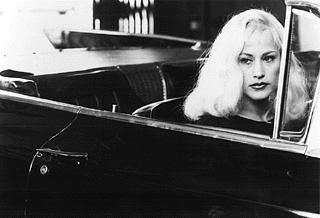
 Patricia Arquette in Lost Highway |
Gifford is on a roll. The movie Lost Highway, which Gifford and co-screenwriter/director
David Lynch describe as a “21st-century noir horror film” opens today
throughout the country. Furthermore, Grove Press has recently published a
paperback edition of Sailor’s Holiday: The Wild Life of Sailor &
Lula. Another movie, Perdita Durango, based on a novella within
Sailor’s Holiday, has recently wrapped. Perdita Durango is also
available as a graphic novel by Neon Lit.
Gifford’s movie career began when David Lynch put Gifford’s then unpublished
novel, Wild at Heart: The Story of Sailor & Lula, on the screen.
Following that, Gifford’s teleplay, Hotel Room Trilogy, another Lynch
collaboration, appeared on HBO.
Gifford’s fictional world is filled with brief yet captivating descriptions,
unflinchingly noirish snapshots of the American demimonde that often
smack of the surreal. An example of the classic Gifford touch: A deceased,
black leather-clad biker is supinely entrenched in an open casket with a fresh
pack of Lucky Strikes in his left hand.
Gifford played a major part in launching the current vogue for noir author Jim Thompson. After discovering French translations of Thompson’s novels
on a trip to Paris in 1983, he purchased the rights to several titles and set
up Black Lizard Press in order to publish them. Black Lizard Press has since
been sold to Vintage Books.
Among his multifaceted projects, he’s published The Devil Thumbs a
Ride, a collection of his critiques of various film noir works, and
edited two studies of Beat personalities: Jack’s Book: An Oral
Biography, about Jack Kerouac and As Ever: The Collected Correspondence
of Allen Ginsberg & Neal Cassady. Some other post-Wild at Heart novels include Night People, Arise and Walk, and Baby Cat-Face. A
new novel, The Phantom Father, is due to be published in May by Harcourt
Brace.
The conceptual vortex of Lost Highway is the seemingly inexplicable
transformation of Fred Madison (Bill Pullman), a jazz saxophonist convicted and
jailed for murdering his wife — although he has no memory of the event — into
Pete Dayton (Balthazar Getty), an auto mechanic with memory lapses of his own.
Patricia Arquette’s portrayal of two different characters (Madison’s wife and
Dayton’s gangster-moll girlfriend), who may or may not actually be the same
person, is the olive floating in this cinematic cocktail.
The Austin Chronicle spoke by telephone with Barry Gifford on the eve
of the national release of Lost Highway.
Austin Chronicle: How would you describe Lost Highway?
Barry Gifford: What would happen if one day you woke up and you were an
entirely different person? That you weren’t Sid Moody. You perhaps had some
inkling of Sid Moody, but you didn’t know who Sid Moody was. In fact, you were
an entirely different person. What I mean by that is you looked entirely
different. But yet you were in Sid Moody’s bed, and there were Sid Moody’s
pictures on the wall, and you were in Sid Moody’s house, and Sid Moody’s mother
and father were in the kitchen eating breakfast. Now, beginning with that kind
of a premise, how would you therefore tell a story? Based on these kind of
circumstances, or circumstances similar to these, how would you explain it?
There’s an entirely plausible clinically psychological explanation for what
transpires in Lost Highway.
AC: Are you talking about psychogenic fugue?
BG: Yes. I like to think about the fugue state in terms of its psychological
implications, which means that somebody — this is a common situation —
somebody will flee. In other words, Sid Moody, for whatever reason, winds up in
Seattle with a totally different name and an entirely new identity, abandoning
the Sid Moody identity from Austin, Texas. A lot of people do this, some people
consciously, some people unconsciously. But that’s what a fugue state is, it
means flight. So a fugue state then takes place entirely within a person’s
brain. And in the case of Lost Highway, that’s what you see, somebody
who’s experienced psychogenic fugue. But then there are some twists. This has
never really been done before, and certainly not in film.
AC: Are you saying that these characters are more than just characters? Are
they Jungian archetypes battling with each other?
BG: It’s a battle raging inside one man’s head. He’s unable to control his life
situation in real life, in real terms, and goes into an inner world, a fantasy
world. He doesn’t have any more success controlling the demons, or battling the
demons in that fantasy world than he did in the real world. In other words, you
can’t escape from yourself.
AC: When you were working on the script were you thinking in terms of
teleportation?
BG: No.
AC: What about the scene where the “Mystery Man” played by Robert Blake
makes a telephone call to himself on the other end of the line?
BG: The mystery man is a kind of alter ego. It’s a situation where nobody else
can see this person. It’s quite clear that he’s only visible to one person and
there’s a very clear reason why.
AC: That sounds like Fire Walk With Me. In that movie, certain
characters walked into the Twin Peaks police station and nobody could see them
except Agent Cooper.
BG: Well, you can ask David about that. I had nothing to do with Fire
Walk With Me.
AC: I understand that the title Lost Highway is a phrase from
Night People.
BG: Big Betty says to Cutie Early, “…we just a couple of Apaches ridin’ wild
on the lost highway.” It’s also the old Hank Williams tune. David had
originally optioned the film rights of Night People and that sentence
stuck in his head. And then we had to determine what Lost Highway meant
to us in a separate context.
AC: Are you familiar with Julian Jayne’s Theory of the Breakdown of the
Bicameral Mind?
BG: No.
AC: Well, I was thinking that Lost Highway was like some lost part of
the brain, some part of our collective consciousness that’s been lost.
BG: That’s possible. I think there will be some very, very interesting
things written, and people will come up with all sorts of explanations. And I’m
sure 90% of them are things we never thought about, and that’s fine. It’s like
when T. S. Eliot was lecturing somewhere and was asked for explanations of
The Wasteland. People got up and gave their interpretations and Eliot
said, “Well that’s very plausible. I can see how you come to those conclusions,
but those were not my intentions, necessarily.” We did a lot of research. I
talked at length with a clinical psychiatrist from Stanford. Of course, we made
evasions and twists, but I feel we’re on very firm ground here, psychiatrically
speaking, psychologically speaking. Lost Highway is very firmly planted
in reality.
AC: When you and Lynch were working on the script for Lost Highway
did you have any specific film noir movie in mind as an
inspiration?
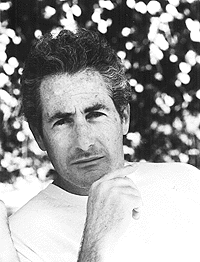 Barry Gifford |
straight. We wanted the film to be devoid of a certain kind of jokiness, which,
of course, you’ve seen before in Twin Peaks and Wild at Heart.
This is a very straightforward kind of picture. We avoided the humor entirely
so that everything that happens here is on a very straightforward realistic
basis. Now, it’s not that there aren’t things in there that you might find
humorous, but it’s all done entirely with a straight face.
AC: When you were writing the Sailor and Lula stories you actually
heard their voices popping out and speaking to you. Did that happen for you
while you were writing Lost Highway?
BG: No, not in the same way, and especially since David and I were
collaborating on this, the voices were really coming through the both of us.
AC: Many of your stories take place in central Texas. For example,
Perdita Durango begins in the San Antonio airport. I was wondering what
attracts you to this part of the country?
BG: I don’t know. I just got back from a long trip across the border. I
did a book called Bordertown. I guess I was always interested in a kind
of Latin sensibility. I was always attracted to the Tex-Mex world. Not that I
grew up with it, I didn’t. But the character of Perdita Durango, when she
popped up, was really kind of an id-driven character. And so maybe the
explanation is all in there.
AC: I read somewhere that Francis Ford Copolla asked you to do an adaptation
of On the Road.
BG: I did. I wrote a screenplay for him, but that project has been abandoned.
That was done with Gus Van Sant as the director and with Francis producing. And
then Francis changed his mind and decided to not have Gus direct the movie.
Probably not to use my script, though they own it. He gave it to his son Roman,
who wrote a script, and he was supposed to direct it. I don’t know if it’s ever
going to be done or not. But I did write a screenplay for On the Road and I was really honored to have been asked by Francis to do it and he seemed
very pleased with what I did. The movie business is full of vagaries and things
change all the time. It’s certainly out of my control. Francis has owned that
property for 25 years and he hasn’t made the movie yet.
AC: Are you influenced by the Beats at all in your writing?
BG: Well, certainly Ginsberg and Kerouac were great influences on my
generation. I think Tom McGuane said it best in an essay, that Kerouac inspired
people to get up out of Dipstick, Ohio — or wherever they were stuck — and
get out on the road and experience life. And I’ve had countless people repeat
the same thing to me. And so I think it’s more of an inspiration than anything
else. And not the Beats per se. Jack Kerouac, yes, who I felt was the one
enduring writer to come out of that so-called Beat era. William Burroughs too,
but Burroughs I never considered to be a Beat writer per se. Ginsberg’s early
poetry was certainly wonderful and inspiring and quite liberating. But Kerouac
influenced me more as an inspiration. I mean, obviously our writing styles are
not the same, so it isn’t in that sense. And not even in terms of a so-called
road novel. People bring that up a lot. Sailor and Lula went on the
road. Isn’t that a direct influence of Kerouac’s On the Road? But
what about Cervantes? What about Don Quixote? That was the first road
novel. What about Henry Fielding and Tom Jones? Or Joseph
Andrews? The tradition of the road novel and the road movie goes back a
very long way and people have very short memories.
AC: Should we look for an uncredited Barry Gifford cameo in Lost
Highway?
BG: (laughs) No, actually my cameo was offscreen. So no, you won’t see me
onscreen.
AC: David Lynch’s movies seem to be very shamanistic to me. Do you see
yourself as a shaman?
BG: I have no claim on any sort of shamanistic influence. All we’re doing is
creating a situation which is provocative, emotionally and mentally. Not to say
that we don’t have some meaning in our own minds about what’s going on in
Lost Highway, or even what went on in Wild at Heart, or in
Hotel Room, which I think is a great lost work, the Hotel Room plays. It’s really for people to draw their own conclusions. It’s not violent,
per se. I mean, a couple of people do get killed in the movie, one you only see
later, you don’t see the actual murder. But it’s really more terrifying in
terms of emotions. It’s a terrifying film. And it’s a serious film. I think it
needs more than one viewing to appreciate it. It’s like Sailor and Lula meet
Kafka as told from the perspective of the cockroach. David liked that
explanation, so I think it still fits.
AC: What other projects are you working on?
BG: Well, I’m writing a movie right now with Matt Dillon. And the film takes
place in Thailand and Cambodia, primarily. I’m supposed to make a trip there
soon.
AC: Is there anything else you’d like to say about Lost
Highway?
BG: This is a movie where we really pulled out all the stops and took a
big chance. It’s not Sleepless in Seattle. You could call it a
noir Sleepless in L.A. People are falling all over themselves to
make gentle comedies, you know, romantic comedies. And I love those movies. But
Lost Highway is kind of an antidote. Whether the public wants it or not,
or is ready for it is another matter entirely.
This article appears in February 28 • 1997 and February 28 • 1997 (Cover).