

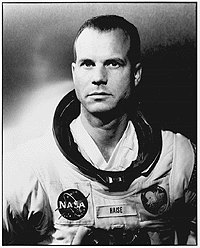
 Paxton in his Apollo 13role |
else is said or written about the actor Bill Paxton — the almost painfully nice guy in such films as
Twister, Apollo 13, and the great One False Move — I will
foremost remember him as the man who flies coach for the movie he loves.
But, of course, there is so much more to talk about when the subject is
Paxton. First, he is a shining example of what is known in his business as the
20-year overnight success. First cast with a one-line role in 1975 (in Jonathan
Demme’s Crazy Mama), Paxton worked steadily but in relative obscurity
until last year’s lead role in Twister. Twister — and you’re not
getting any breaking news with this — is the kind of film that makes an
instant star even of someone who has one of the most forgettable faces in
Hollywood.
It’s not that the face lacks appeal; quite the contrary. It’s just that its
comfortable, unthreatening ordinariness suggests the boy next door, that nice
guy in school whom girls flock to not for hair and muscles but for an
unmistakable aura of decency.
And the career — well, patches of it are admittedly unremarkable. Like that
long stretch between standout work as the obnoxious but redeemable Private
Hudson in 1986’s Aliens and the nomadic vampire Severin in Kathryn
Bigelow’s stylish bloodsucker Near Dark (1987) to the great One False
Move in 1991. Some of the films in between include Pass the Ammo,
Slipstream, Next of Kin, Predator 2, Navy SEALS,
and Brain Dead.
 In Twister |
on screen. Take his hilarious brother Chet in Weird Science, or Hudson
in Aliens. These were big, broad performances of characters who we sense
have little in common with the artist portraying them. He simply disappeared
inside a fanciful creation of his own making. But in One False Move,
Indian Summer, Apollo 13, Twister, and his new
Traveller, he throws off the wigs and heavy makeup and becomes a
variation on the real Bill — the Bill born and raised in Fort Worth and now
bringing up a family in a small California town.
Both methods produce outstanding results. With the larger-than-life
characters, his broad brush never overwhelms the canvas. His Chet in Weird
Science demonstrates how an actor can absolutely command a scene without
overdosing his audience. The much different working style in films like One
False Move and Traveller, which Paxton calls “minimalist,” is even
more interesting. Here he is generally calm, more normal, more what we suspect
Real Bill is like. Yet we know he’s not skating on a one-note persona, or
“playing himself,” because each of these cooler characters differs in
personality and temperament.
He has become an unlikely leading man, at least in terms of Hollywood
convention. And perhaps he is a model for the leading man of the new
millennium. He’s not alone, of course — Bill Pullman and Kevin Spacey, to name
two, possess the similar qualities of vulnerability and ordinariness. Together
they bring balance to the stable of action heroes and pretty boys that usually
get first crack at high-end Hollywood films.
Lately the 41-year-old actor has counterweighted his work in such Hollywood
hits as Twister and the forthcoming Titanic by producing and
starring in his own project. Traveller, which makes its world premiere
this week at SXSW, is a modestly budgeted serio-comedy about a group of scam
artists working the Southeast. They are of Irish descent and are known as
“travellers” for their nomadic lifestyle. They differ from gypsies, whose roots
are in Eastern Europe, only in ancestry.
In a lengthy telephone conversation last week from his home, he talked about
his new film, his approach to his craft, and of life after Twister.
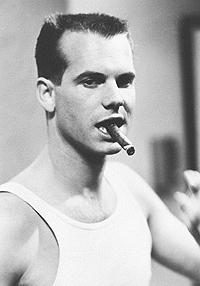 Paxton as Chet in Weird Science |
did someone bring it to you?
Bill Paxton: I was looking for something to follow One False Move,
another really great independent film. When One False Move came out it
got really great reviews; this was the film that legitimized my career. I had
been praised for Aliens, Weird Science, and Near Dark, but
it wasn’t until One False Move that people in this town began to take
notice of me. Anyway, I get a lot of scripts sent to my house, and my wife
Louise, who has worked as a script reader said, “This is pretty good, you
should take a look at it.” So she really discovered it.
It had a producer and director attached to it and I had seen the director’s
previous film and approached them about it. Well, I never heard back from them,
and then I heard that some other actors with more muscle at the box office had
expressed interest in it. That never went anywhere, though. Finally, after
Twister and Apollo 13 the past summer, I thought this would be a
good time to do Traveller. We approached them and asked to buy them out.
We paid them handsomely, I must say.
AC: How did Jack Green (cinematographer on Unforgiven and
Twister) come on board as director?
BP: Jack was legendary for his Clint Eastwood films, especially
Unforgiven. While we were doing Twister, I found he had this
burning desire to direct. I told him you can direct Traveller as your
first picture, but as producer I’m going to be more creative, so it’s going to
be more of a collaboration on every level. I can’t say enough good things about
him, especially in creating an esprit de corps, respect for the actors.
He is so disarming he puts you completely at ease.
AC: Are “travellers” real?
BP: They’re so real that on the second day of shooting (in Wilmington, N.C.)
the newspaper had a front-page story about scam artists who were going to
people’s houses saying they would light their furnace for $10, then they’d come
back upstairs with a Mason jar full of bugs and say, “You have brick mites
everywhere, but for $800 we can get rid of them for you.” There’s also a
company that makes cheap knock-offs of brand-name house trailers, and these
guys buy them and sell them for twice as much. They fall apart in about two or
three months.
AC: Let’s go back to the beginning. You left Fort Worth for Los Angeles when
you were only 18. Why was that?
BP: Well, I had tried to go to film school. I had been working at Mrs. Baird’s
Bakery at night in my senior year. Then I got a chance to go to England for
three months in a student exchange program. That’s where I met Tom Huckabee
(who supervised music for the Traveller). I had made a few Super-8 films
in high school and it turned out he had, too. When we got back in the fall of
’73, we pooled our money — I was working at my dad’s lumberyard — and started
making films together — parodies. We did one called Earth Army on
Venus, and Death Wish in Venice, which used elements of Death
Wish and Death in Venice.
I decided that was it. I went to the TCU [Texas Christian University] film
department dean and he said you ought to go to Dallas and get some work in
commercials and see if it’s something you want to pursue. Then come back and
I’ll let you into film school. I did that but I didn’t find anything. I said,
“Dad, who do you know in Hollywood?” It turned out he knew someone who did
industrial films, and I got a job for two weeks. My father bought me a ticket
and took me to the airport and said, “Son, I love you, I support what you’re
doing, but you picked a really screwed business.”
Anyway, I did that job for two weeks and then met a guy doing art direction
for Roger Corman. I got hired as a set dresser for Crazy Mama, and one
day they needed somebody to play a lawman so they put a costume on me and had
me say one line.
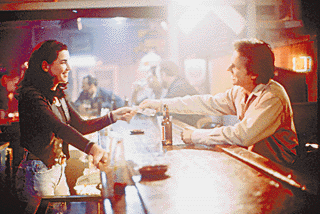 Paxton as Bokky in his new film Traveller, with Julianna Margulies |
BP: Actually, no. I went to see him on a project not long ago and he didn’t
remember.
AC: You have been working steadily ever since. I couldn’t believe when I saw
you’ve done something like 40 films. Are you the typical actor who worries that
his last job will be his last job?
BP: I think every actor has that insecurity. I’m as hungry as ever in terms of
what I’d like to accomplish. When you move up the next rung on the ladder, like
I did with Twister, the competition is much keener; there are fewer of
those slots to fill. I turn down work a lot because most of it is trashy stuff
and they just want to use my name to sell to foreign markets. I’ve taken a
couple of professional dives for the money, but, generally, I think I have a
pretty good record.
AC: Name one of those dives.
BP: Vagrant [1992]. It was an unmitigated disaster, and I ended up on
the video box in a pose like Macaulay Culkin from Home Alone. It was
supposed to be a comedic version of Pacific Heights. There’s a vagrant
living on a vacant lot, and I’m a yupster across the street who obsesses on the
guy. Mel Brooks produced it and we had a great cast, but about halfway through
the studio decided they wanted more of a horror film. You know, you have to be
careful about the tone you set. But now we were shooting scenes that were much
more horror-driven, so it came out a mish-mash.
AC: And then there’s One False Move. I have my opinion, but why do
you think this is such a terrific film?
BP: Well, my contribution is certainly just one. I’d say the script by Billy
Bob Thornton and Tom Epperson. Carl Franklin’s deft handling of the material.
He is just so consistent, there’s not one false note. He had been an actor for
many years. The film has a real simplicity in the way it is presented, there’s
not a lot of fancy camerawork. In the MTV Age it’s very chic to call attention
to the camera, but when you call attention to the artifice you lose something
else.
AC: How did you approach your character of the Arkansas lawman in the
film?
BP: All actors try to perfect what they do, hone it, distill it. Years
ago when I was a student in New York, I had the opportunity of studying with
Stella Adler. Very early on, she had me do a scene from Zoo Story, the
Edward Albee play. Well, she just ripped my balls off. I couldn’t even get out
of bed the next day. But she did say one funny thing. She said, “Dahling,
you’re not ready for realism.” So she had me do all kinds of things — Noel
Coward — but no realism.
With One False Move, you’re kind of naked up there, you’re much closer
to the center of who you are. It’s naturalism. What you’re trying to do is make
maximum impact with minimal effort. When I did The Last Supper (last
year), I had a first-time director and I didn’t get much from her so I said,
“I’m gonna do this for Bill and see how minimally I can play that.”
AC: That’s a chilling scene you’re in.
BP: All I did was relax. Besides, I didn’t have much prep time. I was
shooting Apollo at the time and shot that scene on a weekend.
AC: Why didn’t One False Move get better distribution?
BP: When it came time to release the film they felt there were no stars in it
and kind of downplayed it. By the time the reviews came around, it was too
late. The person who got the whole thing going for us was Sheila Benson of the
Los Angeles Times. She has this little critics’ festival in the
Caribbean where everyone shows these little gems they have found, unheralded
films like ours. She showed it to Roger and Gene, and picked up the flag and
carried it.
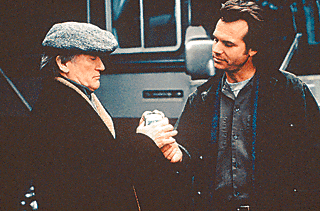 With Luke Askew in Traveller |
can’t get to a screening or if there is no screening, people can see them. I
called the distributor and they weren’t even planning to send out cassettes. So
I put up $20,000 of my own money — the cardinal rule in Hollywood is never use
your own money — and sent out videos to all the members of the Academy. It
turned out to be one of the best investments I ever made.
AC: Did it get you Twister?
BP: Well, I was the first and only one Jan [de Bont] interviewed for the part.
And I know that Tom Hanks put in a good word for me.
AC: Will there be a sequel to Twister?
BP: I don’t know. There’s been some loose talk, but when a movie makes
something like $700 million, you have to think about the possibility. I would
like to be involved in the conception of that film.
AC: You’re also in Titanic later this year. What’s that going to be
like?
BP: It’s the most unbelievable thing you’ve ever seen. I play a supporting part
in the movie. There’s a wrap-around story about an expedition into the bowels
of the ship in a submersible, a salvage operation. I’m very mercenary, never
bothered by ethical considerations. It’s more naturalistic, but maybe not as
minimal as that guy in Last Supper.
AC: Back to Traveller. There’s a lot of good music in it, Randy
Travis singing “King of the Road,” things like that.
BP: There’s a man in Connecticut who fronted the money for this film and he
told us to spend the time to make it right. A score was written but it didn’t
really work. I had always wanted to use a lot of source music, but to get all
the songs we wanted in the movie would have cost us
$300,000-400,000 to
license it. So I called Seymour Stein at Elektra Records. He loved the movie
and wanted to use some forgotten country songs using contemporary artists. The
music took a month and a half to organize, then six weeks to record. About 90%
are covers of classic songs. We worked out a deal with Asylum where they picked
up the cost of recording it, and we paid for the remix, and we brought it in
for $135,000.
AC: You are pretty famous and recognizable now. How does celebrity agree
with you?
BP: Yeah, the nickel finally dropped. I can go into town or be standing in a
lobby and I’ll see people point. It’s kind of freaky, but it’s good because if
you have that kind of recognition in the marketplace, you feel that there will
be another job coming your way. We live away from Los Angeles in a small town
and we have a lot of privacy up here. On Traveller, I was flying around
a lot and because I was producing the film I wanted to save money and fly
coach. People got a kick out of that and said, “What are you doing back
here!?”
AC: Has your father changed his opinion of your line of work?
BP: Well, my father retired a few years ago and he moved out here and is taking
acting lessons and trying to get parts in movies. I told him “Dad, I love you,
I support what you’re doing, but you picked a really screwed business.”
The SXSW Film Festival showtimes for Traveller are Saturday, March 8, 9:30pm
at the Paramount and Saturday, March 15, 2:30pm at Dobie II.
This article appears in March 7 • 1997 and March 7 • 1997 (Cover).