

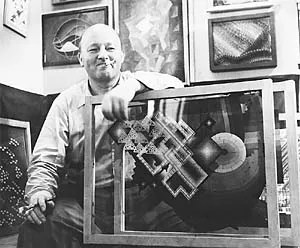
Oskar Fischinger Retrospective
His patron, Baroness Hilla Rebay, mocked his masterwork, “Motion Painting No. 1,” and its “awful little spaghettis.” His homeland branded his abstract art as “decadent” and “degenerate.” Uncle Walt signed him up to work on Fantasia; hiring the internationally renowned artist as a “motion picture cartoon effects animator” for a lousy $60 a week. By 1947, he could no longer secure funding for the brilliant animated films that married music and drawing in fantastic, ever-shifting geometric shapes. He turned to traditional easel painting to make a living, and never finished another film before his death 20 years later.
Welcome to the life and times of Oskar Fischinger. He didn’t get much respect then — in addition to Disney, Fischinger was punted between Paramount, MGM, and Mercury Studios, none of whom knew what to do with him — but he always had champions, including Orson Welles, Wassily Kandinsky, and, later, John Cage, who credited Fischinger with having changed his entire perception of sound and music.
Cinematexas’ restrospective features 13 of Fischinger’s pieces, including the playful “Allegretto,” which mimics each of composer Ralph Rainger’s orchestral shifts: The fluttering of flutes is rendered in falling teardrops, while the fat “whaa-whaaa” of a trumpet ovals out in concentric circles expertly timed to the music. It is “Motion Painting No. 1,” however, that stands as Fischinger’s masterpiece. Set to Bach’s Brandenburg Concerto and painstakingly shot in stop-motion, this 12-minute-long seamless series of paintings calls to mind Seurat, Mondrian, and Van Gogh (at one point the colors and swooning strokes recall Starry Night), as well as a mosque’s mosaic-tile art and an architect’s careful line drawings. Far-flung influences, to be sure, but the effect is something wholly Fischinger’s own. By film’s end, the eyes can barely focus from this dizzying confluence of motion and music. Awful little spaghettis, indeed.
The Oskar Fischinger Retrospective screens on Wednesday, Sept. 17, 5pm, at the Alamo Drafthouse Downtown.
This article appears in September 12 • 2003.
