

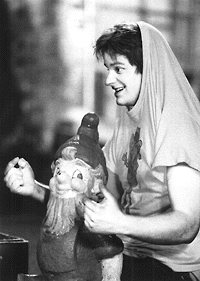
 In her festival coverage for Cinemania Online, Sheila Benson is the first to report a new trend in independent films: lawn-troll snatching. Witnessed in at least four festival films, she first noticed it in subUrbia with Steve Zahn. |
you seen anything good?” That was the most frequent conversation starter at the
1997 Sundance Film Festival.
Everyone was searching. After all, that’s why they had trekked to this Utah
mountain resort of Park City for the Robert Redford-blessed, annual celebration
of American independent filmmaking, held this year between January 16 and 26.
Be they acquisition executives, distribution deal makers, festival programmers,
talent agents, trend-hungry writers and journalists, or ordinary film fanatics
— all were looking. For what? For that special “must-see” film, for the
“best-bet” investment, for a diamond in the rough, for the next big thing, for
that special niche film, for… a hint of consensus. It was not to be found.
The disappointment was almost palpable. It may have been the only point of
agreement among the festivalgoers. Certainly, there were good movies to be seen
within the festival’s presentation of nearly 200 features and shorts. But none
of them, for better or worse, seemed able to prompt the kind of passion that
erupted in last year’s infamous restaurant brawl/bidding war between the two
distributors who each thought they had a lock on the movie Shine. Prior
to the conference, Redford went on record condemning the tendency to tag
certain festival favorites as “buzz” movies because of the way it caused all
the other selections to fall below the radar blip. His cautions may have been
prescient. Although the term hardly disappeared, the buzz was more in the
category of low frequency than deafening roar. And no one movie had its hand on
the knob.
Sundance has launched the career of many a budding filmmaker. As the biggest
and most important annual showcase of American independent film, the festival
maintains its Cinderella mystique whereby a first-time filmmaker can arrive in
an impoverished Rent-a-Wreck and fly home first-class. Getting a film accepted
is already like winning the sweepstakes. But, then, being tapped by audiences
and buyers as one of the “chosen” ones is the indie filmmaking world’s version
of overnight success.
The watershed year in the history of Sundance was 1989, the year that Steven
Soderbergh’s sex, lies and videotape won the audience prize and prompted
an unprecedented bidding war from which the fledgling Miramax distribution
company emerged the winner. The low-budget movie went on to win the top prize
at Cannes and grossed over $24 million. Ever since, the rush has been on. It
may just be that the high-water mark was reached in 1996. Perhaps it was a
serendipitous anomaly that so many well-crafted and commercially viable
independent films hit the screens in 1996. Maybe the apparent paucity of
sure-fire hits at the 1997 festival is a comparative illusion based on
unrealistic expectations carried over from the year before. It might just be a
result of the natural ebb and flow in the cultural process — an “off” year —
or perhaps, the intangible vagaries of the selection process. Yet, somewhere in
all this, I suspect that we may now be entering the gluttony cycle of
independent filmmaking. These days, everyone wants to be a filmmaker but so few
of them are artists. Approximately 600 submissions were received for the 18
dramatic competition slots, a drastic increase from the approximately 250
submissions just two years ago. With greater access to the means of production
and distribution, more and more people flirt with the romance of filmmaking. As
might be expected, few prove to be good lovers.
1996 turned out to be a landmark year for independent filmmaking. On both the commercial and critical
fronts, independently produced movies came out big winners — Fargo,
Lone Star, The English Patient, Secrets & Lies,
Trainspotting, Shine, Big Night, Welcome to the
Dollhouse, and Bound are just a few of the titles showing up on box
office and year-end critics’ lists. Shine, Big Night,
Dollhouse, and Bound all took their first bows at Sundance 1996,
along with some other of the year’s big indie titles including Caught,
Walking and Talking, Looking for Richard, The Last Supper,
Hype!, Ed’s Next Move, The Celluloid Closet, I Shot
Andy Warhol, as well as some that are scheduled to be released in Austin in
early 1997: Citizen Ruth, johns, When We Were Kings, and
The Whole Wide World.
Unlike the feeding frenzy that took place in 1996 when Fine Line’s record
purchase price of $2.5 million for Shine was immediately eclipsed by
Castle Rock’s $10 million purchase of The Spitfire Grill, 1997 appeared
calmer. A number of films were sold during the festival and undoubtedly will
continue to sell over the next few weeks. The big purchases averaged in the
$2-3 million range, up from the average several-hundred-thousand dollar range
it had been just a few years earlier but nowhere near Spitfire Grill‘s
record-setting price. And with Spitfire Grill‘s disappointing $12.5
million box office return, the buyers were understandably chastened.
If the distributors appear more mindful of the risks of the marketplace, they
still recognize the profit potential inherent in one solid indie hit.
Shine, for example, has brought in $12 million since its November
release and is still going strong. Ever-increasing advertising and marketing
costs also continue to shrink profit margins, although the overall marketplace
success of independent films in 1996 has been nothing short of remarkable.
Inevitably, as the commercial viability of these films grows exponentially, so
too does the whole Sundance phenomenon. With attendance expected to climb to
nearly 10,000 this year, the festival has become more of an arena for
presenting new films and talent to industry representatives, rather than to
unaffiliated audiences of moviegoers. As this occurs, some also question
whether that push for commercial potential affects how films are chosen for
competition and presentation. Is there room enough in one festival for the
contingents of industry executives on shopping expeditions and the film fans
seeking riskier fare?
For the organizers of Slamdance, the apparent answer is no. Organized three years ago by three
filmmakers whose works were rejected by Sundance, the counter-festival
continues to be a thorn in the side of Sundance. Held in Park City
simultaneously with Sundance, the festival of “refuseniks” seems as much an
adjunct as a rejection of the festival that, inevitably, provides its identity.
In their first year of existence, Slamdance was embraced by the press more for
its spirit and puckish behavior than for the quality of its movies. And this
festival dedicated to the first-time filmmaker may well be responsible for the
institution in 1996 of the new Sundance sidebar called the American Spectrum,
which showcases another couple dozen movies out of competition. In its second
year, Slamdance’s choice of films appeared a bit stronger and the inclusion and
jury win of The Daytrippers, the hilarious Steven Soderbergh-produced
movie by Greg Mottola, went a long way toward increasing Slamdance’s profile
and reputation. In 1997, former Sundance golden boy Soderbergh once again
showed his new personal movie Schizopolis, in which he also stars. The
movie was shown out of competition, as was the new movie Fall by Eric
Schaffer (My Life’s in Turnaround, If Lucy Fell).
Although this year’s Slamdance presented nothing quite as solid as the comic
Daytrippers, the 10 competition films had much to recommend them. Having
last year’s venue of the Yarrow Hotel boldly usurped this year by Sundance for
additional screening rooms, the scrappy fest found new digs at Main Street’s
Treasure Mountain Inn, across the street from another primary Sundance venue,
the Egyptian Theatre. Slamdance organizers are already trying to extend their
reach with additional programs such as their first annual screenwriting contest
and plans for film co-ops and the inclusion of indie trailers on its website
(http://www.slamdance.com). Also, there is unconfirmed talk of Slamdance moving
next year to another city and date, something that would help direct the
festival toward a unique identity. One of the greatest Slamdance ironies is
that the festival’s ratio of refusal has grown even greater than that of
Sundance. Approximately 1,000 films were submitted for the 10 Slamdance
competition slots, compared to approximately 600 for Sundance’s 18 dramatic
competition slots.
The birth of Slumdance in 1997 may thus have been inevitable. Billed as an
“experience” rather than a festival, Slumdance more than lived up to those
modest claims. Housed in a basement across the street from Slamdance, the new
kids on the block spread the word about their event via flyers in Park City and
a spontaneous, and very funny, website (http://www.slumdance.com) that appeared
just a few weeks before the start of Sundance. Filmmakers were invited to
submit tapes which could be checked out by Slumdance visitors in a “build your
own festival” fashion. The “Slum” contained a couple of screening rooms which
projected films on a regular schedule. But the highlight of the Slum was the
Tent City, a cluster of makeshift screening areas scattered throughout the
basement where mattresses and hammocks would be plopped in front of VCRs and
TVs and visitors could check out the submitted tapes for viewing. A daily soup
kitchen also provided nourishment for those slumming their way through the
pricey ski resort of Park City. Their all-night Slumberdance advertised itself
as the only festival at which it was not a faux pas to fall
asleep during a screening.
A few noticeable patterns could be discerned from the films shown at this year’s Sundance Festival.
First, were the many out-of-competition premieres of films by seasoned
filmmakers, many of whom could be considered festival “regulars.” Richard
Linklater’s subUrbia, based on the Eric Bogosian play, had the
distinction of being selected as the opening night movie. Also premiering were
Chasing Amy, the smart and funny new film about sexual barriers by Kevin
Smith (Clerks, Mallrats); Nowhere, the heterosexual teen
drama from the New Queer Cinema’s bad boy Gregg Araki; two-time grand jury
prize-winner (for Gal Young ‘Un and Ruby in Paradise) Victor
Nu�ez’s Ulee’s Gold; David Lynch’s newest creative dementia
Lost Highway; the wacky stylings of Robert Downey, Sr. (Putney
Swope) in Hugo Pool; Living in Oblivion and Johnny
Suede‘s Tom DiCillo’s quirky new effort Box of Moonlight which stars
another festival darling, John Turturro; Arturo Ripstein’s lurid Mexican
novella version of the Honeymoon Killers story, Deep Crimson; and
the masterful, if almost indescribable new film, Fast, Cheap & Out of
Control, from the ever-original mind of Errol Morris (The Thin Blue
Line, Gates of Heaven).
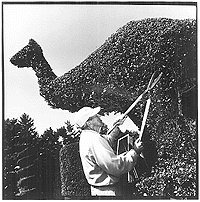 Fast, Cheap & Out of Control,from the ever-original mind of Errol Morris |
Melodramas about boys in the urban jungle were common. The triple-awarded
Hurricane (audience award and jury awards for directing and
cinematography) is perhaps the best example. Executive-produced by former
Dallas residents L.M. Kit Carson and Cynthia Hargrave and starring Welcome
to the Dollhouse‘s Brendan Sexton III (Carson also has an acting role), the
movie is an affecting, albeit contrived, story about a boy swept up in the
consequences of a murder he didn’t commit. Strays by Vin Diesel and
Black Circle Boys by Matthew Carnahan were also two of the big
contenders in this category. The anguish endured by young men were also the
subjects of Going All the Way, a period adaptation of a Dan Wakefield
novel that won a special recognition prize for production design, and
Slamdance’s mildly amusing audience award winner, Eight Days a Week by
Michael Davis.
Teenage gal pals were also in great visibility, even if the sexual components
were sometimes more incipient than overt. Arresting Gena is a muddled
drama about two troubled teens by Hannah Weyer; All Over Me is a more
successful tale of challenged friendship directed by the sister team of Alex
and Sylvia Sichel; and Girls Like Us by Jane C. Wagner and Tina
DiFeliciantonio, which tracks the lives of four South Philadelphia girls, won
the documentary grand jury prize. Other films that presented their takes on
teen female angst included Su Friedrich’s Hide and Seek, Sarah
Jacobson’s Mary Jane’s Not a Virgin Anymore, and Coky Giedroyc’s British
film Stella Does Tricks, which explores prostitution through the eyes of
a 15-year-old protagonist.
Issues of sexual politics and fetishistic sex preferences were also rife.
The Canadian film Kissed by Lynn Stopkewich, based on a story by Barbara
Gowdy, explores necrophilia; and the painful but riveting documentary Sick:
The Life and Death of Bob Flanagan, Supermasochist by Kirby Dick makes us
understand the subject’s intertwined relationship between his 43-year battle
with cystic fibrosis and his S&M practices and humorous performance art;
Kristine Peterson’s Slaves to the Underground looks at p.c. culture;
Mark Waters’ popular House of Yes includes incest in its exploration of
the family dynamic; Ira Sachs’ The Delta is a meditative gay
coming-of-age story set in Memphis; gay-bashing is the subject of the new
documentary by Arthur Dong (Coming Out Under Fire); Julie Davis’ popular
I Love You… Don’t Touch Me follows a 25-year-old woman’s search for
love and the loss of her virginity; Kiss Me, Guido is a Lower East Side
Birdcage knockoff from esteemed producers Ira Deutchman and Christine
Vachon (Poison, I Shot Andy Warhol). Audience award winner
love jones by Theodore Witcher is a story about love between two young,
black professionals, and the filmmakers trophy winner, In the Company of
Men by Neil LaBute is a relentlessly misogynistic but wholly original and
smart drama.
Some other notable films include Sunday by Jonathan Nossitor, the
winner of both the grand jury prize and the Waldo Salt screenwriting award and
one of the few films in the festival about middle-aged people, and a number of
distinguished documentaries including the nearly three-hour-long Waco: The
Rules of Engagement by William Gazecki, which provides a gripping
expos� of abysmal government conduct.
Austin filmmaking was well-represented at the festival. In addition to the opening night honors
bestowed upon subUrbia, two shorts by local filmmakers also premiered.
Words of the Ancients by Paige Martinez, which relates the struggle of
the Hopi people to retain their cultural and religious sovereignty, was in a
special program of Native American work. George Langworthy’s eight-minute, 35mm
short Breezeway was shot in Hyde Park and tells the humorous story of a
nicotine addict. It stars Joe Stevens and features the on- and off-screen work
of many folks familiar to the habitu�s of the Chronicle offices.
Breezeway was made with the grant money Langworthy received this summer
from the first annual Texas Filmmakers’ Production Fund endowments. The road
movie Lewis & Clark & George by Rod McCall features the
production design work of local resident John Huke, with set decoration by
Randy Huke. And producer’s rep Elizabeth Avellon (From Dusk Till Dawn),
helped broker the sale of I Love You… Don’t Touch Me to Metromedia
Entertainment Group. Also in attendance were film critics from both Austin’s
daily and weekly, SXSW Film Festival head Nancy Schafer, Dobie Theatre owner
and programmer Scott Dinger, and many, many more.
It’s become fashionable to gripe about the way Sundance has become so big and
unwieldy, about the long waits in line that do not even guarantee admittance,
the projection difficulties and bad sound in the makeshift hotel ballroom
theatres, the commercialism, the Attitude, and the inconveniences of attending
a major film festival in a small town that lacks the infrastucture to support
such an event. All this is true. Yet, everything is forgiven when the house
lights fade and you find yourself rapt in the dark and, possibly, catching a
glimpse of the future.
http://www.sundancechannel.com/festival97/
This article appears in January 31 • 1997 and January 31 • 1997 (Cover).
