

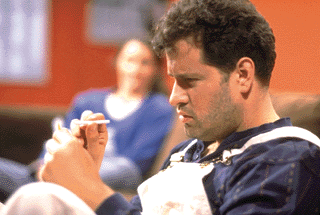
|
criteria are used when labeling a film `alternative’ these days, it’s certain that
Use Your Head would qualify based on its subject matter alone —
fictitious sessions excerpted from a government-funded drug study designed to
determine the effects of marijuana and alcohol in combination. For one thing,
the six characters we follow exist in an almost perpetually altered state of
consciousness. But how they arrived there, hatched by the filmmaking
partnership of Loch Phillipps and Lee Skaife, is an alternative matter in
itself. Even more interesting: How did these guys create a wholly entertaining
film based on what are essentially random thoughts?
Seduced by the freedom an atypical narrative structure allows — and rising to
a task that really puts a film’s writing to the test — Phillipps and Skaife
set out to uncover something larger from these small, everyday philosophies by
examining them closely and humorously. The revelation that it’s these banal
thoughts that shape who we are as humans is actually rather comforting. No
matter how many times each pair of study participants — Moss and Kellen, Sarah
and Duncan, or Konrad and Dave — puts a joint to his or her lips and inhales,
we can identify with what they are thinking. We like them; they make us laugh.
And when the smoke lifts, clearly there’s something tangible left behind.
In town to attend Use Your Head‘s theatrical debut (the film had its
world premiere at the South by Southwest Film Festival last year), Phillipps
and Skaife sat down with us to talk about the film, its comic philosophy, and
the unusual process it took.
Austin Chronicle: How did the idea of Use Your Head come about? Is it
based on a real drug study?
Loch Phillipps: I kept saying to John Huss, who co-wrote the film with me,
“We’ve got to think of an alternative structure, something that allows us to
bring whatever we experience that day to the script.” I didn’t want to be
confined by a plot. And he had heard of this university drug study — we knew
some people who had done it. I interviewed a bunch of the actual participants
and we weren’t really happy with the real characters so we made up our own
characters and kept the basic format of the study.
Lee Skaife: We kept the parameters of the study intact, like how the subjects
had to blow into an apparatus at a certain time each day, and they could only
drink a certain amount at a time.
LP: The research assistant was doodling in the actual study and one of the
participants actually bought the doodles, just like in the film. I have some of
those drawings at home. And one of the test questions that Konrad and Dave make
fun of — “Do I feel more light-headed than dreamy?” — that’s an actual
question from the questionnaire.
AC: Reviews I’ve read all note the quality of the comic writing in the film.
All those stories the characters tell each other, where did they come
from?
LP: Some of the stories were ours, some were collected from friends. Both John
and I (John is a philosophy of science major) keep notebooks of things we
observe in life, and so often we’d start with one of those observations or the
conversation would be centered around one of the thoughts that either of us had
previously had. We literally just passed the keyboard back and forth, which
worked great because of the structure of the study — two subjects in a room
together talking.
LS: John and Loch have crazy minds, they’re both really on the same level —
their ideas are out of control. Also, the way they word things is hilarious. I
can brag about them because I didn’t write any of the dialogue. The spontaneity
of the whole thing really helps with the humor factor.
AC: And you scripted it together?
LS: Loch and I took all those conversations and stories and made one-sentence
synopses of them. We put them on note cards and tried to decide which character
each thought or story belonged to. After we had the dialogue chosen, then we
scripted it. Loch and I had long talks about what the characters would see in
their heads while they were describing their thoughts or telling a story.
AC: The exchanges are just so natural, there didn’t seem to be any forced
dialogue at all. If there’s an awkward moment between characters it’s an
awkward moment because of the situation that’s been set, and they just giggle
it off or change the subject and proceed naturally.
LP: Some of the credit goes to the actors on that — especially with the Sarah
character and Dave, the black character. I’m a white guy so I gave them a lot
of leeway to change the dialogue, as long as they were getting the meat of what
we were saying. And we worked a lot. We really rehearsed the hell out of those
major six characters.
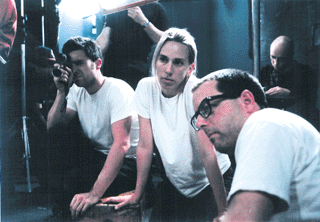 Use Your Head filmmakers (l-r): D.P. Mott Hupfel, directors Lee Skaife and Loch Phillipps |
the character Moss.
LP: They’re all from New York; no shortage of good actors there. A great story
(except for the guy we had to can) is that we had the two main characters —
Kellen and Moss — but we had a different guy playing Moss and it just wasn’t
feeling right. I’ve always thought my brother was talented so I called him up
to see if he’d do it. He worked really hard for three weeks…
LS: …and ended up being everyone’s favorite character.
AC: He provided some unique physical humor. He was always eating while he
was talking but he was never self-conscious about it.
LP: Yeah, we noticed later he was sort of always ingesting something.
AC: It really is notable that most of the comic value is attained by a
putting a spin on everyday occurrences that we would hardly notice
normally.
LP: Well I’m a pretty neurotic, high-strung person really, and I will freak out
if I’m going to buy rubbers in a 7-Eleven or something like that. I’m very
tense. So, you know, these things don’t seem minor to me. Frankly, I’m totally
middle class. I haven’t been in a car chase, have not seen many guns — well, I
think we did see some, we live in Brooklyn (laughs) — but things like that
don’t happen to me and I really believe that politically, at least
sociopolitically if you will, that these things really do matter. It’s so
important how we treat other people. Most movies would have you leaving the
theatre thinking if you weren’t being chased by a guy with a gun today or you
weren’t participating in a drug deal or something like that then you haven’t
lived. But, in fact, you have lived, and you have had impact. This is a movie
that’s saying: Pay attention to these things; it’s saying: Don’t forget, don’t
feel insignificant.
AC: Despite the fact that the plot isn’t full of conventional action, the
scenes are interesting to watch. As an audience, we become engrossed because
the pacing of the film is very structured, like how the pair of characters will
have an exchange and then we will almost always progress to a scene that
explains one of the characters’ thoughts.
LP: I’m really interested in consciousness and that’s what we wanted to get at.
There was supposed to be a different look to each character’s thinking — I
don’t think it really comes out as well. We did chicken out to some extent,
partly because we couldn’t afford it.
LS: We gave each character a rhythm, like Sarah is supposed to be very jumpy,
her ideas are far away and then close up. The funny thing, though, about their
consciousness is we never even thought of it as what they were seeing on drugs
or anything. It had less to do with drugs and more about how you remember
something.
LP: We tried to characterize their personalities here, too… like the
character, Kellen, has all these bright colors all the time.
LS: We decided to mess around with time as well — fast and slow motion — to
illustrate how the characters remembered, and we experimented with muted colors
and black-and-white for certain scenes.
AC: Being high does help bring certain aspects to the foreground that when
straight you might pass over.
LP: That’s exactly what I consider to be the role of drugs here — really
minor. It’s not at all about being high and being stupid in that classic
Hollywood sense. It’s just that being high might help you follow a thread a
little bit longer.
AC: I can imagine most people will really identify with the characters in
the film. Have you had any problems because of the subject?
LP: It’s not the drugs, it’s the structure. And it’s a comedy that lacks any of
that sort of overt political correctness. There’s not much talk about any
specific minority group. It’s fairly middle class all the way around.
LS: And people have trouble classifying it. It’s sort of in-between an art film
that you might find in a museum and a commercial film…
LP: Except it’s a comedy and museums don’t take comedies. It’s tricky. That’s
what frustrates me about comedy. People definitely, as Woody Allen says, couch
it as “sitting at the kids’ table.” And I think that’s such crap.
LS: But this is a great place for the film. During South by Southwest last year
I would watch people in the audience each laughing at different parts they were
relating to.
LP: We’re really happy to use Austin as a test market. It’s such an ideal town
for us. I love Austin. The filmgoers here are so open to different kinds of
movies and this is what happened with Slacker, not that much success on
the festival circuit and then it showed here for a long time and then [the
movie business] said, “Wait, maybe we made a mistake, maybe people are ready
for this kind of film.”
AC: So what’s next for you guys?
LP: We’re writing a film that I’m excited about with a similarly convoluted
plot which is really about money. It’s based on a couple of months of one guy’s
checking account and you follow the checks out in all these directions to see
who gets the checks and how they respond.
LS: Use Your Head is great cause you can probably see it six times and
each time see something new. But it’s demanding too. We’d like to slow down in
this next project, suck people in a little bit, create more of a mood.
LP: We’ve learned if we wanna make people think, we’ve gotta give them a little
time to do so.
AC: I can’t let you go without asking the obvious question: How much pot
smoking went on during the filming? Are all the actors stoned out of their
minds for real?
LP: There was only one actor who was actually high during the shooting and
that’s the mystery. If someone guesses who it is we’ll give ’em a Volkswagen
Beetle or something. But the actors had all smoked pot before; we tried not to
play it up too much. To be honest though, there was quite a bit of pot
smoking going on in the writing stage.
Use Your Head opens at the Dobie on Friday, February 14. Check “Showtimes” for
screening schedule. Coincidentally, Use Your Head co-writer John Huss, who also
wrote and performed some of the songs on the movie soundtrack, is playing here
with his band The John Huss Moderate Combo on Feb. 13 at the Manor Road Coffee
House and Feb. 15 at The Showdown.
This article appears in February 14 • 1997 and February 14 • 1997 (Cover).