

Now
is the winter of our… literary classics on film.
Sure, invasions like this happen every autumn as the summer’s no-sweat film
amusements melt into oblivion. Yes, it was fun to see those cows fly by in
Twister and to watch our stand-ins protect the American way of life from
alien takeover in Independence Day. But sure as the earth continues to
rotate around the sun and one season assuredly begets another, the summer’s
movie escapism gravitates into the serious-mindedness of fall.
Perhaps it’s just a part of our conditioned American lifestyle that triggers
that sensible inner voice that chides at the end of every summer: “Back to
school. Back to school.” It’s the voice that reminds us that recess is over and
it’s once again time to hit the books.
The Hollywood distribution system has long helped to solidify this national
biorhythm by deeming summer to be the exclusive domain of genial, undemanding
fare — the silver screen equivalent of lightweight beach books. But as the
days grow increasingly shorter and colder, and the race toward the Oscar finish
line pares down into a high-visibility sprint, Hollywood rolls out its
“quality” material. It’s even ordained in the official rulebook: Never wear
white after Labor Day; never release a Shakespeare film before Labor
Day.
This notion that thought-provoking, high-minded material is best reserved for
the winter months has proven resilient, even though some arthouse distributors
during recent summer months have chipped away at the catechism by daring to
release some decidedly non-fluff items that went on to achieve successful
box-office numbers. Of course, there are also the exceptions that prove the
rule, such as this summer’s disappointing release of Moll Flanders and
the animated Hunchback of Notre Dame.
 Nicole Kidman in The Portrait of a Lady |
“quality” with the classics. The reasons are many. As a fledgling art form, it
benefited the movies to be linked with great works of literature and theatre.
The high art was bound to rub off on the celluloid and the cultural importance
of the material was already established. The classics endure because they are
stories for all time, their storytelling skills transcend the petty specifics
of culture and history. And even today, if the subject matter draws from
Shakespeare, Jane Austen, the Bible, or some other venerated scribe, our
tendency is to automatically regard the film with dignified respect. Although
we’ve learned that great literature does not always a great picture make, we
still believe that a good pedigree sweetens the odds.
As we enter the new winter film season, the outlook is predictably familiar. It’s time to trade in our
Stripteases and Nutty Professors for corsets and iambic
pentameter. What’s different about the season ahead is not the kind of
material being offered. What’s different this year is the number of
high-art films being presented. Depending on how you count such things, there
are anywhere from six to twelve film adaptations of certifiable literary
classics scheduled to open during the next couple of months.
William Shakespeare leads the pack with at least five film treatments on tap
of his Elizabethan-era plays. Moreover, these come on the heels of 1995’s
Othello starring Laurence Fishburne and Kenneth Branagh; the extremely
inventive Richard III with Ian McKellan, which recast Shakespeare’s most
notorious villain as a fascist in 1930s England; and Branagh’s comical A
Midwinter’s Tale, in which an amateur theatre troupe mounts a production of
Hamlet. Taking little heed of the farcical disasters that befell his
volunteer thespians in A Midwinter’s Tale, Branagh is due to release on
Christmas Day his new four-hour-long (including intermission) film version of
Hamlet with a cast that includes Julie Christie, Gerard Depardieu,
Rosemary Harris, Charlton Heston, Derek Jacobi, Jack Lemmon, Robin Williams,
Billy Crystal, and Kate Winslet. As both an actor and a director, Branagh has
shown himself to be one of Shakespeare’s most loyal film boosters. His 1993
rendition of Much Ado About Nothing became the most prosperous
Shakespeare film released in the last 20 years, and also broke the traditional
release-pattern laws by debuting during the summer of that year.
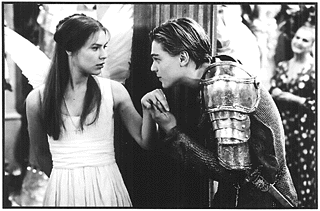
Currently playing in Austin are William Shakespeare’s Romeo &
Juliet and Looking for Richard. Each boldly uses the medium of
filmmaking as a tool for uncovering aspects of the plays, Romeo and
Juliet and Richard III respectively, heretofore unseen. Neither film
is a recording of a standard stage performance. Each film wants to find ways to
share the immortal texts with new audiences and to take advantage of
20th-century technology and aesthetics to elucidate their mysteries. In Baz
Luhrmann’s opulent updating of the Romeo and Juliet saga to the
imaginary town of Verona Beach, Florida, the director appropriates iconography,
artifacts, and sounds from every corner of modern life and uses them to bombard
the senses with such overwhelming stimuli that the authentically spoken (albeit
with American accents) Shakespearean dialogue is experienced as one further
aural cascade of pleasure. Al Pacino, on the other hand, uses Looking for
Richard as a sketchbook for sharing with an audience some of his own
passion for the character of the inscrutably villainous Richard III. His
approach is informal; he wants to find the modern obstacles that derail our
appreciation and understanding of the Bard. Both projects create universes that
can exist only within the realm of the movies; both films use the trappings of
the 20th century to tell their oft-told stories in unique and original
fashions.
Also due this season is a version of Shakespeare’s comedy Twelfth
Night directed by Trevor Nunn, the renowned former director of the Royal
Shakespeare Company and current head of England’s Royal National Theatre. The
complex plot full of mistaken identities becomes a meditation on desire and
disguise and stars Helena Bonham Carter, Richard E. Grant, Nigel Hawthorne, and
Ben Kingsley. Using a print ad campaign that quotes Stephen Holden’s New
York Times review describing the film “a gleeful cross-dressing romp” and
theatrical trailers set to the music of the Village People, it’s clear that
Twelfth Night‘s distributors hope to boost its Lit Crowd market share
with some crossover customers.
 Claire Danes and Leonardo DiCaprio in Romeo and Juliet |
together write, direct, and star in this tale of rival Italian caterers. Lainie
Kazan, Barbara Carrera, and Paul Sorvino also co-star.
Moving on from Shakespeare, we find another rung of authors who have as yet to
acquire as many generations of readership as the Bard, but would be on anyone’s
short list of great English novelists of the last century. Jane Campion’s
much-anticipated rendition of Henry James’ The Portrait of a Lady stars
Nicole Kidman as the story’s independent woman of the 1870s. Campion’s
follow-up to her widely praised The Piano seems to again match the
director with another headstrong heroine as well as the lush camerawork of
Piano collaborator Stuart Dryburgh. The movie also co-stars John
Malkovich, Barbara Hershey, Mary-Louise Parker, Martin Donovan, Shelley
Winters, Richard E. Grant, and Shelley Duvall.
In Jude, director Michael Winterbottom brings Thomas Hardy’s bleak tale
of doomed love, Jude the Obscure, to the screen. Hardy’s harsh final
novel seems fitting subject matter for the director of the profoundly
disturbing Butterfly Kiss and stars Shallow Grave‘s Christopher
Eccleston and Sense and Sensibility‘s Kate Winslet (who is emerging as
one of the most pervasive actresses in the Lit Flick arena). Not to be left out
is the other great turn-of-the-century novelist Joseph Conrad.
Carrington‘s director Christopher Hampton has adapted Conrad’s The
Secret Agent for the screen starring Bob Hoskins, Patricia Arquette, Gerard
Depardieu, and Jim Broadbent. Set in Victorian London, Hoskins plays an agent
provocateur who works for the police and a foreign power while at the same time
ostensibly a member of a Soho anarchist group whom he must betray. Reportedly,
the novel is cited in one of the Unabomber’s screeds as one of his favorites,
which adds a touch of unforeseen topicality to this literary classic.
 Winona Ryder in The Crucible |
the block a sufficient number of times to yet rank as immortal classics, but
each has left an indelible imprint on 20th-century literature. Scheduled for a
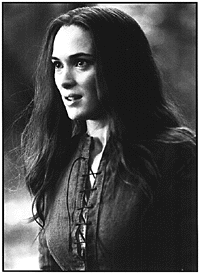
Thanksgiving release is the film version of Arthur Miller’s famed play The
Crucible. The screenplay was adapted by Miller himself from his play which
uses the Salem witch hunt trials as an allegory for the then-contemporary
injustices of the anti-communist McCarthy hearings. The movie reteams those
Age of Innocence co-stars Daniel Day-Lewis and Winona Ryder, and is
directed by The Madness of King George‘s Nicholas Hytner.
Truman Capote’s coming-of-age novel The Grass Harp has been adapted for
the screen by scriptwriters Stirling Silliphant and Kirk Ellis. Charles Matthau
directs his father and a fine ensemble cast that includes Jack Lemmon, Sissy
Spacek, Piper Laurie, and Nell Carter. In Kurt Vonnegut’s Mother Night,
an American spy poses as a Nazi sympathizer in World War II Germany and, in
typically absurdist Vonnegut fashion, eventually loses track of his real
identity. It stars Nick Nolte, Sheryl Lee, Alan Arkin, and John Goodman.
It remains to be seen how this season’s bounty of Lit Flix fares at the box
office. Luhrmann’s Romeo & Juliet had a happy ending after the
opening weekend’s receipts were counted. Now, the surprised distributors and
exhibitors wonder how long the star-crossed lovers can keep it up. Industry
insiders worry that the burgeoning competition for the limited Lit Crit dollar
will cause the overgrown field to become the wallflowers of the cineplex. Or
perhaps demand can keep pace with supply and force the market to cater to
audiences with literary tastes. The bottom line is the feared discovery of the
saturation point beyond which classical remakes reach a point of diminishing
return. One thing, however, is certain: Lit Flix are not likely to ever go
away. This summer, when a retired projectionist turned over his basement film
cache which unexpectedly contained the oldest surviving feature film in
America, what was the title of that 1912 silent? Why, Richard III, of
course.
This article appears in November 8 • 1996 and November 8 • 1996 (Cover).
