

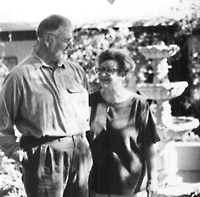
 Ben and Carolyn Durr, proprietors of Casa de Leona in Uvalde. |
really too icy to drive to work, and then climb under a few comforters for
about a month. But let’s face it, winter in Austin is over.
The good news is, there’s no better time to get out of town for a weekend
getaway. Whether it’s hiking in Garner State Park or staying in a cozy bed
& breakfast in a small town, there’s plenty to see and do outside of Austin
and still avoid tourist-trampled Fredericksburg and Salado. The key to finding
them are two new websites called BluebonNET and Interactive Vacations.
The man behind this tourism push is Leland Beatty of Texas Rural Communities
(TRC), a non-profit company that grew out of one of Ma Ferguson’s New Deal
programs. Now TRC makes loans to small rural businesses that are richer in
ideas then equity, and Beatty uses the assets in every way he can to help rural
Texas prosper.
So when the drought caused problems for many bed & breakfasts who depend
on wildflower season, Beatty came up with BluebonNET
(http://mail.texasrural.org/bluebonnet/).
“We were able to put actual maps online, showing what county roads to turn on
to get to the good wildflowers,” says Beatty. “For a very small amount of
effort, you could not only know where the best fields were, but what else there
was to do and where to stay and where to eat.”
The bed & breakfasts pay nothing to get a homepage. Beatty only asks them
to provide information about the wildflowers and the events happening in their
areas.
Casa de Leona in Uvalde, about an hour’s drive southwest of San Antonio, is
one of the bed & breakfasts listed. The historic hacienda-style house has
five elegant guest rooms, run by Carolyn and Ben Durr. The couple makes it a
point to pamper their guests, whether it’s with Ben’s Russian cognac in the
evening or Carolyn’s mini-souffl�s and venison sausage in the morning.
“I have gotten more foreign guests as a result of the Internet than I’ve ever
had before,” says Carolyn Durr, who loves to rattle off the list of countries
from her visitor’s log book. (It includes England, Japan, Lebanon, and the
Ukraine.) “It’s amazing how these countries find this little country town, but
they do.”
BluebonNET’s pleasantly readable site is organized into four state regions. A
traveler can select the general area, then peruse the different wildflower
tours, as well as other attractions. Programmer John Paul Moore, who helped
design the site, is excited about its potential.
“What is unique about BluebonNET is it has empowered rural people to have a
presence on the web, even though they may not be able to access an internet
service provider in their town.”
While the hotels don’t need to access the Internet to appear on Beatty’s
sites, it helps if they can log on, so that they can answer questions and take
reservations by e-mail. Until recently, most rural communities couldn’t afford
the long distance phone charges to surf the web, but now that electric and
telephone cooperatives are offering its members local internet access, more and
more residents are getting connected.
Judy Adams, who owns Whiskey Mountain Inn in Lakey near Lost Maples State
Park, says BluebonNET has helped increase her business by 30 percent. And now
that she’s been able to log on, the Internet has helped her in a personal way,
too. A survivor of breast cancer, Adams suffers from the debilitating effects
of silicone rupturing. Without access to big town newspapers, Adams’ web
surfing helped her find out how to fight Dow Corning and is one of the
plaintiffs suing the pharmaceutical company.
“I know what’s going on in the world,” says Adams, who moved to the small town
from Houston. “I don’t feel like I’m left out of the loop now.”
Beatty has just launched a more comprehensive tourist site called Interactive
Vacations
(http://texasrural.org/lasso/ivacation/index.html). While it’s
thin on data now, it will provide tourist information about the many small,
undiscovered towns of rural Texas. Did you know, for example, that you can see
more bald eagles in Emory than anyplace else in the state? Or that Goliad has
what is considered to be the world’s finest example of a Spanish frontier
fort?
Mason County seems to have jumped into the tourist trade with vigor. Its
homepage boasts three driving tours designed by a travel writer and
photographer team, Larry Hodge and Sally Victor. Other activities include
traveling on a historic train and observing the art of glassblowing. If you
really want to take in the culture, take a hayride to a traditional chuckwagon
cookout.
Sanderson, located near the Rio Grande east of Big Bend, is one of the most
remote towns in the state, but it may be the most high-tech. While many
residents don’t receive television or radio, they can surf, thanks to Austin
transplant Steve Milstead, who moved to Sanderson four years ago. Already
familiar with web technology, Milstead was determined to wire himself, and the
town, to the Internet.
“We were the first internet connection west of the Pecos River,” says Milstead
proudly, who charges nothing to Sanderson residents for the service. When
Beatty heard what the electronic pioneer was up to, he helped out by getting
Milstead together with some of the town’s business owners.
“It kind of lent some authority to a meeting, where we could talk about dude
ranching and nature tourism,” says Milstead, who says he and Beatty hit it off
immediately. Now when tourists visit Sanderson via BluebonNET or Interactive
Vacations, they learn about Harkins Dude Ranch, the historic Old Tio’s Trading
Post, and the Southwest Championship Sheepdog Trials.
If you’re ready for a low-key vacation, BluebonNET and Interactive Vacations
can help you plan a stress-free trip to parts used to be unknown. You’ll
see some beautiful country, spend little cash, and visit some downhome folks
who’ll be just tickled to have guided you from the information highway to the
open road.
Janet Heimlich is a freelance writer and radio reporter for public
radio.
This article appears in February 21 • 1997 and February 21 • 1997 (Cover).