


I had never seen an Alfred Hitchcock movie. Ever. Until now.

There was never a plan, a scheme, some grudge, or contrarian disinterest. I never actively decided to not watch any Hitchcock – it just never happened. Yes, despite the three separate college film courses, a suburban upbringing equipped with a cable box, and the fact that I’m an entertainment writer, Alf has evaded me.
So as many have done with their Netflix subscriptions and a weekend, I binged: a double feature of North by Northwest and Rear Window, two of the auteur’s most storied works. The process incurred a small, personal miracle: I did not become restless. I got up to go to the restroom once and another for a fridge raid. I did not simultaneously surf the web or text on my phone. I just sat. And I watched. I emerged edified, enamored, and charging forward on the path to film enlightenment.
Because how deeply Hitchcock’s work informs current cinema visually and narratively, there were no “surprises”: Of course Eva Marie Saint is North by Northwest’s secret agent; obviously they catch the killer in Rear Window. But I’m primed for gotchas, finger-wagging diatribes, and meta-horror-comedies – when I think thrills, I imagine Jason Bourne jumping through a window or Ghostface Killer slashing up a co-ed.
But what surprised and thrilled me about these films was their magnificent sense of playfulness. Master of suspense? Indeed, but not quite in the ways that I thought. If I learned anything about Hitchcock in my brief experience with his work, it’s that he was more interested in exploring and capitalizing on how we understand and think about suspense and fear than outright scaring us. It’s all in our heads, so to speak, and Hitchcock knew how to rattle your skull looking for it. It wasn’t to frighten the bejesus out of you – or maybe it was? I still haven’t seen Psycho – but rather, to delight you in unexpected ways.
The plot of North by Northwest is a sprawling, ambling mess. Cary Grant is here, then he’s there, then’s he dodging a bullet-slinging crop duster somewhere in Indiana, then he’s tumbling down Mount Rushmore. But God bless Grant’s Roger Thornhill, whose outsized sense of incredulity manages to dwarf the movie’s oversized scope. He just can’t seem to take any of it — his convoluted case of being mistaken as the George Caplan, an imagined undercover CIA agent — with the slightest seriousness:
“Something wrong with your eyes?” a man asks a sunglassed Thornhill, concealing his identity after being framed for murder.
“Yes, they’re sensitive to questions,” Thornhill blithely rebuffs.
But it’s those sequences on the train between Grant and Saint’s Eve Kendall that demonstrate how the best couples in film and TV are the ones who can go quip for quip. Roger and Eve are the proto-Carrie-and-Big, Don and Megan Draper as written by Diablo Cody. Their back-and-forth perilously walks the line between being a clever, knowing, and sexy meet-cute and being too on the nose for its own good:
Roger: “Now, what can a man do with his clothes off for 20 minutes? Couldn’t he have taken an hour?”
Eve: “You could always take a cold shower.”
That’s how the film derives some of its best tension: from the persistent fear that the duo’s chemistry will topple beneath the weight of its own wit and the stars’ twinkle-eyed looks. Half of what makes Roger and Eve so great is their wordplay; the rest is you nervous it’s going to end up being too much. But it never is. It’s all part of Hitchcock’s deft psychoanalysis, his playing on our fears that our love stories, even the ones with the best, smoldering banter, could fall apart at any second.
He takes that headiness in a different direction in Rear Window, where the restless, wheelchair-bound photographer L.B. “Jeff” Jeffries (James Stewart) looks in through the windows of his neighbors and observes what he believes to be a man who’s murdered his wife. He convinces his girlfriend (Grace Kelly) and his insurance company care nurse (Thelma Ritter) of it, too. It’s not about if they’re crazy for thinking like such ghouls; it’s about how crazy we are for wanting them to be right.
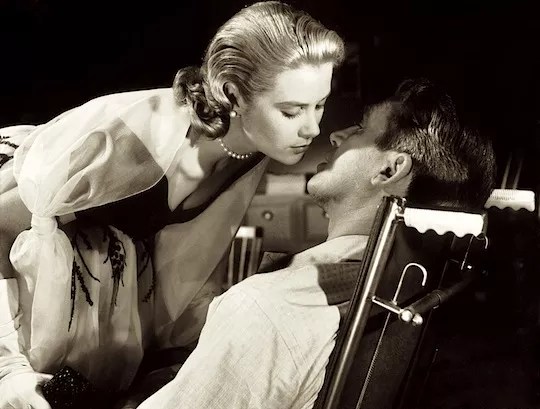
Hitchcock revels in this cognitive dissonance, and when the three band together and hatch an elaborate and kooky plan to expose the supposed murderer with subterfuge, drive-by gardening, and minor acrobatics, it’s all happening on a giddy, psychoanalytical level: These guys are crazy! That’ll never work. And they could be wrong!
But then: But I hope they’re right and it works and OH MY GOD GRACE KELLY GET OUT OF THERE!
By making the film’s voyeurism our own, Hitchcock tricks us into turning it inward, and it’s quite the head-trip. Like Jeff and the movie, we’re confined to one room: Jeff in his apartment, us in our minds. But it’s not punishing or condescending – it’s fun. And that’s why I ended up enjoying Rear Window and these Hitchcock films so much, because unlike the murderers and the criminals of his movies, he lets you get away with freaking yourself out a little.
Editor’s Note: In anticipation of Saturday’s premiere of HBO Film The Girl, about Alfred Hitchcock’s fraught relationship with leading lady Tippi Hedren, all week the Chronicle staff will be writing about their own relationships – sometimes tender, sometimes tortured – with the master of suspense.
See Marc Savlov’s Monday post about Family Plot and Alfred Hitchcock Presents here.
See Richard Whittaker’s Tuesday post about The 39 Steps here.
See Margaret Moser’s Wednesday post about The Birds and Rebecca here.
This article appears in October 12 • 2012.