

Included here is The Austin Chronicle‘s second round of reviews of
various films screened during the SXSW Film Festival. (Reviews also ran in last
week’s “Screens” section.) The symbols (RP) and (WP) indicate regional and
world premieres.
BATTLE FOR THE MINDS
Dir/prod: Steven Lipscomb; DP: Dean Lyras, Bill Mills; Ed: Steven Lipscomb,
Anthony Sherin.
16mm, 75 min., 1996 (RP)
Battle for the Minds is a fascinating documentary, up to a point.
Beginning with an examination of the categorical exclusion of women as
candidates for ordination in the Southern Baptist church, the film then
explores the emergence of fundamentalism as the dominant divisive influence in
the modern Southern Baptist world. The fundamentalist takeover of the Southern
Baptist Convention (which Battle for the Minds argues was a paragon of
democratic practice prior to the takeover) is seen as a stepping stone in the
fundamentalist agenda for affecting government policy and national concerns. So
far, so good. Clearly, these internecine religious battles have relevant
political consequences for all U.S. citizens. Yet Battle for the Minds never once questions its own internal biases and suppositions regarding the
goodness of the Southern Baptist belief system prior to the fundamentalist
takeover. And the question of women’s equal entitlement in religious
institutions has always struck me as analogous to the “dancing dog” phenomenon:
the wonder is not that they are able to perform so well but, rather, their
willingness to perform the act at all. For many, misogyny is one mere blip on
the extensive list of offensive Southern Baptist tenets. Moreover, Battle
for the Minds is not a terribly well-executed documentary, despite its coup
of getting the rights to use R.E.M.’s “Losing My Religion” at the film’s
beginning and close. Mixing black-and-white and color footage, the film is
primarily an amalgam of interview clips and a good example of what is known as
“talking heads” documentary style. And even here, the interview subjects are
framed in excessively tight shots that are also frequently filmed from
curiously low angles. The overall effect is quite unsettling. Be advised,
however, that Battle for the Minds has been playing to packed houses and
walked off with an honorable mention for best documentary in the SXSW Film
Festival. — Marjorie Baumgarten
THE BIG CHARADE
Dir/Scr/DP/Ed: Daniel Robin, Jonathan Sanford; Prod: Gabriel Guzman; with
Matt Seidman, Nicole Katovich, Luis Fernando Bohorquez.
16mm, 75 min., 1996 (WP)
When bank robbers Sarah (Katovich) and Max (Seidman) pose as an American
artist and her boyfriend visiting an artists’ commune in South America, they
trigger a number of big charades. Protecting their identities is crucial, but
repairing their disintegrating relationship soon proves to be the most
essential element for their survival. Filmmakers Daniel Robin and Jonathan
Sanford pay homage to the French New Wave through their stylish use of jump
cuts, hand-held camera work, and a narrative that says more about its
characters through what is not expressed on screen. Seidman and Katovich
are perfectly cast as the young American couple whose style, flair, and
ultimately doomed relationship may remind viewers of that other infamous bank
robbing duo, Bonnie and Clyde. The Big Charade‘s opening and closing
sequences are particularly lyrical in their use of movement and sound, while
the film as a whole contains an eclectic mix of humor and melodrama. —
Alison Macor
BULLET ON A WIRE
Dir: Jim Sikora; Prod: Joe Carducci; with Jeff Strong, Paula Killen, David
Yow, Rex Benson, Richard Kern.
16mm, 84 min., 1996 (RP)
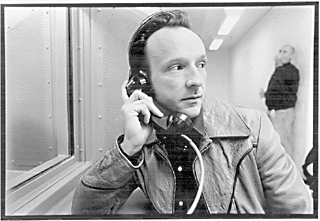 Bullet on a Wire |
Wire is a taut drama about the thoughtless pain we indifferently inflict
upon each other. The “wire” in question is the telephone variety, the
pernicious yet ubiquitous cords that connect and separate human beings and
allow us to strafe human targets with all the precision and anonymity of
radar-controlled jet bombers. Shot in black-and-white on a next-to-nothing
budget, the movie has a tight visual and narrative structure that incorporates
its technical limitations into its thematic observation of the indecorous
aspects of human behavior. Raymond, the movie’s central character, is an
emotionally unstable Drew Carey-like hulk who, in a passive-aggressive action
toward his sister, commits an impulsive and malicious act (a prank phone call)
that causes dire consequences in the lives of some unlucky strangers. It drives
a young woman named Tanya to murder her stepfather, but Tanya’s victimization
continues into her imprisonment as Raymond further exploits the girl as a means
to his redemption and Tanya’s shiftless boyfriend (David Yow) hawks her
sensational story to the highest media bidder. Filmed in the Chicago area,
Bullet on a Wire‘s bleak urban milieu fittingly complements its bracing
narrative austerity. Look for underground film legend Richard Kern in a cameo
as a bartender. — Marjorie Baumgarten
CHOCOLATE BABIES
Dir/Scr: Stephen Winter; Prod: Jason Kliot, Joana Vicente; Co-Prod:
Samuel-Moses Jones, Jordan Flaherty; Exec Prod: Charles Rosen; DP: Chris Shaw;
Ed: Francisco Macias, Stephen Winter; with Suzanne Gregg Ferguson, Dudley
Findlay, Jr., Jon Lee, Michael Lynch, claude e. sloan, Bryan Webster.
16mm, 83 min., 1996 (RP)
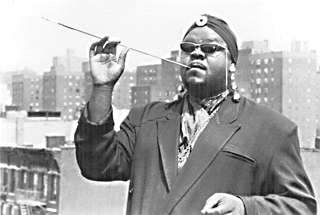 Chocolate Babies |
being run by a band of unlikely warriors: two drag queens, an HIV-positive man
with tiny gemstones dotting his bald head, and his HIV-positive sister. These
self-proclaimed “black faggots with a political agenda” launch street assaults
on conservative politicians who won’t support a hospice in their New York City
neighborhood, but when they also manage to infiltrate the office of one such
official, a city councilman who, it turns out, is deep in the closet, the
action sets in motion unexpected events that begin to pull the group apart. In
addition to introducing a memorable gallery of characters — most of whom are
vividly realized by a fiery cast — screenwriter-director Stephen Winter’s film
plays with issues of identity: who we are and who we pretend to be. Its
characters get so absorbed in their roles — drag queen, undercover activist,
closeted councilman — that they lose sight of their more basic identities:
brother, friend, lover. Winter offers no easy answers to political dilemmas,
only a warning that much of what is important in life may be lost when the
political consumes the personal. His Chocolate Babies amuses, provokes,
touches, haunts. — Robert Faires
DAUGHTERS
Dir/Prod/Scr/DP/Ed: Chris Brown; with Robin Huntington, Colette Keen, Jill
Paxley, Nicole Vigil.
16mm, 75 min., 1996 (WP)
This modest story about three generations of women from one family who live
together under one roof is quietly unassuming and absorbing. Each woman faces
various age-appropriate crises: The eldest, the widowed grandmother, deals with
the portents and implications of the minor stroke she suffers as the movie
begins; the middle woman faces her 50th birthday and the stressful
complications of sustaining the precarious viability of the company of which
she is a partner and temporary landlord; and the youngest, the daughter in her
mid-20s, finds it easier to invest her money in a new car she can’t afford than
apply it toward a college education. The characters maintain our interest
throughout this 75-minute-long feature narrative as they work through their
individual dilemmas and discover collective touchstones. Another nice touch is
how the unseen but ever-present Wal-Mart on the edge of town assumes a brooding
and symbolic presence in Daughters. The short film “Jesus of Judson”
screened before Daughters. Jacob Vaughan’s Austin-made film is a
provocative story about a couple of neighborhood kids: one an adolescent
newcomer to the block and the other a near-adult suffering from stunted
emotional growth. — Marjorie Baumgarten
DAVID SEARCHING
Dir/Scr: Leslie L. Smith; Prod: Leslie L. Smith, John P. Scholz; DP: John P.
Scholz; Ed: Toni Blye; with Anthony Rapp, Julie Halston, Camryn Manheim.
16mm, 103 min., 1996 (WP)
David and Gwen are New York City apartment roommates and each of them is
looking for Mr. Right. David is a young documentary filmmaker who has more
aspirations than job offers but, nevertheless, hones his chops by obsessively
filming his daily encounters and experiences. His youthful idealism about love
and career is beginning to show signs of erosion, yet David still manages to
stay remarkably free of cynicism and doubt. Gwen, who is separated from her
husband and awaiting her divorce, moves in with David and becomes his best
friend. Her seasoned perspective, humor, and incomplete emotional disclosure
provide a complementary balance to David’s constitutional transparency. Along
the way, David also receives some life coaching from stand-up comic Julie
Halston (playing herself). The charm of David Searching is the way this
extremely low-budget movie pokes fun at youth’s angst and allows three
extremely talented performers to create winning characterizations. As David,
Anthony Rapp (Rent, Dazed and Confused) presents a quotidian
aspect of gay life little explored by popular storytellers and Camryn Manheim’s
Gwen is a natural if constantly surprising presence. Leslie L. Smith’s first
feature film is a deceptively simple and engaging work that finds some of the
stories that lurk behind life’s big dramas. — Marjorie Baumgarten
DAY AT THE BEACH
Dir/Scr: Nick Veronis; Exec Prod: Sophie Marr Veronis; DP: Nils Kenaston;
Ed: Mark Juergens; with Nick Veronis, Catherine Kellner, Neal Jones, Patrick
Fitzgerald, Jane Adams, Paul Gleason.
35mm, 98 min., 1996 (RP)
Former Newark Star-Ledger reporter Nick Veronis displays more than
enough precocious craft and finesse in his debut feature to suggest that
journalism’s loss will be indie cinema’s gain. Though made for only $90,000,
this smart, quirky, splendidly acted ensemble comedy beats 95% of Hollywood’s
current output in a similar vein. The story by triple-threat Veronis (in
addition to writing and directing, he also acts in a lead role) centers on
three young NYC pasta-factory workers (Veronis, Jones, and Fitzgerald) who’ve
accidentally killed a man while shooting a homemade action movie. Romance,
stolen mob money, and a disastrous road trip to the Hamptons with their wives
and girlfriends also figure into the equation. Though Day at the Beach superficially resembles any number of recent Gen-X “friends” movies, it
distinguishes itself repeatedly in vivid, arresting moments of poignancy,
revelation, and intriguing dream imagery. Though it’s too often true that a
good debut film and a buck will get you a cup of coffee in today’s competitive
movie marketplace, Veronis has firmly established himself as a talent to watch
both as a filmmaker and an actor. — Russell Smith
THE DELI
Dir: John Gallagher; Prod: Sylvia Caminer; Exec Prod: John Dorrian; Scr:
John Gallagher, John Dorrian; DP: Robert Lechterman; with Mike Starr, Matt
Keeslar, Judith Malina, Brian Vincent, Michael Badalucco, Heavy D, Ice T, Iman,
Michael Imperioli, Heather Matarazzo, Debi Mazar, William McNamara, Gretchen
Mol, Chris Noth, David Johansen, Jerry Stiller, Burt Young.
35mm, 98 min., 1996 (RP)
The Deli serves up a colorful slice of New York City life. Occurring
over the course of one week, the movie features a host of characters, all of
whom either work in the neighborhood corner store or come in to shop, do
business, or shoot the breeze. A loose plot forms around Johnny’s gambling debt
to mob capo Tommy Tomatoes, a debt compounded by Johnny’s mother, whose number
has finally come in. She has given Johnny money to play the same number every
day for years, knowing that sooner or later it would hit. Only problem is that
Johnny’s been pocketing her money and hasn’t played the number in five years.
The Deli strives for broad comic farce, but more often than not, it
fails to reach its goal. It builds little antic momentum or surprise. An
impressive cast that features actors ranging from stage vet Judith Malina to
Welcome to the Dollhouse newcomer Heather Matarazzo, rapper-turned-actor
Ice T to punker-turned-pop crooner-turned actor David Johansen, supermodel Iman
to comedy pro Jerry Stiller, indie poster boy Michael Imperioli to TV hunk
Chris Noth… and more. The soundtrack also features numerous tunes by David
Bowie, Marvin Gaye, the Posies, and David Johansen. The only thing truly
missing from The Deli is genuine comedy, leaving the viewer with the
uneasy feeling of having witnessed so much talent having gone to so much waste. — Marjorie Baumgarten
DOGS: THE RISE AND FALL OF AN ALL-GIRL BOOKIE JOINT
Dir/Scr: Eve Annenberg; Prod: Heather D’Adamo, Eve Annenberg; Exec Prod:
Marcia Kirkley; DP: Joe Foley, Wolfgang Held; with Toby Huss, Pam Columbus, Pam
Gray, Leo Marks, Amedeo D’Adamo, Melody Beal, Eve Annenberg.
16mm, 80 min., 1996 (RP)
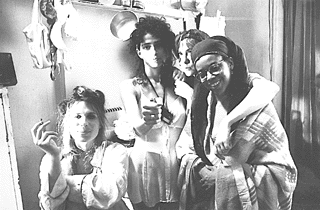 Dogs |
directed by first-timer Eve Annenberg. The story involves a character named
Leila Wascowicz who lives in an overcrowded tenement apartment with four other
women on the Lower East Side. Leila comes up with the resourceful idea of
running a bookie joint out of their kitchen and, before, they know it, money
comes rolling in. Along with their new-found profitability, the girls find
themselves dodging boyfriends, mobsters, deadbeats, cops, and one
ever-demanding dead mother. Dogs exudes a kind of “girls just want to
have fun” spirit appropriate to this episodic screwball romp and cuts the
audience in on the merriment. Preceding Dogs was the short film “Blixa
Bargeld Stole My Cowboy Boots” by writer-director Leslie McCleave. The film is
essentially a welcome excuse for a monologue by the ubiquitous and underpraised
New York indie actor Michael Imperioli (I Shot Andy Warhol,
Basketball Diaries, Girls Town). Here he plays a washed-up rock
& roll barfly who regales a woman he’s trying to seduce with a tale about
an industrial musician named Blixa Bargeld that he shared an apartment with in
Germany. Though the seduction may not work with the bar patron (Gretel
Roenfeldt), Imperioli’s rap wins over the audience. — Marjorie
Baumgarten
DRAWING FLIES
Dir/Scr/Prod/Ed: Malcolm Ingram, Matt Gissing; Exec Prod: Kevin Smith, Scott
Mosier; DP: Brian Pearson; with Jason Lee, Renee Humphrey, Jason Mewes, Carmen
Lee, Martin Brooks.
16mm, 76 min., 1996 (WP)
“These are the fuckers who tried to ruin my life,” begins Donner (Lee) as he
introduces us to his friends and fellow slackers in Vancouver. No strangers to
welfare checks, Donner and his friends decide to get out of town when all but
one of them is turned down for their usual government subsidy. Convinced by
Donner to travel west on foot to his uncle’s cabin in inland British Columbia,
the other members of the Donner party soon realize that their friend has
slightly more adventurous plans in mind. First-time directors Ingram and
Gissing wear many hats for this film with a little inspiration and help from
their mentor, Kevin Smith, himself an independent film wunderkind of sorts.
Smith alumni Jason Lee and Jason Mewes (Clerks, Mallrats) take
center stage, but look for cameos by other notables from the New Jersey trilogy
that now includes Chasing Amy. In the same general spirit as Smith’s
films, Drawing Flies shows us a seamier, Canadian side of the
twentysomething cultural clich�. Moody black-and-white cinematography
effectively captures the dramatic undertones of the film, and the familiar
angst-driven narrative derives a touch of quirkiness from Donner’s quest for
the elusive Sasquatch. — Alison Macor
THE GAUGIN MUSEUM
Dir: Alexander Kane; Prod/Scr: Bob Epstein; DP: Zoran Drakulich; Ed: Ryan
McFaul; with Marc Ardito, Julie Lund, Robert Pusillo, Joe Masi, Rafael Cabrera,
Carlyn Smith, Patricia Migliori, George Santana.
35mm, 87 min., 1996 (RP, FA)
Think “exotic locale” and your mind may still wander to Tahiti. That South
Seas isle has been rendered so vividly — especially by artist Paul Gaugin —
that it seems the essence of exotic: vibrant with color, sensual, rich with
wonders. In this fanciful comedy, screenwriter Bob Epstein and director
Alexander Kane try to paint New York City’s low-rent urban areas as a jungle
just as exotic as Tahiti, albeit in a tongue-in-cheek way. Via a
bargain-basement tour of the Big Apple’s “lesser known museums” (e.g., one
devoted to the toilet — with live dioramas!), they dab the screen with
extravagant characters whose curious, often kooky histories are nothing if not
colorful. Onto this metaphorical hook linking Tahiti and the Big Apple, Epstein
and Kane hang a spoofy mystery involving the murder of a corpulent crook and
the theft of a Gaugin sculpture. The duo seems to be aiming for a kind of
breezy intellectual farce — part Tom Stoppard, part Firesign Theatre, perhaps?
— but while some of their efforts are fun, many of their attempts at whimsy
(names like Fisher Fowl and Nino Linguini) feel studied, and the film’s
meandering quality and ragged pace make it frequently less breezy and more
windy. — Robert Faires
A GUN, A CAR, A BLONDE
Dir: Stefani Ames; Scr: Stefani Ames, Tom Epperson; Prod: Tom Epperson, Gary
Bettman; Co-Prod: Stefani Ames, Peter Zinner; DP: Carlos Gaviria; Ed: Peter
Zinner; Cast: Jim Metzler, Kay Lenz, Billy Bob Thornton, Andrea Thompson,
Victor Love, John Ritter.
35mm, 107 min., 1996 (RP)
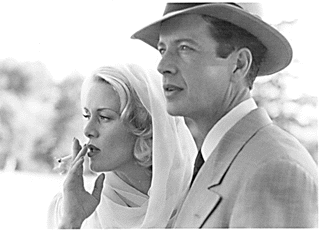 A Gun, A Car, A Blonde |
homebound in a wheelchair in his spacious Los Angeles home, smoking, drinking,
and moping, until he begins “objectification therapy” to escape his physical
and mental pain. In these hyper-realized daydreams, he’s Rick Stone, a private
eye who talks tough but always falls for the good-looking dame. It’s Spillane
and Chandler territory, with a dollop of parody. Screenwriters Stefani Ames and
Tom Epperson (co-author with Billy Bob Thornton — who also co-stars in A
Gun, A Car, A Blonde — of One False Move and A Family Thing screenplays) construct a parallelism between reality and fantasy that sometimes
works, but frequently doesn’t — the two stories just don’t converge as
seamlessly as you’d expect. Still, the narrative structure is unquestionably
inventive, if not fully realized, and there are moments when A Gun, A Car, A
Blonde simultaneously embraces and sends up the noir genre. A mixed bag,
indeed. — Steve Davis
HELL’S KITCHEN
Dir/Prod/Scr: Peter Noel Duhamel; DP: Horacio Marquinez; with Matthew Dixon,
Britt Sady, Robert Spillane.
35mm, 89 min., 1996 (RP)
Set in the notorious New York neighborhood of the same name, Duhamel’s film is
a remarkable tale of dark dreams and faltering ambitions that sometimes recalls
Scorsese’s earlier work, minus that director’s clear-cut mobster sensibilities.
Michael is a young guy who’s spent his life growing up in the Brooklyn streets,
surrounded on a daily basis by the grim, deadly residue of pushermen and
junkies. His friend Bobby is dying of AIDS, and Bobby’s dealer Ramon has a
score to settle with Michael. But Michael’s head is elsewhere. Day in and day
out, he practices the craft of acting, hoping to score a decent shot
Off-Off-Broadway. His chance comes when he lands the prime role of Laertes in a
conceptual version of Hamlet. Here he meets up with Amanda (Britt Sady),
a bright, sexy, Yale-grad WASP chosen to play opposite him as Ophelia. The two
make occasional stabs at romance — you can tell Bobby wants it bad — but his
past and his streetwise upbringing keep interfering. Matthew Dixon is great as
the tortured Michael, playing this tough-guy schmo with panache, a little
Stallone, and a little De Niro. Likewise excellent is Duhamel’s portrait of the
city: It may not have any lines, but it’s the most eloquent performer in the
film, all grit and trepidation, knives and needles. Hell’s Kitchen is a
bracing debut. — Marc Savlov
NO EASY WAY
Dir: Jeffrey Fine; Prod: Douglas Ludwig, Eileen M Chambers, Scr: Patrick
Tobin, DP: S. Douglas Smith; Ed: Pamela Raymer; with Alan Boyce, Khandi
Alexander, Brandon Hammond, Hermaine Montell.
35mm, 108 min., 1996 (RP)
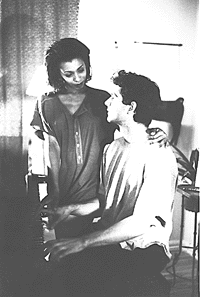 No Easy Way |
genuinely affecting film that swings from pathos to irony to bittersweet love
story at the drop of a hat. It’s also one of the finest character-driven films
in recent memory. Matthew (Boyce) is a young concert pianist who’s seen his
love and future shattered by AIDS. By day, he makes ends meet by playing in the
lobby of an upscale Los Angeles hotel; by night, he smoke cigarettes, drinks
coffee, and ponders his fate. This ineffectual routine is broken when he
befriends Pam (Alexander), a welfare mother trying to raise her youngest son
while making do on the fringes of society. Matthew, estranged from his family
and pre-AIDS life, finds a shred of hope in this unlikely, sometimes turbulent,
always realistic alliance. Director Jeffrey Fine and scriptwriter Patrick Tobin
eschew the standard HIV morality tale in favor of a decidedly non-bittersweet
glimpse into the lives of two remarkably dissimilar people thrown together by
fate and need. The dialogue crackles with day-to-day intensity, and Boyce and
Alexander’s characters are brilliantly realized. It’s not Philadelphia;
it’s better. — Marc Savlov
OTHER AMERICAN FABLES
Dir/Prod/Scr: Scott Michael Nabat; DP: Matthew Uhry; Ed: Matt Friedman,
Tyler Hubby, Kewus Schoenbrun; with Matt Gallagher, Rafer Weigel, Nancy
Hochman, Harry van Gorkum, Janet Erlich.
16mm, 95 min., 1996 (WP)
“Did you miss me while I was gone?”
“With all my heart.”
“That little?”
These lines of dialogue from Other American Fables capture the essence
of LA writer-director Scott Nabat’s first feature: glib, caustically funny and
laced with broken-glass shards of regret. Eight young Angeleno singles form the
core of Nabat’s story, which pairs them as friends and lovers in multiple,
overlapping plotlines. Neuroses, treachery, witty verbal abuse, and compulsive
behavior (particularly of a sexual nature) are the common coin of this
relentlessly talky crew, most of whom seem to be their own biggest obstacles to
happiness. Nabat flouts several screenwriting conventions here, chiefly the one
mandating that all movie characters must have pronounced “arcs.” The players’
emotions are churned vigorously and most of their storylines do resolve
themselves after a fashion, but no one changes drastically. The end result is a
distinct sense of emptiness that is disquieting yet probably inevitable given
these individuals’ natures and circumstances. Like the Matthew Sweet song that
accompanies the closing scene, Other American Fables is melancholia
clothed in a suit of lights. An early contender for wrist-slitting comedy of
the year. — Russell Smith
POUSSE CAFE
Dir/Prod: Susan Winter; Scr: Susan Winter, Anthony F. Hamilton, Dominic
Hamilton-Little; Exec Prod: Burnt Mountain Films, W. Wilder Knight II; Co-Prod:
Lisa McVicker; DP: Erich Roland; Ed: Kelly Korzan; with Dominic
Hamilton-Little, Anthony F. Hamilton, Beatrix Ost.
35mm, 103 min., 1996 (WP)
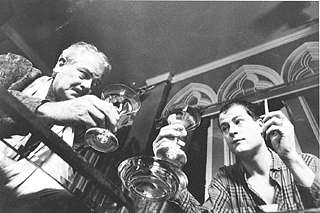 Pousse Cafe |
second floor while our parents entertained. The smoke, music, laughter, and
clink of ice in glasses drifting upstairs tantalized us and we would creep to
the stair railing in an attempt to catch glimpses of that glittering, grown-up
realm. Pousse Caf�, a paean to the cocktail, promised another
foray into that glamorous milieu. Indeed, the film offers glimpses of a
privileged world filled with sparkling crystal, jewel-colored liqueurs, and
posh interiors. Unfortunately, the glimpses are just that, detached images that
never really speak to or draw the viewer into the action. Hampered by uneven
performances and a disaffecting narrative, Pousse Caf� is more a
collection of pretty, often superfluous, pictures than an engaging portrait of
an aging bon vivant and his embittered son. Their attempts to
emotionally communicate, either with each other or with their runaway wife and
mother are distanced, almost unintelligible. Though the movie has a few witty
moments, the attempt to define complicated family relationships through the
mixing, naming, and drinking of cocktails is an expository failure. Some of the
visuals are memorable (especially a brilliantly illuminated wall of Barbie
dolls in a tiny, tropical bungalow) but in the end, though we can peer in the
windows of Pousse Caf�, there’s no way to get inside. —
Hollis Chacona
PUDDLE CRUISER
Dir: Jay Chandrasekhar; Prod: Richard Perello; Scr: The Broken Lizard Comedy
Group; Co-Prod: Greg Jennings, Jay Chandrasekhar, Kevin Heffernan; DP: Tony
Foresta; Ed: Jay Chandrasekhar, Kevin Heffernan; with the Broken Lizard Comedy
Group: Jay Chandrasekhar, Kevin Heffernan, Steve Lemme, Paul Soter, Erick
Stolhanske.
35mm, 94 min., 1996 (RP)
The perils of college romance are commented upon with sophomoric but humorous
observations in Jay Chandrasekhar’s Puddle Cruiser. A film that often
successfully captures the hilarious camaraderie that develops between college
buddies, Puddle Cruiser is a valentine to the escapades and antics of
male college students. It should come as no surprise, then, that the members of
the cast and crew went to college together and reunited five years ago to form
a comedy group in New York. Along with other members of the Broken Lizard
Comedy Group, director Chandrasekhar plays a college student for whom women
represent the Rubik’s Cube of interpersonal challenges. When Felix (Lemme)
meets Suzanne, his attempts to play it cool while wooing her away from her
longtime, rugby-playing boyfriend with the “girlie” name become fodder for his
housemates and represent the universal missteps and misnomers of college
dating. The appeal of this film lies in its characterizations; less convincing
is the romance between Felix and Suzanne. As a supporting character named
Freaky Reaky, Broken Lizard member Erick Stolhanske steals the show with his
outrageous but oddly sincere behavior. — Alison Macor
RETURN TO GIANT
Dir: Jim Brennan; Prod: Kirby Warnock; DP: Randel Bird; Ed: Sandy Schwartz;
with Don Henley, Dennis Hopper, Earl Holliman, Carroll Baker, Fran Bennett, Bob
Hinkle, Rock Hudson, George Stevens, Jr., Don Graham.
Video, 58 min., 1996 (FA)
In 1955, Hollywood in all its big-budget, wide-screen, larger-than-life,
movie-star glory came to the Lone Star State to make a picture as big as Texas
itself. And they did it, too: 42 years later, Giant still dazzles with
its epic vistas and sense of outsized Texas spirit. But what’s on screen isn’t
all there is to the story of Giant, and director Jim Brennan has made a
film that tells the rest of the tale: how big-time Hollywood and small-town
Texas — specifically, the West Texas town of Marfa — came together in an
uncommon way and had an uncommon effect on each other. Through period footage
and latter-day interviews with the film’s actors and residents of Marfa,
Brennan reveals how Giant‘s director, George Stevens, insisted on an
open set, allowing townsfolk and film folk — even the biggest stars — to
mingle, share meals, jokes, dates. They developed bonds, something which can be
clearly seen in the scenes where the Texans touchingly recall the untimely
death of James Dean; they aren’t remembering the death of a star, but a friend.
Return to Giant is homey and personal and sweet, a gentle reminder that
not all of Texas is big and blustery, and that even a Giant has its
small side. — Robert Faires
RICKIE LEE JONES — NAKED SONGS: THE LIFE AND TIMES OF RICKIE LEE JONES
Dir: Ethan Russell; with Rickie Lee Jones.
Video, 90 min., 1995 (RP)
What a life. What a film. Ethan Russell brings the idiosyncratic tale of
musician Rickie Lee Jones’ life to the screen with wonderful results. A mixture
of musical performances made especially for this film, archival photographs and
footage, and dramatizations of moments in her life “narrativized” by Jones in
voiceover, Naked Songs displays Jones’ genius for storytelling, both in
life and in song. A friend of the musician’s since the late 1970s, Russell
obviously loves and respects his subject. His tremendous expertise and
experience photographing rock greats such as the Beatles and the Who only add
to the film’s polish. While the length of a few of the musical performances may
detract from the overall pacing of the film for some viewers, these interludes
form the core of the film and prove what an amazing vocal stylist and lyricist
Jones is. Naked Songs is an absolute must for all Rickie Lee Jones fans,
but other viewers will find it equally compelling as a testament to the force
of Jones’ musical talent and the strength of the human spirit. —
Alison Macor
RIDING THE RAILS
Dir/Prod/Scr: Michael Uys, Lexy Lovell; DP: Samuel Henriques; Ed: Howard
Sharp; with Jim Mitchell, Clarence Lee, Rene Champion, Peggy De Hart, John
Fawcett, Charley Bull.
16mm, 72 min., 1996 (RP)
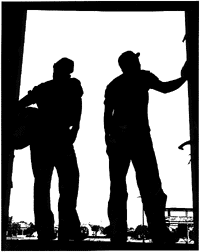 Riding the Rails |
formed a unique culture with a lore all its own. Riding the Rails focuses on the teenagers who took to the rails to escape crushing poverty,
abusive homes, or just plain boredom. What they found, in many cases, was a
harsher existence still, but one that was surprisingly difficult to abandon.
Filmmakers Uys and Lovell have documented the history of the hobo culture
through old news footage and movies, interviews, and excerpts from the letters
of over 3,000 surviving rail riders who responded to their queries. They paint
a picture of stark contrasts — the Depression, the dust, and the dangers of
vagrant life provide a sobering visual backdrop to the adventure, romance, and
lyricism of the lore. A fabulous soundtrack with lots of harmonica (the
quintessential train music) alternately mimics the siren rhythm of the rails
and mourns their hollow promise. The hobo life gets into your blood and even
after six decades, the septuagenarian’s pulse can quicken at the very notion of
hopping the cars again. The surviving riders depicted are an engaging lot and
their reminiscences are sweet and funny and sad and not a little wistful. It
seems you can take the rider off the rails, but you can’t take the rails out of
the rider. — Hollis Chacona
STILL BREATHING
Dir/Scr: James F. Robinson; Prod: Marshall Persinger; Co-Exec Prod: Janet
Graham; DP: John Thomas; Ed: Sean Albertson; with Brendan Fraser, Joanna Going,
Ann Magnuson, Toby Huss, Angus MacFadyen, Lou Rawls, Michael McKean, Celeste
Holm, Junior Brown.
35mm, 109 min., 1997 (WP)
A breath of fresh air in a world suddenly overpopulated by teen angst and
Tarantino knockoffs, this debut feature from San Antonio native Robinson
revives the stale notion of the romantic comedy with grace, wit, and sweet
panache. In what is certainly his best role to date, Fraser plays Fletcher
McBracken, a San Antonio street performer and puppeteer who sees the face of
his one true love in a dream (a trait common to the men of his family), and
travels to Los Angeles in search of her. Her name is Roz Willoughby (Joanna
Going), and she turns out to be a hard-bitten, cynical scam artist who, at
first, finds this idealistic Texan to be a bit of a rube. Before you can say
Frank Capra, though, she’s following Fletcher back to his ancestral manse in
South Texas. Here she meets his eccentric family and friends (Celeste Holm is a
joy as Ida, the family matriarch) and slowly, inexorably finds herself falling
in love with this wildly improbable Romeo. Robinson’s film is pure, romantic
poetry, a love note to the world-at-large, and especially Texas. The
soundtrack, cinematography, and acting coalesce to form a picture-perfect
vision of what love should — and can — be. Delicious, giddy, and
delightfully sly, Still Breathing is the best romantic comedy of the
Nineties thus far. — Marc Savlov
SUDDEN MANHATTAN
Dir/Scr: Adrienne Shelly; Prod: Marcia Kirkley; Exec Prod: Paul D’Addario,
Jeff Sine, Larry Lavine; DP: Jim Denault; Ed: Jack Haigis; with Adrienne
Shelly, Tim Guinee, Roger Rees, Louise Lasser, Hyden Walch.
35mm, 83 min., 1996 (RP)
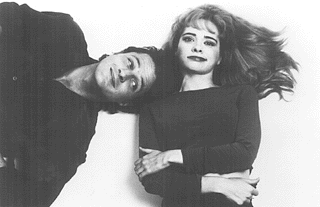 Sudden Manhattan |
her debut as a hyphenate with Sudden Manhattan, a zany tale set in the
playground of the Big Apple. A must for Hartley and Shelly fans, Sudden
Manhattan chronicles the life crisis of Donna (Shelly), recently fired from
her job as an assistant at an art museum. With her life reduced to diary
entries about the fruitlessness of her existence (“I have nothing to do…
nothing needs to be done”), Donna half-heartedly plunges ahead with her writing
despite the unwanted fervent attention from her writing teacher Murphy (Roger
Rees). Meeting Adam (Tim Guinee) doesn’t improve her situation too much at
first, but it provides a wealth of ludicrous situations and frustrated sexual
encounters. With the help of a beleaguered psychic named Dominga (Louise
Lasser), Donna begins to make sense of the circus element that’s recently crept
into her life. Sudden Manhattan‘s finest moments occur during a point of
high hilarity — a great, crazy party that culminates in a revelation of sorts
for Donna — proving that Shelly’s knack for translating quirkiness to the
screen extends well beyond her acting talent. — Alison Macor
TALK TO ME
Dir/Prod: George Esquerra; Scr: George Esquerra, Robert Foulkes; DP: Randy
Drummond; Ed: Tom McArdle; with Cheryl Clifford, Peter Welch, Elizabeth
Landis.
35mm, 87 min., 1996 (RP)
 Talk to Me |
the knock on the door for the less daunting ring of the phone. The Universe of
Love, a party talk line for the romantically disenfranchised, doesn’t prove
much better, at least the first few times out. Then Betty connects with Arnold,
a tongue-tied architect who, heretofore, has only been a mute listener on the
party line. The two talk and end up engaged in a mutually satisfying fantasy
involving a cleaning lady, a bathroom, a bucket of water, and a few squirts of
Mr. Shine. Not your textbook fantasy, but part of Talk to Me‘s charm is
the fact that its characters are so extraordinarily ordinary and come from a
world where a cleaning lady is a far more natural part of life than, say, a
French maid. Though blatantly sexual, Esquerra imbues his film with a palpable
innocence that is reflected in the static camera, the dated soundtrack, and the
unhip costuming. Betty and Arnold’s sex romp is not so much erotic as it is
endearing. Talk to Me is a less sophisticated reincarnation of last
year’s same-subject festival entry, Denise Calls Up. Lacking the
cinematic flair, polish, and wit that distinguished Denise, Talk to
Me still manages to carve a sweet little niche in what could be the next
major category at the video store: Technophile/Romance. — Hollis
Chacona
TOO MUCH SLEEP
Dir/Scr: David Maquiling; Prod: Jason Kliot, Joana Vicente; Co-Prod: Michele
Medina, David Maquiling; DP: Robert Mowen; Ed: Jim Villone; with Marc Palmieri,
Pasquale Gaeta, Philip Galinsky, Nicol Zanzarella, Joudy Sabo Podinker.
35mm, 80 min., 1997 (WP)
While distracted by the face of a pretty girl, Jack Crawford loses his gun.
Not only does he need the gun in his work as a security guard, but it was also
something he had inherited from his father. Thus begins Jack’s shaggy gun story
as he goes off in search of his weapon. The movie is a series of comic episodes
that, supposedly, will culminate in Jack’s discovery of his missing piece.
Along the way, he encounters a series of odd characters, and gradually uncovers
some of the quirkier aspects of this nondescript suburban community. Yet these
encounters make for a slim narrative thread and, although the proceedings are
occasionally amusing, the unproductive chase drags on far too long. Marc
Palmieri is excellent as the deadpan Jack, who reacts to the increasing
absurdities with an earnest calm that holds everything together. David
Maquiling’s first directorial feature is technically well-executed and
generally likable. It will be interesting to see what he can accomplish with
another, more focused, script. — Marjorie Baumgarten
UNDER THE BRIDGE
Dir/Scr: Charles Weinstein; Prod: Andy Clark, Charles Weinstein; DP: John
Thomas; Ed: Michelle Harrison; with Damien Leake, Matthew Weathers, Zach
Grenier, Bruce MacVittie, Melissa Leo.
35mm, 90 min., 1997 (RP)
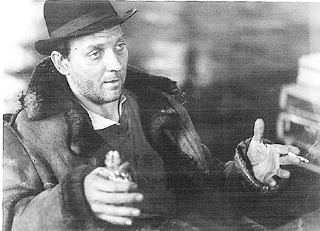 Under the Bridge |
orphanage and moves in with a community of squatters in an abandoned Brooklyn
warehouse called Hellhole, is refreshingly unsentimental and natural. Shot on
location and using many homeless non-actors as extras, Under the Bridge brings a realistic feel to its urban drama. At first, Eddie is regarded as a
nuisance by Hellhole’s inhabitants but, gradually, he comes to have an effect
on each of their lives. Responsibility for the boy is passed from one to
another until Eddie and Kathy form an uneasy bond of mutual nurture. Memorably
played by Homicide‘s Melissa Leo, Kathy is a junkie and a streetwalker,
whose own child was taken from her by the state. The movie manages to convey
some sense of the individual personalities of the various squatters as well as
their precarious community relationships with each other, but also resists
slipping into oversimplified stereotypes and easy emotions. Under the
Bridge exudes an authenticity that almost allows you to smell the rotting
stench coming in off the East River, but like the squatter who teaches young
Eddie how to fish, we discover that sustainable life is indeed returning to
these waters. — Marjorie Baumgarten
YESTERDAY WHEN CHARLES ARRIVED
Dir: Joy Newhouse; Prod/Scr: Joy Newhouse, Mark Cassar; DP: Michael
McDonald; Ed: Mark Cassar; with Nancy Huddleston, B. Martin Williams.
16mm, 93 min., 1996 (WP)
Charlotte has been living at the Brooklyn YWCA since she impulsively left her
home and marriage back in Michigan. As the movie begins, her husband Charles
barges past the “Y” security desk to see the wife who clearly no longer wants
to see him. Charles has driven straight in from Michigan on this retrieval
mission and, as appears customary in their marriage, Charlotte reluctantly
accedes to his wishes. Yet, throughout the road trip, Charlotte recalls her
time at the “Y” and the personal growth she experienced while living there in
the company of women. The flashbacks are no match for the overbearing and
unswerving provincialism of hubby Charles and what she must do finally becomes
clear to Charlotte. Yesterday When Charles Arrived is a small, quiet
movie that explores a character’s state of mind and how it expands. The problem
is that such development occurs in subtle and incremental ways and is terribly
difficult to convey onscreen. The characterization of Charles is so broad and
self-centered that it is painfully evident that any living creature would
thrive better living apart from him in another domicile or state. Although the
drama of Charlotte and Charles is unsatisfyingly drawn, the movie is at its
best when depicting the character-rich vignettes of life at the YWCA. — Marjorie Baumgarten
This article appears in March 21 • 1997 and March 21 • 1997 (Cover).