

The Emmy Awards blah blah blah. Let’s get straight to the point. Looking at a fall TV season that seems overly dependent on testosterone, there was one bright spot in the Emmy wins, and I don’t just mean The Larry Sanders Show.
|
|
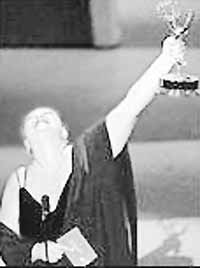
Mannheim’s win ought to be simply the recognition of excellent performance by a fine actress, but it was really a win for all the fat girls out there, the ones who cringed inwardly during Wilson Phillips videos because Chynna Phillips was decked out in body-hugging Lycra dresses while Carnie Wilson was bundled in overcoats. Remember those don’t-blink-or-you’ll-miss-her flashes of Ann Wilson in Heart videos after she started packing on pounds as the lens lovingly caressed the angular face of not-fat sister Nancy Wilson? I’d bet a year’s salary that Rikki Lake is miserable fighting the battle of the bulge even though she loves being thinner. How about that TV Guide cover some years back that pasted Oprah‘s head on the body of Ann-Margret?? We watched Roseanne yo-yo on the scale, even resorting to plastic surgery. Who can forget Delta Burke‘s season-by-season expansion from voluptuous vixen to plus-size spokesperson on Designing Women? And when Rosie O’Donnell‘s new promo photos appeared a couple of weeks ago, the talk was about whether or not she had liposuction on her chin. Fat girls get the point.
Being fat is tough. It may be tougher on women than men. It’s even tougher for those in front of the camera, because who hasn’t heard “the camera adds 10 pounds”? For actresses in television, being fat is a one-way ticket to industry Siberia. They get to play maternal neighbors, kindly teachers, jolly secretaries, and almost always objects of jokes. (Until Roseanne. Then they played cranky housewives.) They get to dress garishly because what the hell, they’re fat — why not ridicule them? Fat girls hear how most women in the United States wear dress size 12 or larger, but they all know the reality of trying to dress well when your ass feels like it has “wide load” tattooed on it.
When Camryn Mannheim was nominated and started looking around for something to wear to the Emmys, she called a few designers. No, many of the Rodeo Drive-type designers told her, we don’t make your size, but we’ll make something for you. (This reminds me of Donna Karan, who refuses to market her clothes in larger sizes because they’re not designed for fat women. FY, DK, and bless you, Liz Claiborne.) Mannheim declined. She wanted to wear something from a company that wasn’t just pandering to publicity but knew their market. And while she looked damn fine in her black Emmanuelle dress, you can bet she crowed about wearing those Payless shoes because she’s got wide feet and Bruno Magli and Joan & David don’t make shoes for women with wide feet. I do think Mannheim could have done better with her accessories. The diamonds were classy but Target jewelry looks like Target jewelry. Camryn dear, you were a class act in Payless shoes, but the cheap jewelry has to go.
The rant is not over. I do love Ally McBeal, but every time I watch Calista Flockhart sashay down the hall in those short little skirts or bounce around the apartment in a cropped T-shirt with perky nipples at attention, I cringe. It’s one thing to watch Heather Locklear on Melrose Place don in an advertising firm what would otherwise be called beachwear, because that show’s premise doesn’t pretend to reflect real life. Ally McBeal‘s appeal, however, is that even though most of us don’t deal with unisex bathrooms at work (thank heaven), the show does create water cooler issues. Fashions worn on Ally McBeal are more likely to influence the way women dress than fashions on Melrose Place.
On television, the display of skin is the barometer of sex appeal in women’s clothing. That’s why men don’t have to worry about it in their business attire. Most male characters in the TV business world seem to know the value of a well-cut suit; you don’t see them trying to cadge sex appeal by wearing see-through shirts in a professional situation. Yet female characters bring sex into the business arena by acting as if what they wear has nothing to do with their ability to fulfill a job. They just want to look good and looking good usually means pleasing the male eye. Pleasing the male eye means getting their attention. Walking down a hall full of suits while wearing a short skirt can do the trick.
In the real world, the traditional male dress-for-success business attire of a suit and tie is an equalizer, like school uniforms. It’s a way of ensuring that even though one man’s suit may be more expensive than another’s, the comparative coverage of the body is equal and undistracting. Men understand this about doing business professionally; it’s my opinion many women — especially young ones — don’t. That’s why men don’t generally vary the business look with skin-tight pants or open shirts but women continually hike up their skirts and lower their necklines. Believe me, we women know exactly the effect that has on men. (There are also many professional women who know this and don’t face such problems. Most of them are older.)
A few years ago, I was part of the Chronicle‘s editorial board interviewing candidates for City Council. One female candidate for City Council came into the Chronicle‘s admittedly casual lounge and found herself unable to sit down comfortably because her skirt was short. Not necessarily too short, just short. The candidate was professional and intelligent, and her attire was by no means inappropriate. But the skirt obviously felt short enough to cause her concern and she ended up sitting in a chair with a cloth over her knees for the interview.
I feel like a curmudgeon. Where’s my muu-muu?
This article appears in September 18 • 1998 and September 18 • 1998 (Cover).