



What’s a zombie? The revenant have transmogrified and diversified since White Zombie’s voodoo possessions, with the only unifying factor these days being an uncontrollable lust for warm-blooded living human flesh. However, the order of mortui vivi can arguably be split into two families: the fast and the slow. But what if you thought you were getting the stumbling, shuffling kind and they turned out to be the sprinting, rending, and ripping kind?
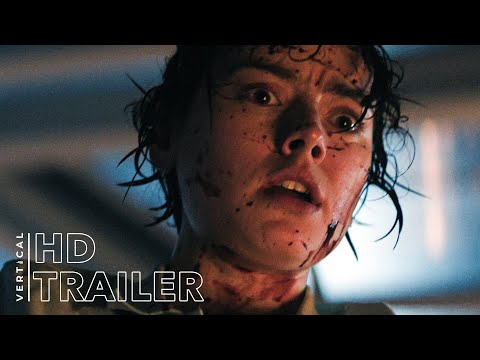
In We Bury the Dead, what Ava (Daisy Ridley) thinks she’s getting is the completely immobile variety. After the Australian island of Tasmania is devastated by a military experiment (American, of course), the population has basically been turned off. They dropped to the ground and are in a state of mindless living decay. As a way to get back on to the island and find her missing husband, Mitch (Matt Whelan), she volunteers to assist with the massive process of removing the half a million corpses decomposing in homes and businesses. There she finds there are the rare victims of the experiment that are somehow left standing, even shambling, but their fate may be bleakest. See one? Just crack a flare and the military will “deal” with them.
Ridley, doing a passable but uneven American accent, plays Ava as the immediate outsider, on the receiving end of (mostly) unstated anti-Yank sentiment. That’s mentioned rather than really developed as a plot point, as writer/director Zak Hilditch is most interested in her single-minded dedication to finding what’s left of her husband, which soon becomes a fairly idiotic quest to find out if there’s more to the more mobile undead than just bloodlust and corporeal corruption.
Underlying the tragedy is the basic question of what Ava thinks she’ll find if she reaches Mitch. Either he’s struck down and rotting wherever he fell, or he’s going to be shot down by troops. It’s an obsession that puts other people in danger, like helpful reprobate Clay (Brenton Thwaites), and it’s arguably no less crazy than the mad plans of soldier Riley (Mark Coles Smith), who has suffered losses of his own. But every time something terrible happens to Ava, it’s kind of her own fault. Hilditch’s script is centered around the idea of the thin line between obsession and commitments, with even the undead having unexpectedly deep motivations driven by their former lives. However, it’s all wrapped up in a perfectly ridiculous and absurdly neat fashion.
Hilditch, who previously directed Stephen King adaptation 1922, does give some impressive moments, like an overhead view of a field filled with dead cows, or the sound of the undead grinding their teeth, but he often relies on them too heavily, There is a point at which another shot of dry landscapes shrouded with ominous clouds of smoke, drifting from the burning city of Hobart, is enough. At the same time, Ridley is given surprisingly little to do but look on in wide-eyed shock.
We Bury the Dead particularly suffers in comparison to another similar recent character-driven zombie flick, Thea Hvistendahl’s elegiac Handling the Undead. The Norwegian adaptation of John Ajvide Lindqvist’s novel Hanteringen av odöda shows that the implacable and unknowable nature of the undead can be used as a mirror to reflect our own flaws without resorting to constant jump scares and gore effects. While We Bury the Dead’s practical prosthetics designs by Jason Baird are indeed innovatively ghoulish, Hilditch feels the urge to throw them into action sequences that his conceit never needed and that don’t amplify any of his narrative or emotional themes. We Bury the Dead is already too slow and mournful to pass as popcorn entertainment, and it’s rarely quite thoughtful enough to bring its art house horror aspirations to life.
We Bury the Dead
2026, R, 94 mins. Directed by Zak Hilditch. Starring Daisy Ridley, Mark Coles Smith, Brenton Thwaites, Kym Jackson, Matt Whelan, Deanna Cooney.
This article appears in January 2 • 2026.