





What responsibility does a filmmaker owe to the past? It’s a complicated question, balancing historical accuracy with the needs of narrative. Recently, Hamnet played against what little we truly know about the Shakespeares and got a big pass because 16th century Stratford-upon-Avon is so long ago and so far away. Conversely, that means the closer to the here and now, the more the filmmaker should be beholden to reality.
So, it’s when Gus Van Sant strays furthest from actual events in Dead Man’s Wire that his high-stakes drama about one man’s bad day falls short.
The real story is unhinged but one with which anyone with debts can empathize. On February 8, 1977, Indianapolis resident Tony Kiritsis kidnapped his mortgage broker, Richard Hall, claiming that he and his father were trying to cheat him out of his property. Kiritsis then tied a shotgun to Hall’s neck with a piece of wire connected to the trigger, called the cops, and became an instant celebrity as local news shows turned his exploits into national headlines.
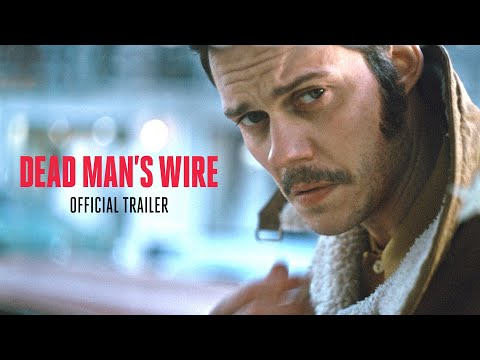
In Van Sant’s somewhat fictionalized version, the paunchy, balding, 44-year-old Kiritsis is played by Bill Skarsgård – a decade his junior, much less obviously blue collar and beaten down, and oddly less charismatic than the dangerously eccentric gunman. Richard Hall gets a similar glow-up, played here by Stranger Things’ Dacre Montgomery. However, the biggest change is the other figure who was central to the real events. Kiritsis demanded to talk to the most trusted figure in Indianapolis news, and that was veteran journalist Fred Heckman, news director over at AM station WIBC. Heckman was the epitome of the comforting, informed voice over the airwaves, and it was his willingness to talk to Kiritsis and finally talk him down that meant the hostage situation ended without bloodshed. However, in Dead Man’s Wire, Fred Heckman becomes Fred Temple (Colman Domingo), a radio deejay on a local soul station with no relevant news experience whatsoever.
For his first produced feature script, Austin Kolodney draws heavily from 2018 documentary Dead Man’s Line by Alan Berry and Mark Enochs, both of whom served as historical consultants here. Kolodney’s script tries to give real insight into Kiritsis’ motivations while also creating greater empathy for the younger Hall, who is left quite literally in the firing line while his father (a miscast Al Pacino boasting an inexplicable Foghorn Leghorn accent) stays safe in Florida. However, Domingo is painted into a corner as Temple, given a part that has far less to do with the actual Heckman than it does with either Cleavon Little as Super Soul in Vanishing Point or Lynne Thigpen as the nameless deejay in The Warriors.
When Kolodney and Van Sant look at the insidious and dehumanizing nature of American capitalism, Dead Man’s Wire is undeniably fascinating. Equally, the combination of Stefan Dechant’s production designs, Sydney Marquez’s sets, and Peggy Schnitzer’s costumes create a truly immersive vision of pre-Reagan era America, when it felt like a weirdo underdog could become a kind of folk hero. But it’s the other elements, about trust in the media and the loss of universally known and respected figures like Heckman, that seem especially underdeveloped, especially by comparison to the documentary. Moreover, by changing Heckman to Temple, Van Sant starts to broach questions of race that he never seems prepared to answer – especially when giving Domingo a part rooted in the longstanding cinematic trope of the Black soul deejay. So, for all the effort that Van Sant and his team put into making Dead Man’s Wire look like 1970s Indianapolis, its ability to really summon the spirit of the era only goes skin deep.
Dead Man’s Wire
2025, R, 104 min. Directed by Gus Van Sant. Starring Bill Skarsgård, Dacre Montgomery, Colman Domingo, Al Pacino, Cary Elwes, Myha’la.
This article appears in January 9 • 2026.