


In a not-quite-anywhere realm of fantasy, a tale is told. In fact, a tale is told over 100 nights, and it’s always a distraction. Not that the lordly Jerome (Amir El-Masry, Limbo) or his louche houseguest, Manfred (Nicholas Galitzine, The Idea of You), realize that they’re being manipulated. Foolishly, arrogantly they believe that they’re in charge of everything. In the way of such men, they make a wager on the fate of the woman in their life. If Manfred can seduce Jerome’s wife, the chaste Cherry (Maika Monroe, Longlegs, Watcher), within 100 days then Jerome’s castle becomes his – and, of course, Cherry will go to the stake as a whore.
The world may not be ours – the number of moons is a giveaway, as is the fact that the patriarchal religion follows the domineering and short-tempered deity known as Birdman (Richard E. Grant). Yet the plight of women remains the same, as do the eternal contradictions of their fate. If Cherry sleeps with Manfred, she’s as doomed as any woman who breaks the matrimonial bonds. If she doesn’t, then she’ll be equally doomed because of her failure to produce an heir – again, not her fault, since Jerome’s interests seem to lie elsewhere, as Manfred not so subtly implies.
Adapting the graphic novel The One Hundred Nights of Hero by Isabel Greenberg, writer/director Julia Jackman creates a fable that is still damningly important and relevant: that women are not allowed to control their own bodies or their own stories. So to Cherry’s rescue comes Hero (Emma Corrin, My Policeman, Nosferatu), who becomes the true hero of the 100 nights by purloining the heart of One Thousand and One Nights. Whenever Manfred heaves into view, moody, shirtless, and occasionally bloodstained from slaying a deer for his human prey, Hero distracts both he and Cherry through the recounting of a story of women who were executed for the sin of literacy.
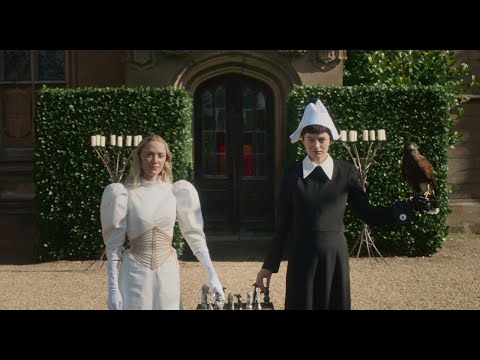
Jackman builds a world that feels like a 1960s theatrical staging of a Jacobean drama – a clear influence on the narrative. There are layers upon layers, yes, and knowingly so, and much credit goes to art director Naomi Bailey and set decorator Tatyana Jinto Rutherston for taking stately Tudor mansion Knebworth House and dressing it to evoke somewhen else’s history. Equally, costume designer Susie Coulthard creates garments that speak to period theatrical performances of classical dramas and yet have an otherworldliness to them.
It’s intriguing if a little dry, an issue not aided by cinematographer Xenia Patricia’s static camera and soft-focus mistiness. Galitzine in particular stands out from the milieu as he brings a musky raunchiness that defies the rest of the oddly dispassionate setting. With the kind of untrammeled sauciness that would rub shoulders or other bodily parts with Tom Jones and Moll Flanders, he occasionally stirs some sparks of passion in Cherry. In those moments of blushing (im)propriety, Monroe is perfectly cast and perfectly conflicted, becoming awakened to her plight by her (as narrator Felicity Jones delicately puts it) “friend” Hero. It’s therefore rather unfortunate that there’s no spark between Cherry and Hero, and the sapphic subplot that emerges between them lacks the verve of the carnal chess game they are both playing with Manfred.
It’s also less interesting than the central metaphor relating to how women’s literacy and women’s empowerment have gone hand-in-hand for millennia. The idea that a secret guild of storytellers has been hiding their tales in needlework rather than at the end of a pen is fascinating and inevitably the cause of revolution. However, Jackman mostly avoids anything so trite as a happily ever after. The bittersweet moral is that changing the world never happens overnight, on our planet or another.
100 Nights of Hero
2025, PG-13, 90 min. Directed by Julia Jackman. Starring Maika Monroe, Emma Corrin, Nicholas Galitzine, Amir El-Masry, Safia Oakley, Richard E. Grant, Felicity Jones, Charli XCX.
This article appears in December 5 • 2025.