

|
Check yo’self, before you wreck yo’self: advice from Chris |
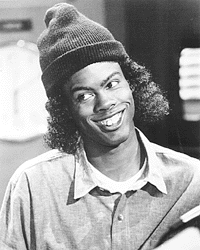
pinch-hit for Margaret, who’s on vacation this week. Of course it’s a working vacation;
last I checked with her, she was catching up on old black & white movies on
AMC. One had Cary Grant calling Joan Fontaine `monkeyface’ the whole way. Much love to
her for letting me do this. Black & white movies are still around, only now,
`monkeyface’ is a fightin’ word or, at the very least, grounds for a lawsuit. We also have
black and white Billboard charts, record labels, ad campaigns, websites,
newspapers, beefs, and points of view. Even using only pop culture as a barometer — for
once, let’s leave academia, government, and industry out of this — it’s clear that
racial tensions still bubble under most of American life. They’ve been a lot more
conspicuous lately: Time Warner sold rap-heavy Interscope last year, Dennis Rodman was
fined for insulting Mormons, a Florida sportscaster made a flip, boneheaded comment
about Thomas Jefferson’s slaves playing basketball, Fuzzy Zoeller rambled on about
fried chicken and collard greens. Even something as seemingly innocuous as a
Vibe record review rails, “Whites have held the blues hostage for so long most
people think they invented it.” When talking about the big Tyson bite Monday, every
white guy I saw looked like he’d rather interview a panel of Luther Campbell,
Sister Souljah, and Ice-T than talk about Mike, because the dreaded N-word and his lips were
about as far apart as Holyfield’s ear and Tyson’s teeth. As some doe-eyed Dr. Joyce
Brothers clone on Ricki Lake would say, by way of promoting some new book about
“understanding,” we’ve got some real issues to work out here.
The main issue is that everybody’s upset and nobody knows why. It could be
Kunta Kinte or O.J., Clarence Thomas or Frederick Douglass, 2Pac or Dred Scott,
Uncle Tom or Colin Powell. Take your pick. There’s an awful lot of baggage when it
comes to talking about race, plenty to go around. But only to the most ignorant bigot
is the color of someone’s skin the sole indicator of their worth as a human being.
Right? That’s common sense. But this grotesque idea has even affected the search for
humanity’s most transcendent moments, the domain of art and creativity. In a society
that supposedly prides itself on such Nineties values as diversity and multiculturalism, and
the old standbys of democracy and independence, even our art remains cliquish and
exclusionary; when everything is reduced to a black/white/left/right/young/old thang,
nobody understands. `Keepin’ it real’ has its limits.
And yet, N.W.A.’s Straight Outta Compton is, I believe, one of the
finest albums ever made. Its great triumph lies in its conversion of street life to
wrenchingly graphic but never fabricated imagery, and how it siezes the possibilities of
the recording medium to deliver its horrific ghetto screeds. Immediate as a SWAT
raid, it forced the hand of all those people responsible for the creation of the
gangsta environment, from the rappers themselves to the conservative lawmakers whose
slash-&-burn approach to social relief during the Eighties bled whole neighborhoods dry of
legitimate opportunity (then there’s that CIA-planting-crack-in-da-hood theory). It
didn’t matter if you were black, white, or purple, Straight Outta Compton told
anyone who listened about the ghetto, down to the last nickel bag and AK-47 shell, and
how it could move these men to create such a document. Anyone who heard it,
particularly “Fuck tha Police,” knew how the Rodney King trial would end
beforehand.
And there, in the most unlikely place at the King trial, was the safety
valve for all this racial tension. Not in the trial itself, but in the way it was
presented to America: television. Televison reaches more people than any other medium.
Everybody watches TV, and it’s becoming increasingly possible for anybody to be on TV.
Shit, there are more TV sets in America than voters — that’s power. Much of our
racial discourse is conducted on television already — from Supreme Court decision
analyses to malt liquor ads — so the medium holds powerful sway over the attitudes
people form. Sometimes attitudes do change, producing isolated spots of equity.
(Well, Men Behaving Badly is just as awful as Homeboys in Outer
Space.) Though it’s probably best not to ask why MTV airs most of its urban programming
during daylight hours, because the channel likes you to think it’s different from the days it
was almost sued for refusing to air black artists, its acknowledgement of hip-hop
and R&B as legitimate (read: profitable) elements of its identity opened up
an interracial era in pop music unseen since Elvis and Chuck Berry traded rockabilly licks
and top-10 singles. White kids turned on to hip-hop by the thousands, leading to the
free-range sonic radicalism of Beck, DJ Shadow, and the Chemical Brothers. Now, there
wouldn’t be any music television without African-American music, as the glut of videos
(BET features hip-hop, R&B/soul, and jazz programming almost as much as
Benson and Thea reruns) stretches all the way to public access’ Sunday
afternoon rap-a-thons.
Elsewhere, HBO’s Dennis Miller Live offers acerbic, candid
commentary — frequently more barbed than even Crossfire — on racial and other
hot-button topics. The Fox cable news channel just hired Chuck D as a special
correspondent, and any time Chris Rock shows up — on his side-splitting ’96 Bring the
Pain special, Politically Incorrect, or Late Night With Conan O’Brien —
he’s worth watching. His “Niggaz vs. Black People” routine from Bring
the Pain and his CD Roll With the New is as hysterically dead-on as
Pryor, Murphy, or Hicks. Think about it. Every time we laugh at an O.J. joke on
Politically Incorrect (from what must be host Bill Maher’s infinite archive), cringe
at Sipowicz’s Cro-Magnon prejudices on NYPD Blue, gape at “Marry Outside Your
Race and You’re Out of the Family” on Jerry Springer, howl at Rock
describing the “Tossed Salad Man,” or otherwise confront our own racial
attitudes through the window of television, and not through violence or ignorance,
we’re helping cool ourselves and the country out that much more. Peace.
This article appears in July 4 • 1997 and July 4 • 1997 (Cover).