

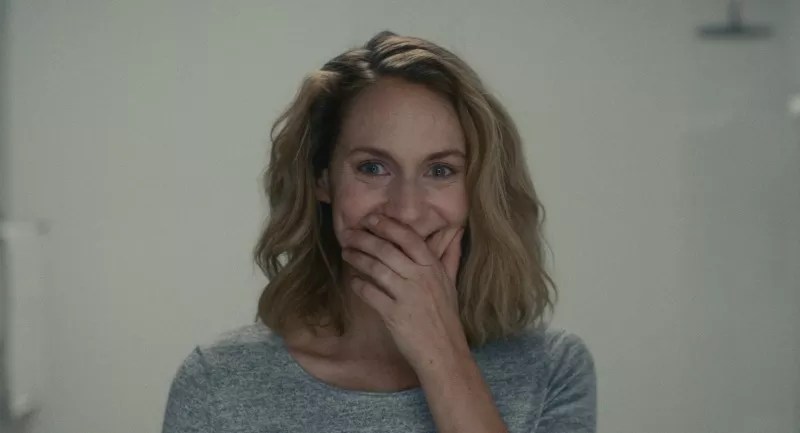
A highly anticipated standout from this year’s Fantastic Fest lineup, art house director Martin Laroche’s newest feature, Laughter (Le Rire), explores the dichotomous layers of war, death, and dark comedy in a psychological thriller that will truly make viewers question at times whether they should laugh or cry.
The film, Laroche’s fourth in a line of features centered around complex female characters and their relationships with tragedies, somehow incorporates scenes of a full stand-up comedy routine, a woman being buried alive in a mass grave, and a musical sequence set to Michael Buble’s 2005 song “Feeling Good”, without any of them feeling out-of-place.
In an alternate dystopian reality that looks and feels startlingly similar to our own, Canada has been split apart by an ambiguous and unexplained civil war. Other than a starkly horrific scene in which a seemingly random community of individuals is forced to strip and climb into their own graves before being murdered en masse, the film takes place largely in suburban Montreal – in modern-looking homes, bakeries, streets, and a remarkably unremarkable elderly center. We experience the tragedy in fragments – flashbacks, hallucinations, nightmares, etc. – through the perspective of Val ( Léane Labrèche-Dor), a kind-hearted caretaker to several seniors, including the vibrant but fading Jeanne (Micheline Lanctôt), and the sole survivor of a wartime massacre.
No clear reason is given for the mass murders, or for the division between the two groups of the civil war. Instead Laroche toys throughout the film with the idea that certain violent aspects of war are, in fact, meaningless. “Accepting that life is meaningless is one of the hardest things in life to do,” Val says.
Despite its premise, Laughter isn’t a war movie. It isn’t even really an action movie. Gore is shown extremely sparingly, and violence is expressed more often than not in non-physical, visual ways through impressively maneuvered camera distortions, transitions, targeted lighting, and psychedelic special effects. Laroche is particularly interested in toeing the line between reality and magical realism throughout the film, with a majority of scenes which could easily be interpreted as internal manifestations of Val and other characters’ thoughts.
In this way, Laughter differentiates itself, by refusing to commodify or fetishize violence – the way so many war movies within the genre tend to take advantage of. Instead, Laroche treats the subject-matter with a delicacy and normalcy that is in a way more horrifying than any horror movie – the prospect that this kind of senseless violence and war could happen anywhere, at any time (even in a country as idyllic as Canada). No one character is simplified to being purely good or evil, and instead characters are given room to exist in the moral grey area – even a man responsible for killing hundreds of strangers in cold blood – yet also never given clear absolution.
Laroche poses the question: is real horror the way in which ordinary people can be manipulated into doing horrific things, through social pressures and an inability to see clearly as part of a collective? As Jeanne says, “In this new reality you forget that everything you found insane just a few years ago is accepted by everyone now. It’s like a cloud is slowly growing, people think that it’s always been the same size, until you realize you can’t see the sun anymore.”

A Celebration of Fantastic Fest
Laughter (Le Rire)
International premiere
Online at www.fantasticfest.com, Sept. 24-Oct. 1.
Find news, interviews, and reviews at austinchronicle.com/fantastic-fest.
This article appears in The Stress Issue.