


“Anachronistic electricity. ‘Keep Out’ signs. Aggressive stares. Has someone been peeking at my Christmas list?”
Oh, but does the Doctor does love a sticky wicket. When he touches down (accidentally) on the outskirts of an Old West town called Mercy with Amy and Rory, all signs suggest they should skedaddle: An odd sticks and stones border around the town. The curious electrical lamps, ten years too early. The aforementioned “keep out” sign. But the Doctor pushes forward, thus giving us no small delight in Matt Smith jamming a toothpick in mouth and sidling up to a saloon with his best American accent: “Tea, but the strong stuff. Leave the bag in.”
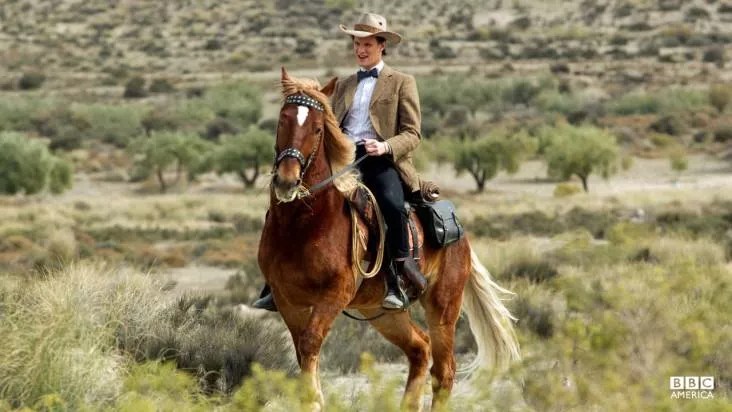
“A Town Called Mercy” was at its most fun when playing around with Western tropes – a horse named Susan, the Doctor playing at cowboy-tough, those glorious vistas. (The episode was shot in Almería, Spain, on the same lot where The Magnificent Seven and The Good, The Bad, and the Ugly were filmed.) It also played with expectations, intriguingly shifting our sympathies over the course of the hour.
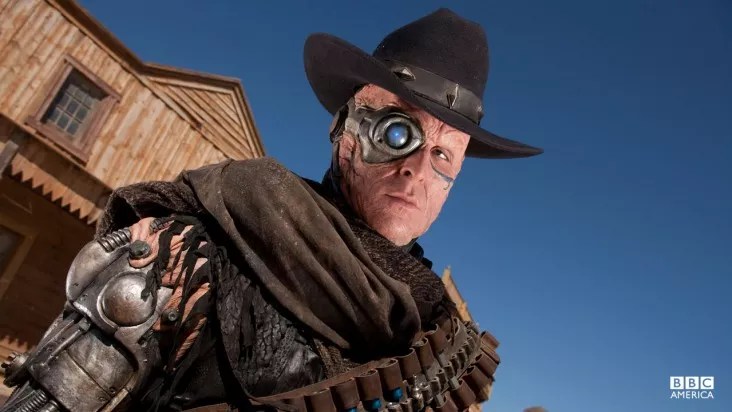
The cold opening introduces the seeming antagonist, a cyborg predator named the Gunslinger who guns down a man and announces “the Doctor” as his final target. When the Doctor announces himself to the townfolk of Mercy, they throw him outside the border, an offering to a vengeful god, but he’s pulled back to safety by Sheriff Isaac (the name’s premonition of sacrifice entirely intentional). The Sheriff’s a good man, but the Doctor’s onto him, his ever-whirring brain parsing the clues and pouncing on the real truth: There’s another doctor – lowercase -d – and the Sheriff is harboring him.
An alien who crash-landed near town, Kahler-Jex is a surgeon who became a part of the Mercy community, single-handedly averting a cholera outbreak. But the town’s willing to turn on him now that the Gunslinger has laid siege. This sounds like the Doctor’s bread & butter – righteously staring down an invading force – but when he proposes a quick save and speedy exit from Mercy without engaging with the Gunslinger (he wants to get back to the Tardis in time for classic BBC radio show The Archers, he insists), warning bells go off. His insatiable curiosity would never let him back down from a fight or walk away without unraveling a mystery.
So off he goes, dialoguing with Susan (he speaks horse, natch) and breaking into Kahler-Jex’s spaceship to gather intel, while Rory and Isaac run interference. Two plot twists emerge here: The Gunslinger has a conscience (when his system reads a potential victim with “87% chance of injury to innocent,” he opts not to fire), and Kahler-Jex has omitted large swaths from his biography – namely, that during wartime he experimented on his people and engineered a cyborg-army. Hence, the Gunslinger = not all bad, and the doctor = not all good.
Doctor Who typically excels at exploring gray-area moralities, and the script – by Toby Whithouse, Being Human creator and penner of standout Who eps “Vampires of Venice” and “The God Complex”) – certainly has the raw materials for something psychologically rich. But that early promise never arrived at a truly great payoff.
Partly the problem was in the absence of a strong B plot. Rory had next to nothing to do, and Amy just a hair more – mostly to remind the Doctor of his own conscience when he pulls a gun on Kahler-Jex after learning of his war criminal past. As the Doctor sees it, all his peace-making hasn’t amounted to much; here, he sees a way to atone, or at least even the score a little, for all the victims of the Master or the Daleks – victims of the Doctor’s own mercy, he puts it. Amy reminds him that he gets this way – raging, vengeful – when he’s spent too much time alone. And it’s true: Remember how dark and embittered David Tennant’s Doctor turned after he parted with Donna Noble?
But after Amy and the Doctor’s showdown (in truth, a more engaging and perilous one then the High-Nooner to come), the story flatlined. For a Western, very little felt at stake here. The townsfolk were uniformly decent people; even the lynch mob didn’t have its heart in it. The Gunslinger was never a credible threat (his only kill, save the cold opening’s, was accidental; RIP Isaac). When he finally stormed Mercy, vowing to lay waste to anyone who got in his way, his conscience still prevented him from hurting any innocents. Kahler-Jex was never particularly threatening, either, though he did deliver a moving monologue about how he must carry all his victims’ souls with him to the afterlife. In the end, Kahler-Jex’s conscience won out, too, and so he did the Gunslinger’s work for him by committing suicide via his ship’s self-destruct mechanism.
I don’t think the episode was entirely a pedal-in-place: There was the idea of the Doctor’s own morality as a kind of prison: With the whole hour wrestling with the dictates of one’s conscience, you gotta assume that’ll be a continuing concern. And then there was the underlining of the Ponds’ increasingly separate existence from the Doctor – aka The Longest Break-Up in History – as well as the effect so much solitariness has on the Doctor, laying the groundwork for the Ponds’ two-episode swan song and the emergence of a new companion. Next week’s “The Power of Three” looks to address head-on the Ponds’ dual life, with Rory’s ominous-sounding suggestion that it’s time to choose one or the other.

This article appears in September 14 • 2012.
