

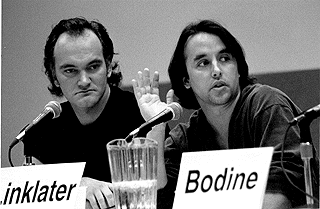
 SXSW Film Conference Panelists Quentin Tarantino and Rick Linklater |
was the consensus of the Nuts & Bolts panel, which included producers
Elizabeth Avell�n, Rana Joy Glickman, Cynthia Hargrave, and Joe Dishner;
vendors Drew Mayer-Oakes (New Independents Film Labs), and John Schrimpf
(Victor Duncan); and production mediator Tom Copeland (Texas Film
Commission).
Saving money is simple: Know what you’re doing and know where you’re going.
Know the ins and outs of all stages of production, plan ahead, and
troubleshoot. Don’t go into a larger production than you have the resources to
accomplish. Hire a good crew who know what they’re doing. Keep your locations
down. Shoot on the format appropriate to your distribution objectives. Beg
favors and equipment, and, finally, stay on the good side of the folks who
provide them so that they’ll be there to help on the next project. —
Elizabeth Peters
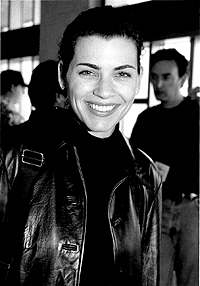 Traveller’s Julianna Margulies |
Festival entry about Irish con artists running games in the American South,
this panel featuring actors Julianna Margulies and Bill Paxton (also a
co-producer), director and cinematographer Jack Green, screenwriter Jim
McGlynn, co-producer David Blocker, and editor Michael Ruscio was one big
lovefest. With Paxton turning on the Texas-boy charm full throttle, the
audience was treated to behind-the-scenes tales of how the deal for the movie
was made while swatting flies over lunch on a pig farm during the filming of
Twister, how Margulies’ casting occurred behind big, open menus at the
Polo Lounge, and how Mark Wahlberg, aka Marky Mark, was bailed out of
jail so he could be in the movie. (The last was one of Paxton’s many, very
funny running jokes.) If Traveller is only half as entertaining as this
panel, the movie will prove quite successful when October Films launches its
theatrical release in a couple of months. — Steve Davis
FINDING MONEY IN A GRANTLESS WORLD: An experienced panel — moderator Ruby
Lerner (executive director of the Association of Independent Video and
Filmmakers), Derinda Dallas (president of the investment firm DV Capital
Entertainment), David Liu (ITVS executive director in charge of programming and
development), Elizabeth Peters (managing director of the Austin Film Society),
Paul Steckler (documentary filmmaker and University of Texas professor), and
Grace Ouchida (special projects coordinator for the International Documentary
Association) discussed strategies for foraging for financing in a funding
desert. Steckler’s “12-Step Program for Accepting Grant Writing into Your Life”
was a standout. Tenacity and exactitude were the watchwords. The world, it
seems, is not so much grantless as it is competitive and persnickety, which
heartened half the audience and depressed the rest. — Hollis
Chacona
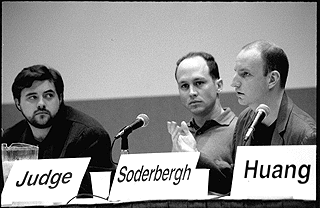 Kevin Smith, Mike Judge, and Stever Soderbergh |
moviemaker today should spend $50,000 to get a degree in film school or to use
the money to make a movie, this panel featuring Drew Mayer-Oakes (Allied’s New
Independents Lab), Bart Weiss (film and video instructor and director of the
Dallas Video Festival), director Sarah Kelly (Full Tilt Boogie), and
writer-director Kevin Smith (Clerks, Chasing Amy) didn’t come up
with any definitive answer except to conclude that whatever you do, every
chance should be made to always network and recruit. And regardless of how you
get your cinematic education, one should never forget “nonreasonability,” a
word coined by Smith for that aggressive, can-do state of mind necessary to get
your movie made, which is something more than waiting for opportunity to come
to you and something less than knocking off banks to finance your venture. — Steve Davis
BUDGETING FEATURES: From “splurging” on insurance to underestimating the cell
phone bill, this panel explored the ethics, the excesses, and the inadequacies
of budgeting independent features. Workshop leaders Michael Hacker (filmmaker)
and Joe Dishner (producer) shed an unflinching light on the risks — both
personal and professional — of such an undertaking while acknowledging the
inexorable need to damn the torpedoes. — Hollis Chacona
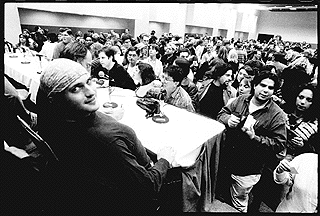 Robert Rodriguez meets his fans |
room: “Where is Quentin?” asks Nancy Schafer, the whites of her eyes showing. I
grab her cell phone. After fruitless calls to Quentin’s hotel room, as well as
those of five members of his posse, the other panelists decide to go on without
him. I walk upstairs with the boys, feeling somewhat lightheaded in the
presence of these six demigods of indie production. We post Quentin-spotters
outside the convention center, and, indeed, he arrives, joining the monster
panel fashionably late.
To studio or not to studio is kind of a moot point for me and most of the
Austin Film Society members I represent. (We’re more at the “How many credit
cards can I collect?” level.) But it was a joy to see these guys (George Huang,
Mike Judge, Richard Linklater, Robert Rodriguez, Kevin Smith, and Quentin Tarantino) in one room and hear them rib each other about their diverse
experiences with studios. — Elizabeth Peters
This article appears in March 14 • 1997 and March 14 • 1997 (Cover).