




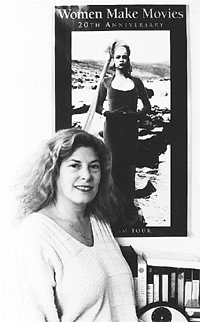
 Debra Zimmerman |
believe that women have something special to say about women,” says Debra Zimmerman, executive director of Women Make
Movies. Her statement sums up the guiding principle of this pioneering producer
and distributor of films and video by and about women. Women Make Movies
celebrates its 25th anniversary this year with an international exhibition
program — no mean feat in these times of reduced public spending on the arts.
Stronger than ever, the New York organization’s 25th Anniversary catalog boasts
over 400 offerings, while the WMM Production Assistance program continues to
facilitate production of everything from three-minute experimental pieces to
well-known feature films such as Julie Dash’s Daughters of the Dust.
WMM was started in 1972 by Ariel Dougherty and Sheila Page, who conducted
filmmaking workshops for women and girls out of a Chelsea church basement.
Beyond the obvious financial obstacles, the group had to overcome social
conditioning. “We’ve had to bodily drag high school girls up to a film
projector to prove to them they can operate it,” laughs Zimmerman. “They think
it’s a boy thing. The issue of technology was so strong.” Workshops led to the
production of a collective project in 1976, Healthcaring: From Our End of
the Speculum, a women’s response to the clinical “learning films” put out
by the male medical establishment. When the group couldn’t find a distributor,
they put it out themselves; the half-hour film was a success and the collective
went on to produce and distribute some 70 projects throughout the Seventies.
Like many of its supporters, Zimmerman was turned on to the group while in
college. “I saw a WMM-sponsored screening put on in a barn. It was the first
film that ever spoke to me, that made me realize that this is what I wanted to
do.” Through WMM, Zimmerman co-produced Why Women Stay, a 30-minute
video exploring the complex issues surrounding women in violent homes, and went
on to work in production for several years. In 1983, she returned to Women Make
Movies. “I wanted to work with women, and I wanted to work in film. There was
only one place to go.”
“I love what I do — it’s my life’s work,” says Zimmerman, who has been with
the organization 14 years and counting. “I feel really lucky to be doing this.”
Zimmerman just returned from a run of festivals which were screening works
distributed by WMM. “I was at the Nordic Glory Festival in Finland, then went
on to Berlin — via Miami. I get to go all over the world, to see incredible
films.”
Films in the WMM collection are themselves incredible, and likely to inspire,
whether through their artistry or through their content. For the most part,
these are distributed for non-theatrical exhibition by colleges, libraries,
museums, media arts centers, women’s organizations, and community groups. This
network of alternative exhibition venues allow a flexibility of programs that
is impossible within the theatrical distribution system; the length and format
of a film can be dictated by the needs of the content and the intent of the
maker, rather than by Hollywood’s demand for commercial product that runs 90
minutes to two hours, often overlooking intelligent content in favor of easily
understood, formulaic stories with high production value.
The four Women Make
Movies films included in the SXSW Film Festival, while representing just one
percent of WMM’s catalog, illustrate a strong cross-section of the group’s
collection. The films address issues including lesbianism, political awakening,
corporate power, war crimes, and cultural and ethnic identity. Although
produced in a variety of media and styles, each of the hour-long programs is
linked by its underlying exploration of the formation of physical person and
personal identity, and the struggle for understanding that is ultimately shared
by the subject, the maker, and the audience.
Resolutely experimental filmmaker Su Friedrich’s mixed-media constructions are
formal to the very edge of being inaccessible. Her carefully ordered but often
ambiguous, non-literal mixes of sound and image pack an emotional wallop, but
once the viewer’s conventional understanding of how to read media relaxes,
Friedrich’s images will resurface, collide, and resonate. Hide and Seek is made up of the fictional narrative of Lou — a 1960s adolescent girl
confronting her nascent feelings and society’s attitudes — intermingled with
documentary footage, including 20 interviews with adult women recounting
childhood experiences, over 100 photographs of lesbians as young girls, and
found footage such as home movies and educational films. This poetic
perspective on the role of nature versus nurture is Friedrich’s attempt to
“reveal the imaginary universe of young lesbians and dispel some of the myths
that have darkened our dreams.” Hide and Seek was made with the
assistance of ITVS, and recently drew the largest audience at the Berlin Film
Festival’s shorts showcase.
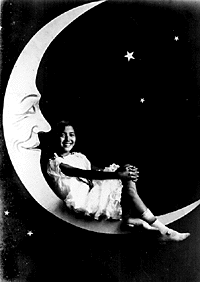 Halving the Bones |
the Bones is a documentary with elements of fiction. Japanese-American
director Ruth Ozeki Lounsbury freely constructs “documentary” elements such as
home movies and newsreel footage as needed, underscoring the film’s theme of
the fluidity of memory. The bones of the title are those of Ruth’s Japanese
grandmother, which serve both as a manifestation of family legacy and a reason
to seek out her estranged mother and document the story of three maternal
generations. This playful document is both a hand-tinted family history and a
subtle examination of alienation and reintegration that works on many levels.
Calling the Ghosts is a heart-wrenching video that puts faces behind
the often sterile print coverage of the war in the Balkans. This document of
damaged women becoming politicized was made over the course of three years by
South African sociologist Mandy Jacobson and Croatian-American Karmen Jelcinic.
The piece centers on the stories of former judge Nusreta Sivac and
lawyer Jandrank Cigeli, both Muslims, who were arrested and interred for two
months at the notorious Omarska detention center where they were routinely
beaten, tortured, and raped by former neighbors and colleagues. Their personal
struggle transformed to a larger fight for justice, ultimately leading to the
United Nations classification of rape as a crime of war. Calling the
Ghosts has served as a powerful advocacy tool which represents many voices
and many shades of meaning. Over the fall of 1996, the film toured with its
makers and “stars,” who conducted workshops and teach-ins to help audiences
formulate personal and practical responses.
Another issues-oriented film with a parallel function as an advocacy tool is
Judith Helfand’s A Healthy Baby Girl. In 1963, Helfand’s mother was
medically prescribed the synthetic estrogen diethylstilbestrol to ensure a
healthy baby; at the age of 25, Helfand was diagnosed with DES-related cancer
and underwent a radical hysterectomy. Returning to her Long Island family home
to recover, Helfand began a five-year video diary that documents
mother-daughter love, survival, political awakening, and community activism.
Helfand and education coordinator Pamela Calvert have developed an amazing
outreach and distribution system, which includes working with community groups
using the film as a platform for education and activism.
Support for the audiences of independent women’s media is a key role of WMM, which provides extensive
curatorial assistance for exhibitors. Not to be trite, but it’s a win-win
situation: through the WMM Distribution Service, makers have their work shown
(and collect their monthly royalty checks), while audiences are exposed to
works that leave an indelible mark. “Every time I meet someone,” says
Zimmerman, “when we get around to saying what we do, they say, `Oh, I saw one
of your movies — it was so important to me.’ That keeps me here.”
Zimmerman has not spent the last 14 years simply jetting around to
international film festivals. She has helped Women Make Movies grow from having
two part-time employees and an operating budget of $30,000 to having six
full-time and six part-time employees and an annual budget of close to a
million dollars — much of which goes directly to filmmakers in the form of
royalties. The key element of this growth was the decision in the early
Eighties to shift the organization’s emphasis to distribution. At that time,
more women were able to access the means of production; a key issue was
bringing completed work to audiences.
The founding mission of Women Make Movies was to address the
under-representation and misrepresentation of women in media. Their work has
always presented a diversity of experiences and voices: Their catalog was
multi-cultural before the word even existed. In the mid-Eighties when college
campuses were scrambling for multi-cultural content, WMM had it in place and
their distribution service took off.
Distribution translates into earned income — essential to a non-profit
organization’s stability and power of self-determination. Although still
supported in part by grants from public agencies including the NEA, the New
York State Council on the Arts, and the New York City Department of Cultural
Affairs, as well as private foundations such as MacArthur and Rockefeller,
“grants are a nasty business these days,” says Zimmerman. Through greater
earned income, WMM can support a larger catalog and bring more money to more
women filmmakers.
Women Make Movies also works with international organizations each year to
present extended public exhibition programs and festivals featuring work from
their collection. This spring, their 25th Anniversary program will visit cities
throughout the world. New York’s Museum of Modern Art will present a 25-program
series, which WMM will augment with community-based presentations in the
boroughs (harkening back to their church basement roots).
Although WMM no longer produces films in-house as it did in the Seventies, its
Production Assistance program continues to support women filmmakers. A series
of low-cost workshops and seminars guides women through the un-sexy side of the
business, from securing funds to finalizing contracts, while the fiscal
sponsorship program offers participants individualized consultation and access
to information resources in addition to a non-profit umbrella for
fund-raising.
Projects made under the WMM Production Assistance program have a strong track
record. The Independent Television Service has funded several projects,
including A Healthy Baby Girl and Hide and Seek. Other larger
projects are made with studio assistance, such as Alex Sichel’s All Over
Me. All three of these films screened at this year’s Sundance Film
Festival. Additional well-known titles include The Incredible Story of Two
Girls in Love, In Harm’s Way, and Daughters of the Dust.
“In 1972, `Women Make Movies’ was a novel statement; in 1997 it is a reality.
This year, there are thousands of women making films and videos around the
world,” says Zimmerman in the preface to the 1997 WMM catalog. But it is still
difficult for women to make large-budget films, especially to maintain control
over their stories. “After Julie Dash’s success with Daughters of the
Dust, she was courted by Hollywood — but they kept wanting her to make
girl gang films,” describes Zimmerman. “Few women in Hollywood have the power
to green-light a production. Even then, they are surrounded by men — the whole
infrastructure is male-dominated.” Zimmerman points out that this year at the
Berlin Film Festival there were just two woman-directed feature films; at
Miami, there was only one. “In 1997, that’s a scandal.”
“Just because their work wasn’t represented at the festival doesn’t mean that
it doesn’t exist. So many women have made films in the last 10 years,” says
Zimmerman. “Women need help to navigate the system and get their work out. Once
it’s out there, it will succeed.”
Which is why Women Make Movies continues to fight the fight, and doesn’t worry
that being a separatist organization — in that it distinguishes and supports
by gender — will prolong women’s estrangement from mainstream structures.
“Women’s work is different. When you have three men selecting the program for
Berlin, then it becomes that much more important to have a women’s film
festival in France,” Zimmerman asserts. “Once there is more structural
equality, maybe there will be less need.”
Women Make Movies rents and sells film and video for non-theatrical
exhibition, curates traveling exhibition programs, and supports women media
producers. For more information, call 212/925-0606; e-mail info@wmm.com; or
write 462 Broadway, Suite 500E, New York, NY 10013.
The SXSW Film Festival showtimes for the Women Make Movies documentaries
are:
Calling the Ghosts (Tuesday, March 11, 8:15pm, Dobie III)
Halving the Bones (Sunday, March 9, 10:30pm, Dobie III)
A Healthy Baby Girl (Friday, March 7, 10:15pm, Dobie II and Monday,
March 10, 8:00pm, Alamo)
Hide and Seek (Thursday, March 13, 10:30pm, Dobie III)
This article appears in March 7 • 1997 and March 7 • 1997 (Cover).