


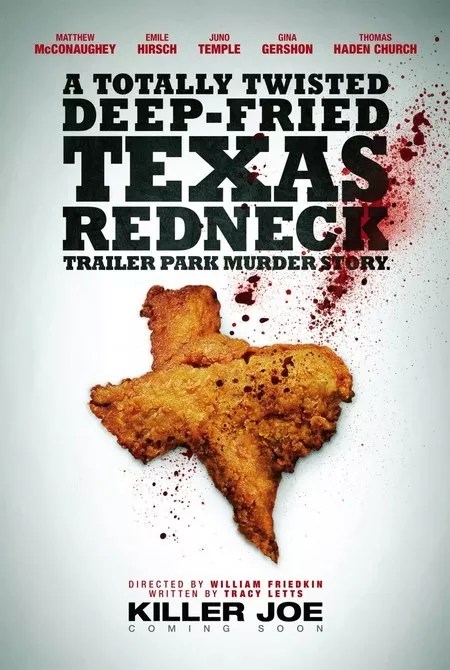
In this week’s paper, we have a Q&A with legendary director William Friedkin, whose latest film Killer Joe opens in theatres tomorrow.
Space considerations meant we had to edit the interview down, but here it is in all its uncut glory. And if tomorrow isn’t soon enough, you might consider tickets tonight’s AFS-sponsored sneak peek at the Violet Crown Cinema, with costar Thomas Haden Church in attendance.
Austin Chronicle: Hello, Mr. Friedkin.
William Friedkin: Call me Bill or Billy, please. Don’t call me late for dinner, Marjorie.
Austin Chronicle: Thank you. I didn’t want to be presumptuous. Congratulations on the film. I think it’s really wonderful and thank you for taking the time to speak with me about it.
William Friedkin: Thank you. It’s a pleasure. And as you know, I’ve extended the time. There’s no time to say hello in 15 minutes.
Austin Chronicle: I have to tell you in all my years of doing this, you’re my only interview subject who’s requested more time.
William Friedkin: I’m doing that with all the interviews. They schedule them for 10 or 15 minutes and I don’t know what can be gleaned from that. It’s basically just volume. It’s not anything of interest to readers.
Austin Chronicle: I see you’ve entered the Twitterverse.
William Friedkin: I enjoy [it]. I take maybe a half hour a day and if I see something that I think should be answered, I answer it. Or make a comment. I just find it interesting as a technology.
Austin Chronicle: Let’s talk about Killer Joe. There’s such a blend of comedy and shock, let’s say. I’m really delighted by those two poles that you’re able to pull off in it. How do you know when enough is enough?
William Friedkin: I’m not sure I do. I certainly rely on the writer. I start out by valuing his script and his writing. That’s where I begin the journey. In terms of the violence and the sexuality, it sort of grows out of how much you think is appropriate and how much you don’t. Obviously, those scenes could have run on and on and on, even longer. But I cut them off where I felt it was enough. It was just instinctive.
Now many people think that it’s all too much. A number of people think what’s in the film goes too far. For example, the ratings board. They felt it was excessive. They, frankly, wanted none of it. There are only two ways to sex and violence on the screen: One is to do it very subtly and stop at the closed door; and the other is to present it raw and unflinching – which is what Tracy Letts’ writing is all about. He has very powerful feelings about the characters that he creates. He works a long time sculpting them.
So when he had sent me this script, he had basically done the work of deciding how far you should go and where you should pull back. I basically follow his lead, as I do with the operas I direct. You know I direct operas now. Clearly, Verdi, Puccini, and Richard Strauss and a number of the composers – Offenbach and Saint-Saëns – a number of the composers whose works I’ve interpreted, you don’t change a note of music, you don’t change a word of the libretto because it’s been worked out for 150 years and it works. People do cut Shakespeare’s plays but they generally don’t rewrite them, although some have I must say with very bad results.
But I respect Letts as one of the best writers in America, and he has cast an eye on a particular corner of the country that I think is extremely accurate. And he doesn’t want the presentation to be subtle. He wants you to experience it as he feels about it. I would say that he and I are on the same page. We both have the same worldview.
Austin Chronicle: Which is what?
William Friedkin: Well, we both see a lot of human behavior as ironic, absurd, violent, stupid – not all, certainly, but we see a lot of what goes on and what has always gone on in pockets of the universe as being not only ridiculous but often life-threatening as well as being humorous. Because these are people who are trapped by their own dreams. They’re trying to escape the world in which they’re in without any practical idea of how to do that. While it is peculiar in his work to people in a certain part of the country I find it try universally in pockets of the world.
Austin Chronicle: Are all of Letts’ plays regionally rooted?
William Friedkin: Yeah, Texas/Oklahoma border. He wrote a play that I directed at the South Coast Rep here called Man From Nebraska, which is set in the Middle West. August Osage County. And Superior Donuts, which is set in Chicago. That was his last play. He’s only written five plays, or only had five produced.
Austin Chronicle: Well, he hit a home run and won a Pulitzer and a Tony with one of them.
William Friedkin: He a fine actor, too. He did Who’s Afraid of Virginia Woolf on stage in Chicago. And Edward Albee said it was the be production he’d ever seen of it. And they’re taking it to Broadway in October with Tracy playing George.
Austin Chronicle: That’ll be something
William Friedkin: He’s a wonderful actor.
Austin Chronicle: I’ve seen him in some small movie roles.
William Friedkin: Very small. He spent about six or seven years in Hollywood and when he failed to get a part on The Love Boat he decided to quit. He figured that was it. He had no success out here as an actor or a writer.
Austin Chronicle: Where does he live?
William Friedkin: In Chicago. He works with the Steppenwolf Theatre in Chicago. He acts with them and writes his plays for them. They’re performed there first.
Austin Chronicle: So he sent you the screenplay for Killer Joe.
William Friedkin: He sent me the screenplay for Killer Joe a few years after I had done Bug. We had kept in touch of course.
Austin Chronicle: Killer Joe, the play, was written earlier than Bug.
William Friedkin: Yeah. I think it was the first thing he had written. But he revised it totally. Characters, and scenes, and exteriors, and other things for the screenplay. Obviously, the screenplay has many more characters and situations than the play. The play is like a kernel for the film.
Austin Chronicle: It’s still pretty stripped down as a film as far as it pretty much being in one location.
William Friedkin: Well, they are really about 25 locations. It feels like a lot of it is done in the trailer, but if you look at The Exorcist, for example, a large percentage of the film is done in the little girl’s bedroom, before and after.
Austin Chronicle: I guess maybe because so many of the film’s memorable shots of Jason Miller on the steps.

William Friedkin: The French Connection for example is all over the place. [It’s] shot all over New York. There are no sets, all practical locations, but it, too, I would say is claustrophobic, as are all of my films.
Austin Chronicle: Intentionally so?
William Friedkin: I think it just happens. I find claustrophobia a very interesting concept for drama. When people are thrown together in a very tense situation from which there’s no exit. Or no practical exit.
Austin Chronicle: I have to ask about the casting in Killer Joe, particularly McConaughey who, the last month or so, has gotten a lot of attention for ‘Who knew? The man really can act?’ How did you know he could do more than take off his shirt? This is before the hype machinery had started.
William Friedkin: I had seen him in a couple of his early films, like Frailty, for example, which is much darker. But then what got me really interested in him , just around the time I starting to cast Killer Joe and was thinking about certain other let’s say grubbier actors, grisly old men, I saw him on an interview – it was either Larry King or Charlie Rose. And he was on for about a half an hour and of course he was himself. He wasn’t playing a role and I found him really interesting and intelligent, and I saw levels to him that I had not seen in his films – though I have to admit I had not seen most of those so-called romantic comedies.
I also knew he’s considered very good-looking by Hollywood conventions. And when you’re considered good-looking, or funny-looking, or strange-looking, or whatever it may be, sinister-looking, that’s all they want you to do. They want you to do that over and over again. As a guy who was very obviously handsome, all they need him to do in a Hollywood film is show up and convincingly make love to the leading lady. And so he made a fortune doing that. Ten or more years, perhaps more. But that’s all he was called upon to do, and now he’s decided to take control of his own career and do the kind of work as an actor that he wants to do. And he’s gotten incredible reviews already for this. And I think he can go in a completely different direction if he choses to. I don’t know what he’ll do with the success he’s already gotten from this performance. I know he’s made two films since then – or three , actually – and at least two of them are very dark – The Paperboy and Mud [from Austin filmmaker Jeff Nichols].
Austin Chronicle: Here in Austin, we’re all kind of armchair Matthew watchers.
William Friedkin: He’s moved back.
Austin Chronicle: Yes he has. And he’s just gotten married.
William Friedkin: His wife actually wanted to raise the kids back there in a more realistic environment than Hollywood.
The perception of him will change internationally because he is a really fine actor. Now, you have to have the roles, you know. You have to have those parts that show that. And there aren’t many. Most of the films being made today are superhero films. They’re spandex pictures. And I’m sure that he’ll be called on to do some of that. That’s what they’re doing in Hollywood now. That’s basically it: guys with a letter printed on their chest and a cape who can fly around and solve crime all over the universe. That’s all there is. Some’s a little better and some’s a little worse. But it’s all that [is coming] out of Hollywood.

Austin Chronicle: Another thing in Killer Joe that impresses me is the resolution, which I find common in most of your movies – not necessarily open-ended but they’re not neatly tied up in a bow.
William Friedkin: That goes way back, Marjorie. The ending of The French Connection. The ending of The Exorcist. People can take from that what they bring to it. If people think that the world is a dark, evil place where the devil, they took that from The Exorcist. Our intention was there’s a place where very often our better angels succeed over our demons. But it’s clearly spelled out for the audience because I feel the audience is entitled to take from a film whatever they want. I don’t like to wrap up the stories with neat endings. I think the audience should take the film with them and discuss the ending. I know the most impressive films I’ve ever seen are films that i still talk about the meanings. And that’s 2001 and Citizen Kane, just to name two. And a film called Blowup. There are many others of course but those are the ones I watch over and over again and sometimes I get a little more insight to them and sometimes i don’t.
Austin Chronicle: Sometimes movies just change because you change.
William Friedkin: That’s right. I’ve changed my attitude over 50 years of watching adult films and now of course they are no more adult films.
Austin Chronicle: Hardly, but there are a few like you that are holding on, fighting the good fight of keeping adults entertained.
William Friedkin: Very few, I must say.
Austin Chronicle: In order to try to reach a larger audience, were you ever tempted to edit this for an R rating?
William Friedkin:No, not at all. I think the NC-17 is a correct rating. I’m not targeting teenagers with this film. That isn’t to say that I don’t think there are lot of young people would clearly understand this and even enjoy it. There are a lot of young people that are very hip and quite experienced. For the ratings board to pretend they’re not, they’re kidding themselves. Nevertheless, I don’t think they should be the target audience for this movie.
Austin Chronicle: But with an NC-17 it’s also going to reduce the number of adults you’re going to get into the movie. And there’s more limited advertising you can do with it, and some people might just want to stay away from NC-17.
William Friedkin: It’s possible. I don’t know that but I know that I made the film I wanted to make and people can always find a reason to not see it or to see it. They’ll always find a reason. There are people like me who don’t like Gone With the Wind. I find it boring, I find it like watching paint dry or listening to your hair grow. I don’t care for that though. I don’t believe a frame of it. And yet it’s considered one of the great classics of all time.
Austin Chronicle: I’m kind of with you on that as well.
William Friedkin: Yeah, but we’re both in the minority on that. That’s it. You can always find a reason to like or not like something. Yes, having an NC-17 limits your advertising and limits the playability, there’s no question. But I’m quite willing to trade that in for the film that I wanted to make and that I hope audiences will see, be challenged by.
Austin Chronicle: You seem to court these elements of boundary-pushing, let’s say. So many of your films for one sociological reason or another have had big uproars attached to them.
William Friedkin:Well, believe me I don’t set out to do that intentionally. I really don’t. These are just subjects, ideas, or characters that I’m interested in. I think that the behavior of the people in Killer Joe is fascinating. The whole idea of this father and son – and Tracy got the story from an actual news story in Florida, he read that as a brief article and the situation intrigued him. For a $50,000 insurance policy, a father and son would contrive something so stupid and venal. But again, I find them absurdly funny.
Austin Chronicle: This movie is more out and out funny than Bug.
William Friedkin: Yeah, there’s not too many laughs in Bug. I’ll give you that.
Austin Chronicle: Let’s talk a little bit about some of your opera work, just because I think that’s an aspect of your career that many cinema people don’t know anything about.
William Friedkin: Nor will they, because the twain doesn’t often meet between film and people who go to the opera. The opera world is a lot more insulated. But I’ve done over a dozen operas. I’m not sure how many. I think I’ve done about maybe 14 operas. I’ve only done 16 films in 45 years. But I’ve done operas all over the world now: Jerusalem, Munich, Turin, Florence, Kennedy Center, Los Angeles. I’ve done operas all over the world. As I mentioned earlier, with great composers. And I’ve been very fortunate with the great singers I’ve been able to work with and I find that a really good singer wants the same thing that a good actor wants, which is a psychological underpinning for their character and a staging that works. And I only do the operas that I’m attracted to. There’s kind a wide spread between them, everything from something as dark as Alban Berg’s Wozzeck, which is one of the darkest operas ever written, to Aida. I did Aida in Turino and Wozzeck in Florence.
Austin Chronicle: What’s the appeal of operas?
William Friedkin: It’s musical theatre. It’s the world’s greatest music to me. It’s time-tested. And the only thing different about directing or staging an opera from making a film is there’s no camera. But you have to do the same thing. You have to focus the audience’s interest on various things as you would do with a camera, but you do it differently on the stage. You do it with placement and lighting. And I have to come up with a concept and costumes and the staging, the look and the interpretation of the whole piece. I find it very enjoyable and it sort of feeds my filmmaking. As filmmaking has influenced the way I do operas.
Austin Chronicle: Is there an example?
William Friedkin: No. I try to make them very visual. The operas that I do will move and be very visual and be unexpected. They’re not going to be traditional and old-fashioned. Once I interpret an opera – many of them are very difficult to find a new interpretation of – once I’ve done that, it quickens your attitude about the films that you’re making. How to find a new interpretation or a different sort of a story to film. I find each art inspires the the other.
Austin Chronicle: Have you directed any music videos?
William Friedkin: I’ve only done three. I did the the music video for my film To Live and Die in L.A., with Wang Chung. I did a music video with Laura Branigan for her song “Self Control,” and it was a No. 1 video at that time. And it was originally banned, by the way, on MTV. It’s very edgy and dark. And the other thing I did was The Broadway Album with Barbra Streisand. That video has been sold to the public [1986’s Putting It Together: The Making Of ‘The Broadway Album’]. The last time I looked, it had sold about a half a million units. It was meant as a promotional video for her album, The Broadway Album, but then they released it for home video.
Austin Chronicle: I’m asking because I’m online interviews with you, your interest in directing a musical at some point always seem to come through.
William Friedkin: Some of my favorite films will no longer be made. Ever. The great MGM musicals like Gigi, An American in Paris, Singin’ in the Rain, and The Bandwagon – these are four of my 10 favorite films. And it’ll never be done again because that music at that time was America’s popular music and now it isn’t. Now it’s hip-hop and rap. There’s not a lot you can do with that in terse of love stories or romantic moments, the very thing that Broadway feeds off.
Austin Chronicle: I also noticed that you contribute a lot to DVD interview and packages, online commentaries, etc.
William Friedkin:I’ve done a lot of commentaries for other films.
Austin Chronicle: Exactly.
William Friedkin: I love the DVD and the Blu-ray. It’s the true American cinematheque. So whenever I’m asked to do something that I particularly care about I do it. I did a track for Vertigo.
Austin Chronicle:I saw a Hitchcock, a Lang movie…
William Friedkin: I’ve done a lot of them. Film noir: The Cat People and The Godfather. Any number of things.
Austin Chronicle: Have you considered going in to teaching?
William Friedkin: I do a lot of lectures at universities. I always tell the students: Get out of film school. Go watch Hitchcock’s movies. It’s all there, the whole lexicon of film is there.
Austin Chronicle: I agree, except I tell them to go watch Howard Hawks.
William Friedkin: That, too. And then find your own voice, find your own vision. But you learn how to do it by watching the masters.
Austin Chronicle: You learned on the job without going to film school.
William Friedkin: And yes. Now the young people can do that more than ever because they can go out an buy a camera, which I could never do. And they can shoot something, and edit something at home, and post it on YouTube or somewhere and have it seen and it’s an audition. That didn’t exist when I started out. Not at all.
Austin Chronicle: It’s a blessing and a curse. It allows people to find their voice but it also has made for a flood of mediocrity.
William Friedkin: That’s true as well. But at least the opportunities are there, and they weren’t when I wanted to be a filmmaker.
Austin Chronicle: Apart from the technological, the cameras have changed and the delivery systems have changed so much in your time of observing the industry. Are there other things like that that you can cite that aren’t technological?
William Friedkin: Well, the zeitgeist is always changing, and right now the zeitgeist favors, as we discussed, comic books and video games. And that was not true when I started making films. There were a lot more serious, adult films being made. There were frivolous films, too, but I think they were on a much higher plane, actually.
Austin Chronicle: Can you imagine what The Exorcist would have been like with CGI instead mechanically doing all the effects?
William Friedkin: Yeah, I think it would have been better. If I were making the film and CGI had existed I certainly would have used it.

This article appears in July 27 • 2012.
